

An ambient agent watches your marketing data all day and asks you only when a decision is needed. But it reads the same data you do. If half your ads have no tracking tags, it will name the wrong winner with full confidence.
An ambient agent is an AI agent that works in the background. A data change, an email or a clock starts it. It reaches a person in three ways: it notifies, it asks a question, or it waits for approval. In marketing it closes the gap between ad spend that moves every hour and reports that arrive once a week.
We build this kind of agent at Improvado, and one lesson came first. Clean data does not make an agent smart. Broken data makes any agent wrong. So we check the data first, then give the agent your context, then let it ask. We build it in three layers: governed data, active insights and a knowledge graph.
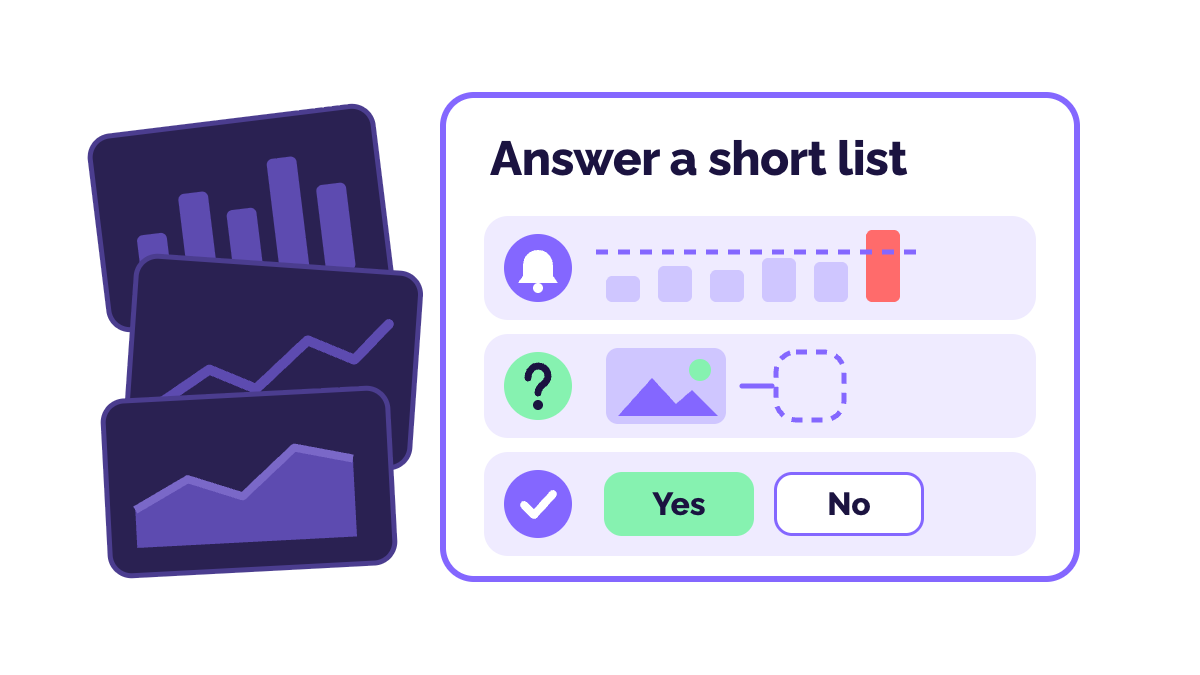
Ambient agent vs. checking dashboards yourself. Even if you open your dashboards every morning, you see only what the charts show, and only when you look. An ambient agent checks the same data every hour or every day. It flags the problem when it appears and asks the owner to approve a fix. People then answer a short queue of decisions. Nobody has to scan charts to find them.
What an ambient agent is
LangChain popularized the term. It is the company behind a popular framework for building agents. In January 2025 its chief executive, Harrison Chase, described agents that listen to event streams and act on them. You do not open a chat to start one. An email, a data change or a schedule wakes it up.
An agent that works without being asked has to know when to bother you. LangChain names three ways it can reach a person. Here is what each way could look like in marketing.
| Way | What the agent does | Marketing example |
|---|---|---|
| Notify | Tells you something happened | "Meta spend is above plan today" |
| Question | Asks for missing information | "Is this new campaign part of the Q4 launch?" |
| Review | Prepares an action and waits for approval | "Pause these three ad sets? Yes or no" |
Results, questions and pending actions land in one place. LangChain calls it the agent inbox, and Harrison Chase explains it in a Sequoia Capital podcast. Your job moves from watching dashboards to answering a short list.
Four related terms describe the same family. Event-driven agents start when something happens. Proactive agents spot useful work on their own. Always-on agents keep their memory between conversations. Human-in-the-loop means a person approves the risky steps.
In October 2026 LangChain showed how its managed platform runs scheduled, always-on agents. Amazon Web Services (AWS) published a reference design for the same pattern on its Bedrock service that month. In under two years the idea went from one blog post to standard cloud infrastructure.
What 2026 papers show about proactive agents
Academic work in 2026 agrees on what these agents look like. It is less settled on how to keep them safe.
| Study | What it found |
|---|---|
| Survey of always-on agents, June 2026 | The authors sorted 435 papers by topic. More of them cover how agents store and recall information than how to control, check or undo what they store. |
| Position paper on proactive coding agents, May 2026 | Sorts agents into reactive, scheduled and situation-aware. Judges each by what it shows, the evidence behind it, and whether to show it at all. |
| Pare-Bench, April 2026 | Tests proactive assistants on 143 tasks and scores the timing of each intervention as its own skill. |
| Prompt injection in proactive agents, October 2026 | Planted outside text pushed agents toward a target. In every tested setup, approval of the target rose, by up to 77.4 percentage points. |
The pattern is clear. Researchers have taught agents to remember far more than they have taught them to be governed. And the moment an agent speaks up is as hard to get right as what it says.
Marketing data makes this harder. In the Supermetrics 2026 Marketing Data Report, 52% of teams said they do not own their data strategy. Only 33% of marketers felt confident putting their data to work. Informatica's 2026 report for chief data officers (CDOs), a survey of 600 data leaders, found that three in four organizations say governance has fallen behind AI adoption.
So an agent that acts on its own needs two things first. It needs data it can trust and rules it can follow.
Five jobs for an ambient agent in marketing
We split the work into five small jobs. Combined, they replace the Monday surprise.
| Job | What it covers | Output |
|---|---|---|
| Watch | Spend, pacing, conversions, tired creative | A signal |
| Check | Tracking tags, naming, currency, missing rows | A pass or a flag |
| Explain | Why a number moved, with the query and the source | A short answer |
| Ask | A proposed action that waits for a yes | One decision |
| Remember | What happened and what worked | A better guess next time |
Many AI tools in marketing do only the third job, and only when someone asks. An ambient agent runs all five without a prompt.
The order matters. When the Check job fails, Explain describes a wrong number and Ask proposes the wrong fix. A fast agent on bad data makes bad decisions sooner.
How we build it at Improvado: three layers
Each layer feeds the next one. Here is what ships today in each.
| Layer | What it does | Jobs covered |
|---|---|---|
| Governed data | Rules check campaign data on a schedule | Check |
| Active insights | Alerts and scheduled reports go out unprompted | Watch, Explain, Ask |
| Knowledge graph | Stores definitions, guardrails and past tests | Remember |
Layer 1: governed data
Marketing Data Governance is the part of Improvado that checks campaign data against your rules, such as naming, tracking tags and budgets, and tells the owner when something breaks.
- A rule library covers UTM tags (the tracking codes on ad links), naming, budget pacing and overspend, and data integrity.
- You can describe a new rule in plain English. The Improvado AI Agent drafts it and shows what it would flag. It goes live after your approval.
- Live-API rules read a metric straight from the ad platform, as often as once an hour. No extraction pipeline has to be set up first.
- Each rule owner gets an email digest after every run.
This layer is the Check job. The goal is that the agent explains and acts only on data that has passed these checks.
Layer 2: active insights
The second layer sends information out on its own schedule.
- Performance-shift alerts reach the team by email, each with suggested next steps.
- Scheduled AI reports rerun any saved question on live data, on the cadence you pick.
- The Model Context Protocol (MCP) is the open standard AI apps use to call outside tools. Teams that work in Claude, ChatGPT or Cursor can schedule the same jobs over Improvado MCP, and the jobs run in our cloud.
When the agent changes something on an ad platform, it asks for one confirmation per change. Anything new it creates starts paused. Each request leaves a record you can keep for audit. This answers a question buyers often ask us about automation: how to let AI act without letting it make bad changes. Our guide to AI marketing automation covers the wider set of tasks AI can take on.
This layer covers the Watch, Explain and Ask jobs.
Layer 3: the knowledge graph
An alert without context is noise. "Cost per lead rose" means little without the target, the season and last quarter's test.
Our Knowledge Graph holds that context: KPI formulas, naming conventions, guardrails and past experiments. On every prompt the AI Agent picks the parts relevant to the question. When the Knowledge Graph Builder proposes new context, a person approves each item before it is saved. Any outside AI tool reads the same graph over MCP. So Claude and our agent work from one definition of a qualified lead.
This layer is the Remember job. It is also what turns a general agent into one that knows your business.
What the agent sends you
Three outputs reach a person today. Each one ends in a short decision.
| Output | When it arrives | What is in it | What you decide |
|---|---|---|---|
| Digest email | After every scheduled rule run, to each rule owner | A subject line that says how many of your rules found problems, six summary cards, a table of your rules, up to 10 broken records per rule, and a NEW badge on records the last digest did not list | Which problem to fix first |
| Rule preview | When you describe a new rule in plain English | The records the rule would flag right now. The rule goes live only after you approve it | Approve the rule or change it |
| Scheduled agent result | On the schedule you set | The latest result with recommended actions, plus the run history and success rate | Whether to act on the recommendation |
Eight use cases, from trigger to decision
| Trigger | What the agent does | What you decide |
|---|---|---|
| Spend jumps overnight | Checks live spend against plan | Pause or keep |
| Click-through rate falls for two weeks | Flags tired creative and finds past creative tests in the graph | Which creative to rotate |
| Ads run without UTM tags | Lists them and emails each owner | Who fixes it |
| Naming convention changes | Regenerates the naming rules to match the new convention (beta) | Approve the fixes |
| Overspend in mid-month | Shows month-to-date pacing by ad account | Shift budget or accept |
| Platform and warehouse disagree | Compares the live API with stored data | Which number is right |
| Monday morning | Sends spend and cost per acquisition by channel, with changes | Nothing, if it is green |
| An analyst works in Claude | Uses the same KPIs and guardrails over MCP | Nothing, the rules travel |
Why the pattern works
Attention moves to the edge. People stop scanning dashboards. They answer a few decisions a day.
The agent gets better with use. Answers you approve go back into the graph. Over time the agent needs to ask less.
Safety is the default. Governance checks what goes in, approvals gate what comes out, and every request leaves a record you can keep for audit. This is our answer to the gap the June 2026 survey found: state that is governed, as well as stored.
How to start with an ambient agent
- Pick one leak. Overspend or missing UTM tags make a good first rule.
- Write the context down. Targets, naming and what "good" means go into the knowledge graph.
- Let the agent notify for two weeks. Then let it propose actions, and approve them one at a time.
Start with trust, and let autonomy follow it.
Want to see the three layers on your own campaign data? Talk to our team about governed agents.
Ambient agents FAQ
What is an ambient agent?
An ambient agent is an AI agent that runs in the background and starts on an event, such as a data change, an email or a schedule. It contacts a person only to notify, to ask a question, or to get approval for an action. LangChain popularized the term in January 2025.
How is an ambient agent different from a chatbot?
A chatbot waits for you to type a question. An ambient agent starts on its own when something changes, does its checks, and comes to you with a short notice, a question or an action to approve. You answer a queue of decisions and skip the prompt.
What should an ambient agent do for a marketing team?
It should do five jobs: watch spend and pacing, check that the data is right, explain why a number moved, ask before it acts, and remember what worked. The check job comes first, because an agent that explains bad data gives wrong answers with confidence.
Are ambient agents safe to let change ad campaigns?
They are safe when every change needs a person's yes. In our setup the agent asks for one confirmation per ad-platform change, anything new starts paused, and every request leaves a record you can keep for audit. An October 2026 paper shows outside content can steer agents, so approvals matter.
Why does an ambient agent need a knowledge graph?
An alert means little without context such as the target, the season and past tests. A knowledge graph stores KPI formulas, naming rules, guardrails and past experiments. The agent reads it on every prompt, so its alerts and answers follow your definitions.
Related reading: AI marketing automation, Marketing Data Governance, MCP server for marketing data