

Data Governance Dashboard
The Data Governance Dashboard is the one place for your data governance work. It shows how well your data follows your rules, which violations are open and who should act on them. You also create and edit rules, and manage alerts, budgets and account owners from here.
Where to find it
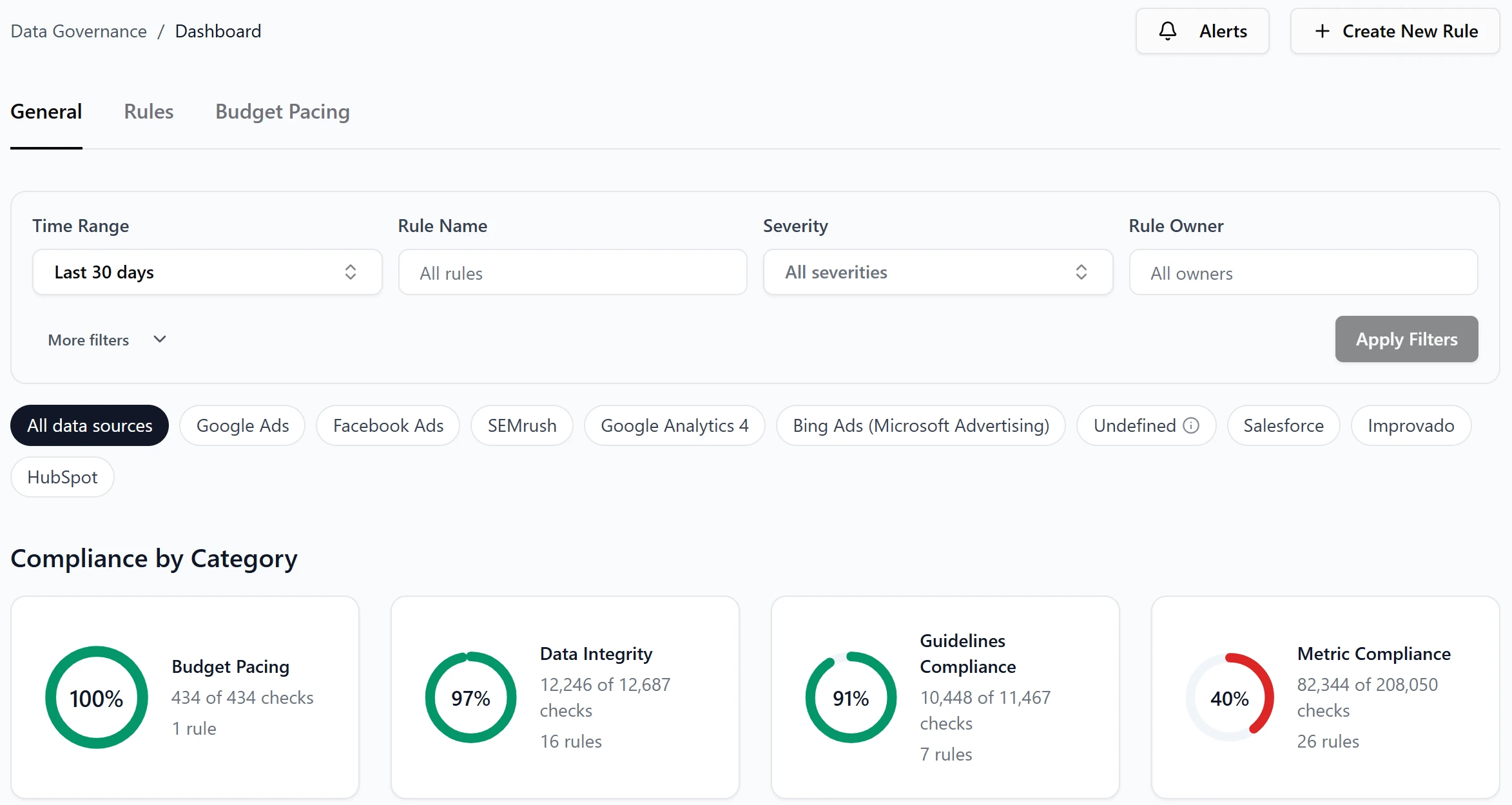
Open Data Governance → Dashboard. The dashboard has three tabs: General, Rules and Budget Pacing. Two buttons stay in the header on every tab:
- Create New Rule starts a new rule. See Rule creation flow.
- Alerts opens the alert settings for the workspace. See Settings on the dashboard.
Filters
Each tab shows its four main filters, such as Time Range, Rule Name, Severity and Rule Owner. The rest are under More filters. Click Apply Filters to update the tab. Below the filters, pick a data source chip to show one data source, or keep All data sources.
The Undefined chip groups data sources that rules report under names Improvado does not recognize. Hover over its icon to see those names.
General tab
Compliance by Category
Each card shows the share of checks that followed the rules in one category, such as Data Integrity or Taxonomy Compliance. Click a card to filter the whole tab by that category.
Resolution
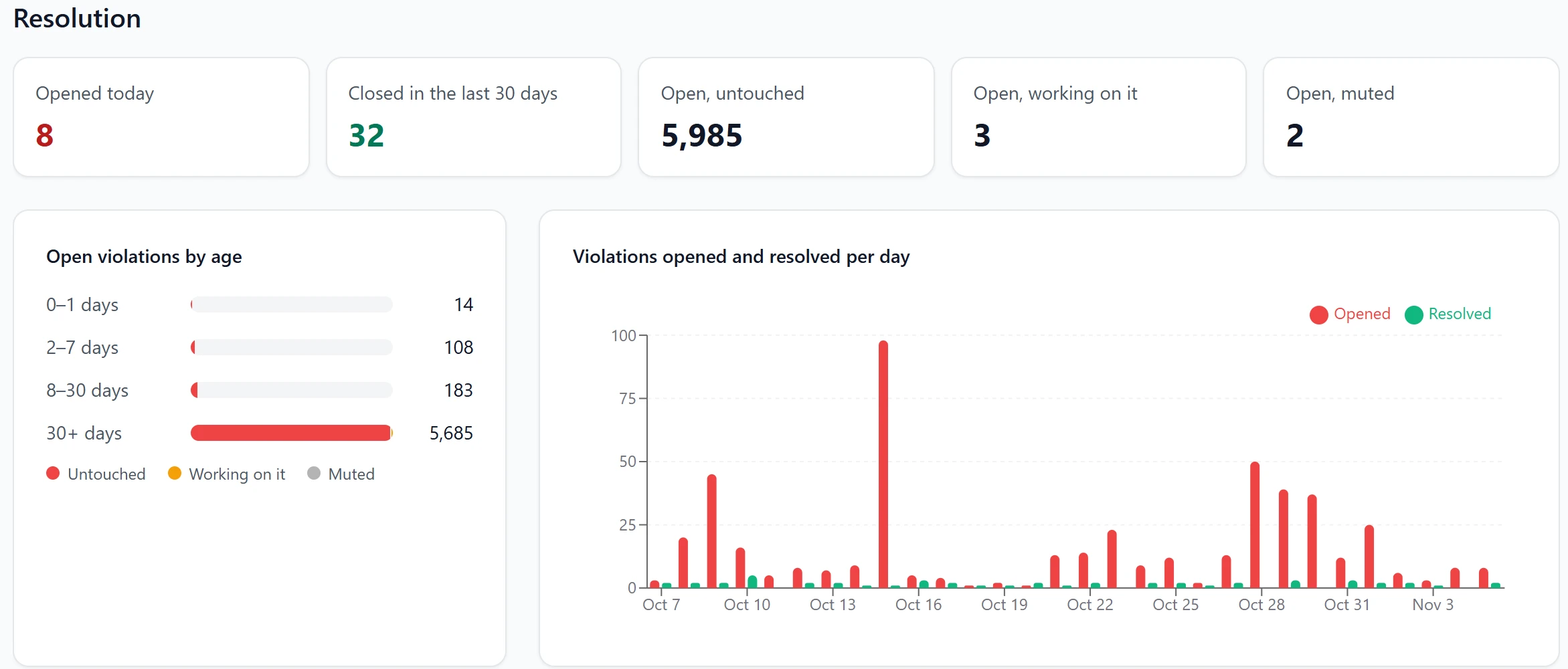
This section shows what happens to violations after a rule finds them:
- Opened today, Closed in the last 30 days, and violations that are still open: untouched, working on it or muted (acknowledged).
- Open violations by age: how long open violations have stayed open.
- Violations opened and resolved per day.
- Open violations by rule owner: who has the most open violations, and the oldest one.
Click any tile, age bucket or owner to open the matching list on the Rules tab.
Breakdown
The Breakdown table summarizes checks, followed and broken results, and the compliance score. Switch Summary by between Data source and Level. Each rule also shows its 7-day history as the share of broken checks for each day.
Rules tab
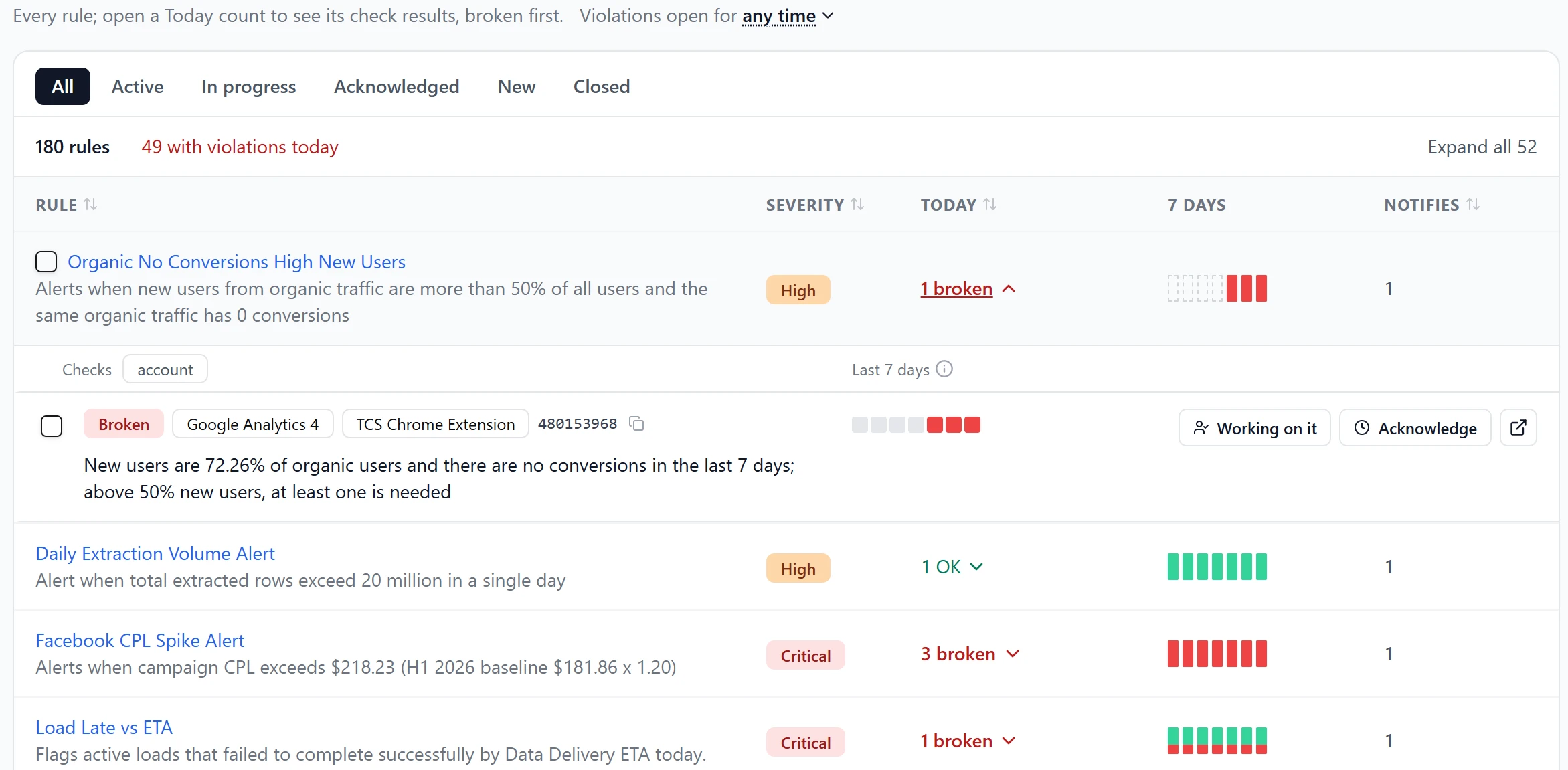
The Rules tab replaces the separate Rules page and its item in the side menu. It lists every rule in the workspace, including disabled rules and rules without a recent check. For each rule you see its severity, today's result, the last 7 days and how many people it notifies. A rule created in the last few minutes shows Processing until its first check finishes. If a rule's last check failed, an icon next to its name shows the error.
Use the strips above the list to focus on violations in one state:
- All: every rule, with followed results under the broken ones.
- Active: open violations that are not acknowledged, including the ones someone is working on.
- In progress: violations someone is working on.
- Acknowledged: muted violations.
- New: violations marked as new in the latest digest of each rule.
- Closed: violations that were fixed. Use Closed in the last to pick the period.
All strips except All show broken results only. On these strips, use Violations open for to show only violations that have been open for a given time.
See a rule's violations
Click the Today count of a rule, for example 3 broken, to expand its violations in place. Broken results come first. You can expand several rules at once, or click Expand all.
Each violation card shows:
- the result, and a New badge for a violation that just opened;
- the data source, account and campaign;
- the checked entity, with a button to copy its ID;
- why the check failed;
- the 7-day history;
- the actions: Working on it, Acknowledge, available fixes, and a link to the entity.
Click Show more to load more cards. To act on many violations at once, select them with the checkboxes. A selection can span several rules.
Edit a rule
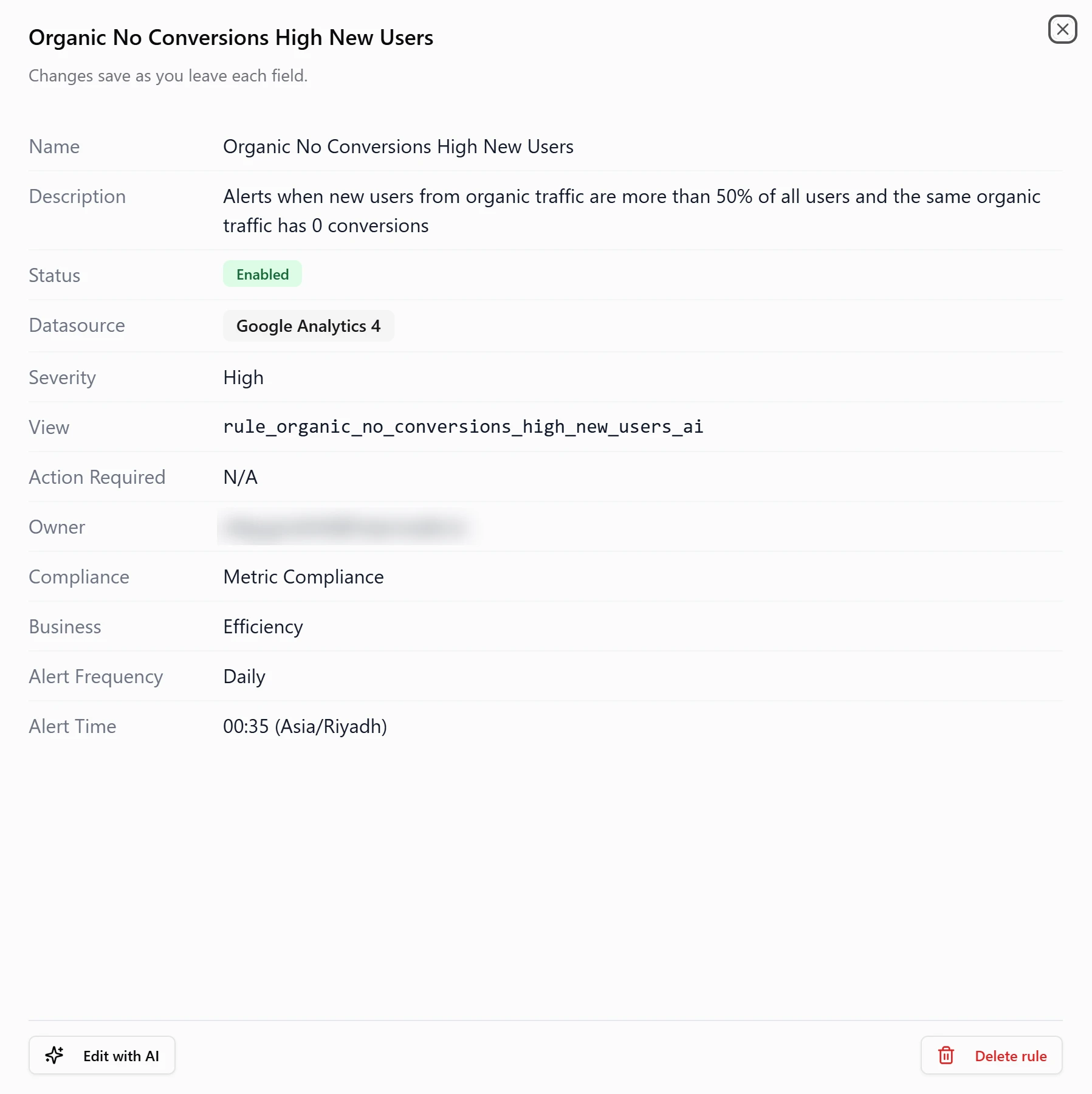
Click a rule name on any tab to open the rule drawer. Click a field to change it. Changes save when you leave the field. Use Edit with AI to change the rule logic in a chat, or Delete rule to remove it.
Settings on the dashboard
Data Governance settings moved from Settings to the dashboard. Old links to these settings open the right panel.
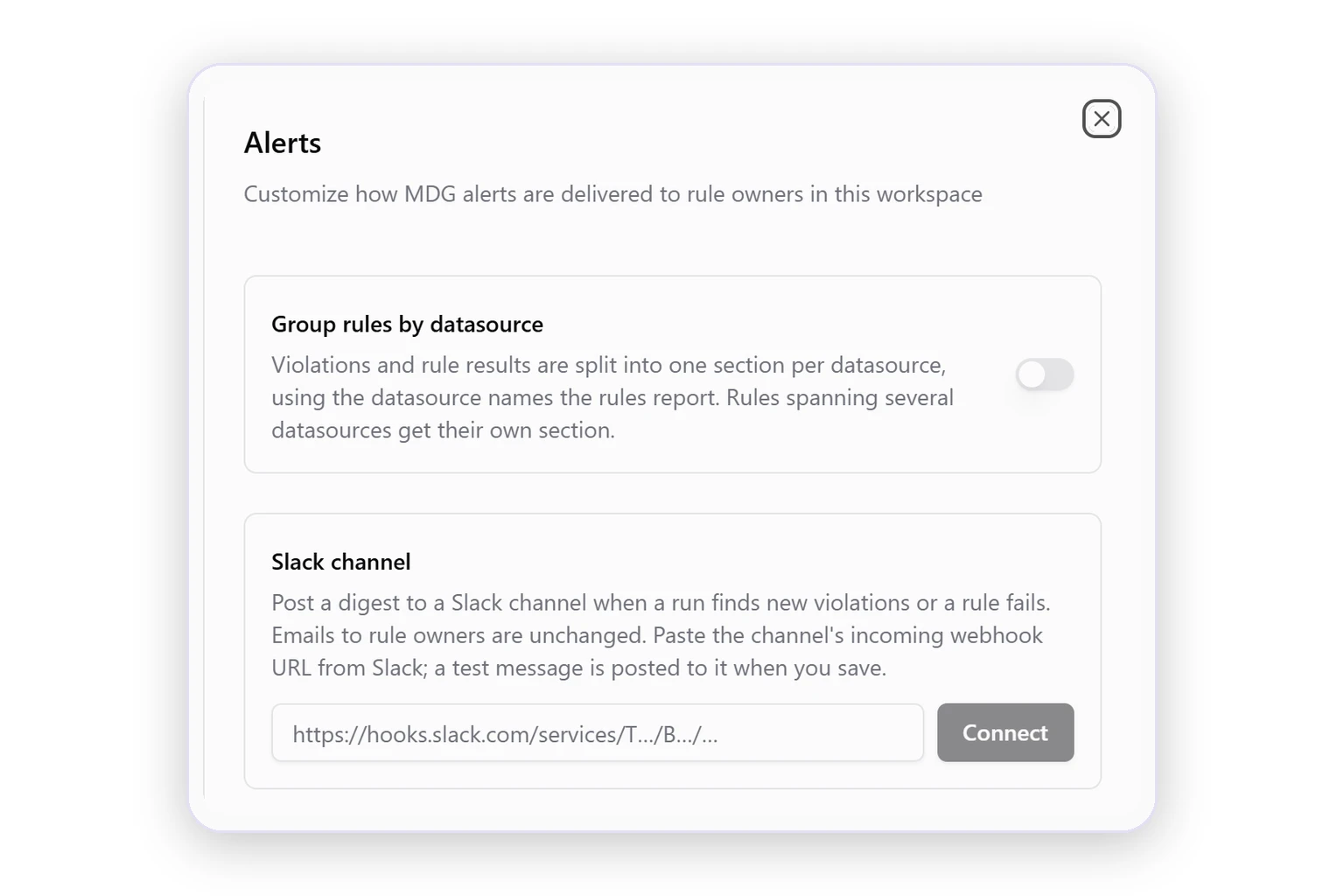
- Alerts: click Alerts in the header. Turn on Group rules by datasource for digest emails, or connect a Slack channel. See Data Governance Email Alerts.
- Budgets: open the Budget Pacing tab and click manage budgets. See Budgets.
- Account owners: click manage next to the Account Owner filter. See Account owners.
Act on violations
Each open violation, that is one entity under one rule, has two actions: Acknowledge and Working on it.
- Acknowledge: you know about the violation and accept it. Choose how long: 1, 7 or 30 days, or permanently. An acknowledged violation is hidden from digest emails and left out of the compliance rates. When the period ends, it becomes active again everywhere.
- Working on it: someone is fixing the violation. It stays open, gets a Working on it marker, and still counts in the compliance rates and charts. Hover over the marker to see who picked it up and since when.
Mark a violation as Working on it
- Open the Rules tab and expand the rule.
- Click Working on it on the violation card. To mark several violations at once, select them and use the bulk action.
- To see everything your team has picked up, open the In progress strip.
Right after you click, a message appears with an Undo button. Use it for a misclick: Undo removes only what that action created. When you stop working on a violation, click Release instead. The violation goes back to active, and the record that someone picked it up is kept.
See how long a fix took
On the Closed strip, each card shows how long the most recent fix took:
- Fixed by next run: the next daily run found the entity fixed.
- Fixed in 9 days: the number of days from when the violation started to when the rule passed again.
- Fixed in 88+ days: the violation started before the lookback period, so the exact start is unknown.
In digest emails
Digest emails, Slack messages and AI Agent links open the Rules tab for the right workspace. When at least one violation of a rule is picked up, that rule's table in the digest email gets a Working On It column with the person and the date.
Budget Pacing tab
The Budget Pacing tab compares each account's spend with its monthly budget. To add or change budgets, click manage budgets on this tab.
Was this article helpful?
Thanks for the feedback!
Questions? The Improvado team is always happy to help. Send us an email, contact your Customer Success Manager, or raise a request in the Improvado Service Desk.