

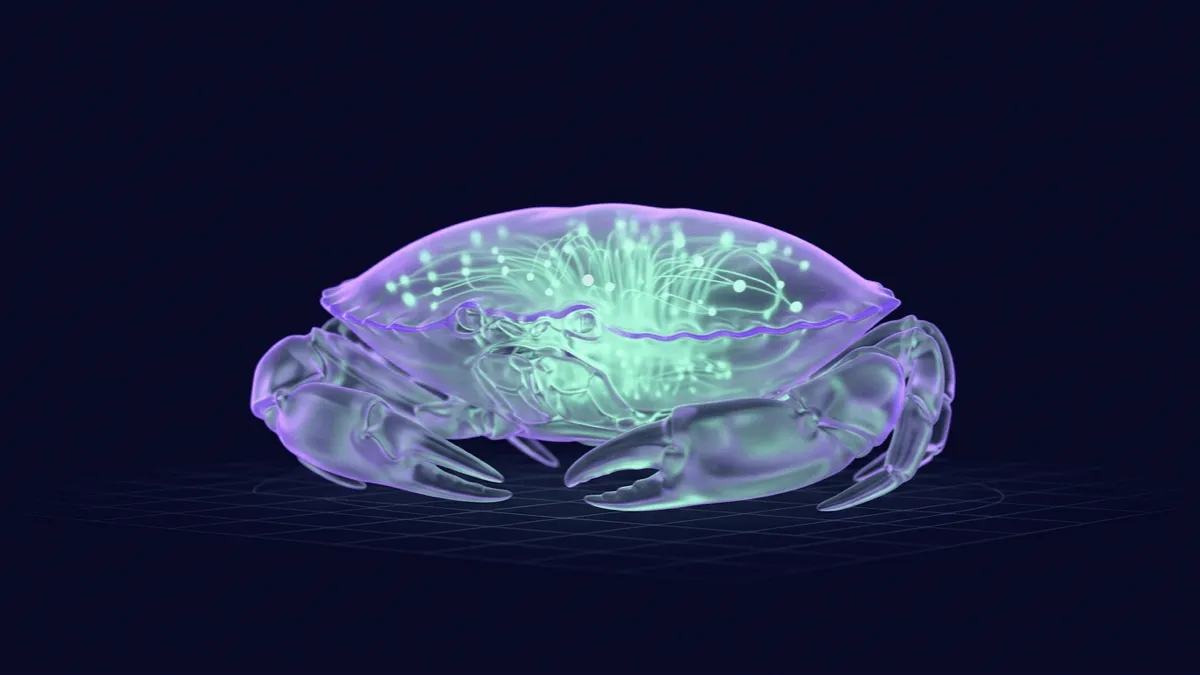
The carcinization of B2B software is the convergence of unrelated B2B products on one anatomy: an integration protocol (increasingly MCP), a context layer or knowledge graph, a workflow builder, agents and skills. The term comes from biology, where carcinization is evolution's habit of turning crustaceans into crab-shaped animals.
Since the fall of 2024, many sales, support, developer and marketing platforms have grown parts of that anatomy, and the pattern keeps repeating. My read is that this sameness is not the death of differentiation. It is evidence that the body plan works, and it moves the competition under the shell: to proprietary data and context, workflow depth, distribution and trust.
This expands on my LinkedIn post on the carcinization of B2B software.
Key Takeaways
- Between September 17 and October 21, 2024, Salesforce, HubSpot and Microsoft put essentially the same bundle on stage: agents that do the work, a way to build or direct more of them, and company data to feed them.
- Big B2B platforms keep growing the same organs: MCP, a knowledge graph, workflows, agents and skills. For skills the anatomy matches down to the file name: Microsoft's custom skills use the same SKILL.md file that Anthropic published as an open standard.
- Only part of the sameness is true convergent evolution. The rest is copying a published playbook and adopting one protocol, and those are different forces.
- Convergence on a body plan is evidence the plan works. When every product wears the same shell, the shell stops being the product.
- Competition moves under the shell: proprietary data and context, workflow depth, distribution and trust.
- Improvado is a crab too. The useful question is not how to avoid looking like everyone else, but what you grew that does not transfer.
What Is Carcinization, and Why Does It Fit Software?
Give evolution a crustacean and enough time, and it tends to turn it into a crab. The zoologist L.A. Borradaile named this carcinization in 1916. According to a 2021 review summarized by Harvard, the crab body plan evolved independently at least five times among decapod crustaceans: in true crabs and in several separate lineages of "false crabs." King crabs are the famous case. They descend from hermit-crab-like ancestors and are not true crabs at all.
Biologists still debate why. But a shape that evolves independently this many times is a workable answer, and the crab is less a lineage than a recurring solution.
I think B2B software is going through its carcinization moment.
When Did B2B Software Start Converging? The Five-Week Window
In the fall of 2024, three companies with very different starting points put essentially the same product on stage.
Salesforce announced Agentforce on September 12 and made it the center of Dreamforce, which opened September 17. HubSpot announced Breeze the next day at INBOUND: a copilot, a set of agents, and Breeze Intelligence, a data-enrichment layer. On October 21, Microsoft followed with ten autonomous agents in Dynamics 365, and said the ability to build your own in Copilot Studio was coming to public preview the next month.
An enterprise CRM, a marketing-first customer platform and Microsoft's Dynamics 365 business apps. One bundle: agents that do the work, a way to build or direct more of them, and the company's data underneath to feed them.
That was the visible start. By 2026 the pattern is everywhere. Deloitte's 2026 TMT Predictions lists the specimens: Salesforce Agentforce, SAP Joule Agents, ServiceNow Now Assist AI Agents and Workday Illuminate Agents, plus agent-building kits from Google, Oracle and Adobe. Different logos, one anatomy. In an August 26, 2025 press release, Gartner predicted that "40% of enterprise applications will be integrated with task-specific AI agents by the end of 2026, up from less than 5% today." The agent stops being a feature. It becomes a body part.
The Five Organs B2B Platforms Keep Growing
Look at the product pages of the big B2B platforms today and you keep finding the same five organs.
| Organ | What it does | Where the convergence shows |
|---|---|---|
| Integration protocol | Connects the product to other systems and to models | Increasingly literally the same one: the Model Context Protocol (MCP) |
| Context layer | Holds company knowledge as a knowledge graph or "company memory" | Atlassian pitches its Teamwork Graph as the context layer for agents, and engineering organizations are building their own internally (Postman, 2026) |
| Workflow builder | Chains the work into repeatable processes | Microsoft paired its Dynamics 365 agents with Copilot Studio, pitched for reimagining business processes |
| Agents | Do the work | Salesforce, HubSpot and Microsoft put them on stage between September 17 and October 21, 2024 |
| Skills | Packaged instructions, scripts and resources an agent loads per task | Microsoft's custom skills use the same SKILL.md file that Anthropic published as an open standard |
Sales tools are growing this anatomy. So are support tools, dev tools and marketing platforms, including ours.
The fifth organ is the most literal case, and it is adoption rather than convergence. Anthropic shipped Agent Skills in October 2025: a skill is a folder with a SKILL.md file inside, plus any scripts and resources it needs. That December, Anthropic published the format as an open standard. Less than a year after launch, Microsoft 365 Copilot previewed custom skills for its declarative agents, each a directory that contains, quote, "a required SKILL.md file."
Who Else Noticed That Software Looks the Same?
I am not the first to notice the sameness, and I am not the first to reach for the crab. Stephen O'Grady of RedMonk applied carcinization to CDNs and clouds in 2022. Marc Solomon applied it to security products in 2023, and Antithesis CEO Will Wilson applied it to company culture in 2026. As far as I can tell, nobody has yet used it for the way B2B software is converging on agents, MCP and knowledge graphs.
Investors supplied the economic frame. In 2023 Sarah Tavel told AI founders to sell the work, not the software, and in 2024 Chris Paik argued in "The End of Software" that models will drive the cost of creating software to zero. In December 2024, Satya Nadella said on the BG2 podcast that business applications are "essentially CRUD databases with a bunch of business logic," and that the logic moves into an AI tier.
By 2025 and 2026 the people watching the category were describing one animal from different angles. Tomasz Tunguz broke the agent harness, the layer that turns a model into a reliable agent, into seven components: "The end of the software era is the beginning of the harness era." Jamin Ball of Altimeter wrote that Microsoft, Salesforce, Snowflake and Databricks all see the same prize: the clearinghouse that controls agent memory, context, execution and governance. Kyle Poyar said it plainest in September 2025, looking at the prompt box that seemingly everyone was putting front and center: "Software products are starting to all look the same."
Why Does All SaaS Look the Same? Three Currents, One Shell
Here is where I have to be honest about biology, because the metaphor only earns its keep if we use it precisely. What looks like one force is actually three, and only one of them is true carcinization.
| Current | What is happening | Is it carcinization? |
|---|---|---|
| Convergent evolution | Teams that never met grow the same organ under the same pressure | Yes |
| Copying a published playbook | Organizations under uncertainty model themselves on their peers | No, it is imitation |
| Protocol adoption | An industry agrees on one standard for connecting things | No, it is adoption |
First: real convergent evolution. Teams that never met, under the same selection pressure, growing the same organ: a knowledge graph. Postman's engineering blog put it this way in August 2026: "Something quietly identical is happening at engineering organizations that otherwise have nothing in common. Every one of them is building a knowledge graph." Agents made context economically critical, and everyone's ribcage grew the same bone. It is the same pressure behind the shift from prompt engineering to context engineering.
Second: copying. Sociologists Paul DiMaggio and Walter Powell called it mimetic isomorphism: when technologies are poorly understood or the environment is uncertain, organizations tend to model themselves on their peers. A lot of the 2025 sameness is exactly this. And unlike biological evolution, our industry received a blueprint before the species existed. Andrej Karpathy sketched the "LLM OS" in November 2023: the model as the CPU, the context window as RAM, a file system with embeddings, classic software tools, a browser and links to other LLMs. The detailed playbooks followed the first launches: Anthropic published its agent patterns in December 2024. OpenAI shipped its own guide in April 2025: model, tools, instructions. Teams everywhere then implemented the same published playbooks. That is not evolution. That is a recipe.
Third: protocol adoption. Anthropic open-sourced MCP on November 25, 2024. OpenAI adopted it in March 2025, Google committed to it in April, and at Build in May Microsoft announced MCP support in Windows. In December 2025 Anthropic donated MCP to the Agentic AI Foundation, formed under the Linux Foundation and co-founded by Anthropic, Block and OpenAI. In about thirteen months, the major model providers and platforms lined up behind one integration protocol. But everyone sharing a skeleton standard is not convergence. It is adoption. Nobody calls the internet carcinization. Standards are supposed to look the same. SKILL.md is the same story one layer up.
So the honest version of the thesis: the industry converged on one body plan through a mix of genuine convergent evolution, playbook copying and protocol standardization, plus some costume. The shells look the same. How each company got its shell does not.
Beyond the SaaSpocalypse Fear: Why Sameness Is Not the Bad News
The reflex is to read all this as an indictment: no differentiation left, a sea of identical pitches. Wall Street has already named the fear. When software stocks sold off in early 2026, traders called it the SaaSpocalypse. Buyers feel it too. In 2025 a16z wrote that dozens of companies are trying to sell identical-sounding solutions to the same enterprise buyer, and those buyers are inundated.
Biology suggests a different reading. Convergence on a body plan is not a failure of imagination. It is evidence the body plan is right. A body plan that evolves five separate times is one that works, and the agents, context and workflows anatomy keeps appearing for the same reason.
What actually happens after convergence, in nature and in markets, is that competition moves under the shell. Jerry Chen of Greylock said it flatly: "The new moats are the old moats." His list is workflows, integration with data and other applications, brand and trust, network effects, and scale and cost efficiency. Jamin Ball's version: the moat is not where the data sits, it is where the work gets orchestrated. Aaron Levie's version: keep "church and state" between the deterministic side of your software and the non-deterministic agents. All three describe the same thing. The shell is the entry fee. The organs are the game.
What Klarna actually built under the shell
The most famous SaaS-killer story of the decade is really a story about this. In August 2024, on an investor call, Klarna's CEO said they had "just shut down Salesforce." The story ran around the world as proof that AI replaces SaaS.
What Klarna built underneath, by its CEO's own clarification in March 2025, was an internal stack, using the Neo4j graph database "and other things," to bring its scattered data together. The headline said the shell. The substance was the organ: context.
The same story carries a warning label, in Klarna's own customer service. In May 2025 its CEO said cost had been "a too predominant evaluation factor" and the result was lower quality, and Klarna began recruiting human support agents again. The AI assistant stayed, and Klarna says it still handles two-thirds of customer inquiries. What did not survive contact with reality was the cost-first version of the push: a shell judged mainly on what it saves. Two crabs can look identical from above and live entirely different lives, because one of them knows where the food is.
Talk to an Improvado expert about the marketing data and context that sit under your agents.
We're a Crab Too: What Still Differentiates B2B Software
I run a company that ships all five: an MCP server, a knowledge graph, custom pipelines for repeatable workflows, AI agents and agent skills. By my own argument, Improvado is a crab. I am not writing this from outside the aquarium.
The useful question for anyone building B2B software in 2026, us included, is no longer "how do we avoid looking like everyone else." The shell converged. That is over.
The question is what is under your shell that took years to grow and does not transfer. In our case it is eleven years of marketing data plumbing across 1,400+ data sources, and the context graph built on top of it. In your case it is something else. But it is not the agents, not the workflow builder and not the protocol. Those are the uniform now.
What Happens Next: Three Predictions for 2027
Three predictions, so this essay can be graded later.
- By the end of 2027, the five-organ anatomy becomes a checklist block in enterprise RFPs: supports MCP, ships agents, has a context layer, the way "has an API" did a decade ago. Nobody wins a deal with it. People lose deals without it.
- The cardboard crabs die first. In a June 25, 2025 press release, Gartner estimated that only about 130 of the thousands of agentic AI vendors were real, and predicted that over 40% of agentic AI projects will be canceled by the end of 2027, due to escalating costs, unclear business value or inadequate risk controls. An identical shell with nothing under it is not a survivable combination.
- Valuation logic follows the organs. Proprietary context, workflow ownership and distribution get priced. Agent counts and feature checklists stop being priced.
Biology adds one final warning. The crab form has also been lost, at least seven times. Zoologists call that decarcinization. Forms that look inevitable stop being inevitable when the selection pressure changes, and in software the pressure changes every time the model layer jumps. The shell is rented, not owned.
Everything becomes a crab. The crabs still have to eat.
Frequently Asked Questions
What is carcinization?
Carcinization is the evolutionary process in which a crustacean converges on a crab-like body form. The zoologist L.A. Borradaile coined the term in 1916. A crab-like body plan has evolved independently at least five times among decapod crustaceans, in true crabs and in several separate lineages of "false crabs" such as king crabs, and it has been lost at least seven times, which biologists call decarcinization.
What is the carcinization of B2B software?
The carcinization of B2B software is Improvado CEO Daniel Kravtsov's name for the way unrelated B2B products are converging on one anatomy: an integration protocol (increasingly MCP), a context layer or knowledge graph, a workflow builder, AI agents and agent skills. Many sales, support, developer and marketing platforms have been growing these five parts since the fall of 2024. The analogy has limits: some of the sameness is genuine convergent evolution, some is teams copying a published playbook, and some is simply everyone adopting the same protocol.
Why do all SaaS products look the same now?
Three forces arrived together. Agents made company context economically valuable, so teams that never met started building knowledge graphs. Model providers published the blueprints (Anthropic's agent patterns in December 2024, OpenAI's agent guide in April 2025), and teams everywhere implemented the same published playbooks. And the major model providers and platforms lined up behind one integration protocol, MCP, in about thirteen months. The result is products that look identical from the outside while differing a lot underneath.
What is the SaaSpocalypse?
SaaSpocalypse is the name Wall Street traders gave the selloff in software stocks in early 2026, driven by fears that AI agents will undercut traditional software businesses. Bloomberg quoted a Jefferies equity trader on February 3, 2026: "We call it the 'SaaSpocalypse.'" The argument of this essay is that the fear is aimed at the wrong layer: the agent shell is turning into a commodity, while proprietary data, context and workflow ownership are not.
Is SaaS dead because of AI agents?
I do not read it that way. Klarna's CEO later clarified that the famous "We just shut down Salesforce" line did not mean an LLM had replaced SaaS: the company had built an internal stack, using Neo4j "and other things," to bring its data together. In 2025 Klarna also began recruiting human support agents again after its CEO said cost had been too predominant a factor and quality had suffered, while its AI assistant stayed in place. What is dying is the idea that the agent layer itself is a product moat. Software that owns proprietary context, deep workflows and distribution is not dead. Software whose only story is "we added agents" is exposed. I made the pricing side of this argument in SaaS is not dead, but per-seat pricing is.
What is agent washing?
Agent washing is rebranding existing assistants, chatbots or robotic process automation as agentic AI without real agent capabilities. In a June 25, 2025 press release, Gartner estimated that "only about 130 of the thousands of agentic AI vendors are real" and predicted that "over 40% of agentic AI projects will be canceled by the end of 2027, due to escalating costs, unclear business value or inadequate risk controls."
How can a B2B software company differentiate when every product has agents and MCP?
By competing on what the shell cannot copy: proprietary data and the context built on it, how deeply the product owns a workflow, distribution, and the trust earned with customers. A useful self-test is to list what took you years to grow and would not transfer to a competitor who installed the same model, the same protocol and the same agent framework tomorrow. If you want to test that against your own marketing data stack, talk to our team.