


 Captured August 25, 2026 ↗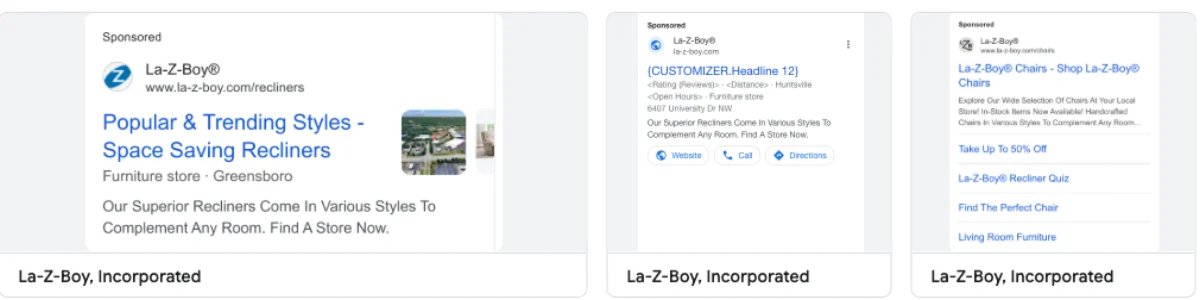
The thesis
The brand is the moat. The click trail stops at the showroom.
La-Z-Boy has what most retailers cannot buy: a name that became the generic word for its own product, 234 company-owned stores, a design service competitors cannot copy, and a supply chain the tariff cycle happens to favour. It also runs a demand engine whose every public signal is a discount, and a customer journey that is genuinely hard to follow from the outside, because the sale closes in a showroom weeks after the click. Whatever La-Z-Boy connects internally, the public trail ends at the gallery door - and this brief is written entirely from that public trail.
A three-year decline is reversing right now
Gross advertising expense fell for three consecutive fiscal years to $148.3M. The Q2 FY2027 guidance names incremental advertising as a reason margin will compress - the line is turning back up.
Every public signal is a percentage
All twenty national television spots listed on the brand's tracking page pair the brand platform with a discount or a financing term. Not one is brand-only.
Four campaign vocabularies, none of them shared
Meta clicks route through a Google ad server with no campaign tags, Google clicks carry only auto-tagging, internal links use a private parameter, and the subsidiary uses standard UTMs nobody else does.
The growing business is the least visible one
Retail written same-store sales grew 3% while wholesale fell 9%. The showroom is winning - and the showroom is exactly where the click trail ends.
Counts are a dated public-source snapshot taken on August 25, 2026, not performance metrics. Ad libraries, sitemaps and search results change after publication. Where this brief says a signal cannot be followed, it means followed from public data; internal systems may see more than any outside observer can.
Demand engine
Four upstream motions, one sale that closes out of sight
The engine itself is coherent. National television builds the brand and announces the event, paid social carries the same discount into the feed, the local gallery layer amplifies it with deeper offers of its own, and a free in-home design service converts a recliner shopper into a whole-room project. The hard measurement problem sits at the end, not the beginning.
National television
A large creative library announcing a rolling calendar of holiday events, each one a percentage and a financing term.
Paid social at the event
Meta carries the same offer, plus in-stock messaging and a nine-ad set promoting free design consultations.
The local gallery layer
Independent dealers and branded galleries advertise on their own accounts, at deeper discounts, to their own domains.
Free in-home design
Degreed designers and room planning turn a single-item purchase into a furnished room - the genuine differentiator.
Channel analysis
Television and Meta carry the demand; LinkedIn and video are unused
Relative signal strength is a research synthesis of public activity, repetition and channel depth. It is not a spend split or an attribution score.
Creative evidence
What the advertising shows when you read it as a system
These are not the prettiest creatives in the account. They are the ones that reveal how the machine is wired - where the money goes, where the click goes, and where the tracking stops.
An ad-customizer token shipped to the public as a headline
Two live local search ads sit side by side. The left renders a real headline; the right renders the literal string {CUSTOMIZER.Headline 12} in the headline slot, above a genuine dealer address. The angle-bracket fields beneath it are the Transparency Center's own preview placeholders and are not a defect - the curly-brace token is. A feed-driven local campaign is failing open, in public, and nothing in the reporting chain surfaces it.
Corporate 30% and dealer 50%, on two different domains
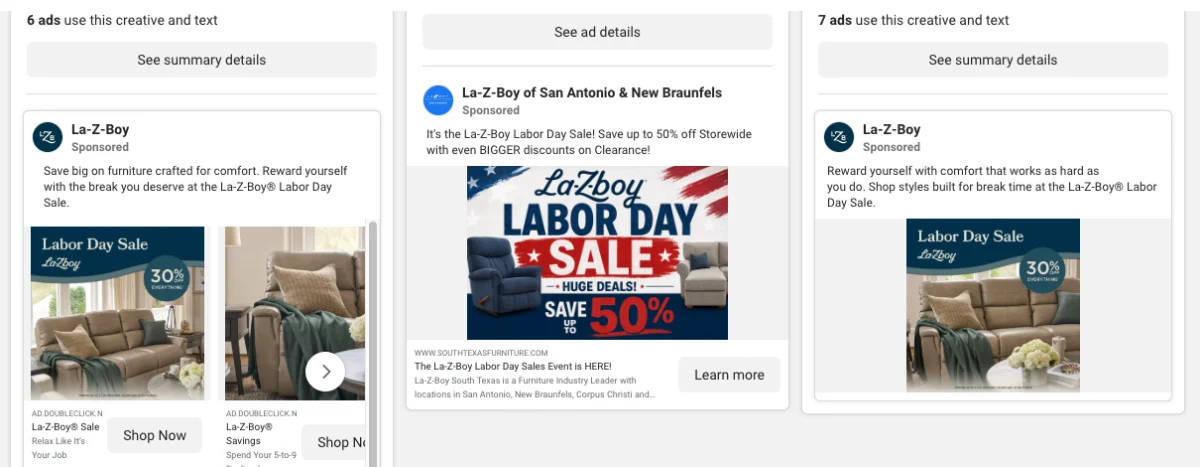
One frame carries the whole measurement problem. The corporate ads promise 30% off everything and hand the click to ad.doubleclick.net - a Campaign Manager 360 redirect, not a tagged destination. The dealer beside them advertises up to 50% off storewide and sends its click to southtexasfurniture.com, a domain the parent brand does not own or measure. Same customer, same weekend, two discount depths and two analytics universes.
The evergreen that has run since May
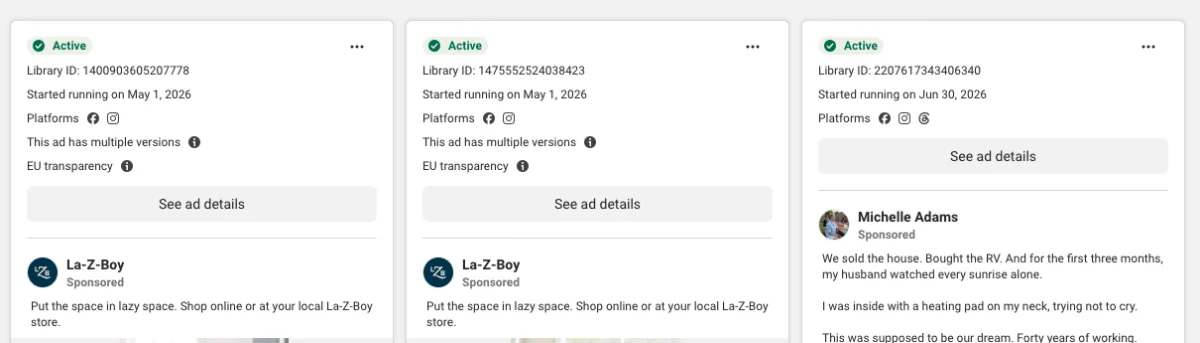
Two ads carrying the same line - "Put the space in lazy space. Shop online or at your local La-Z-Boy store." - have run continuously since May 1, 2026 on Facebook and Instagram. Longevity is the closest thing an outside observer gets to a performance signal, and this is the only always-on brand message in the sample. Everything else cycles with the promotional calendar.
Zero video ads on Google
Filtering the verified La-Z-Boy, Incorporated advertiser to video returns nothing at all. For a brand whose category is sold on comfort you have to see demonstrated, and whose national television library runs to hundreds of creatives, the complete absence of video in Google's inventory is a channel decision with no obvious rationale.
The subsidiary runs the video the parent does not
The same filter on Joybird - legally Stitch Industries Inc. - returns a working video library. The capability exists inside the company; it is simply not applied to the brand that carries the television budget.
Customization as the whole pitch
Joybird sells the choice rather than the discount: 90+ fabrics, the same hero piece rotated through named colourways, and a product feed that swaps the swatch instead of the message. Its ads also run wider placements than the parent brand's, reaching Threads and Messenger alongside Facebook and Instagram.
The only B2B story it tells is healthcare furniture
The consumer brand is absent from LinkedIn advertising. What exists is a separate healthcare-furniture identity, La-Z-Boy Healthcare | Knu Comfort, paid for by KNU LLC and promoting a New York trade event. A second, unrelated source corroborates the motion: measured-media records place the company in Healthcare Design magazine in August 2026.
Brand platform on top, discount underneath
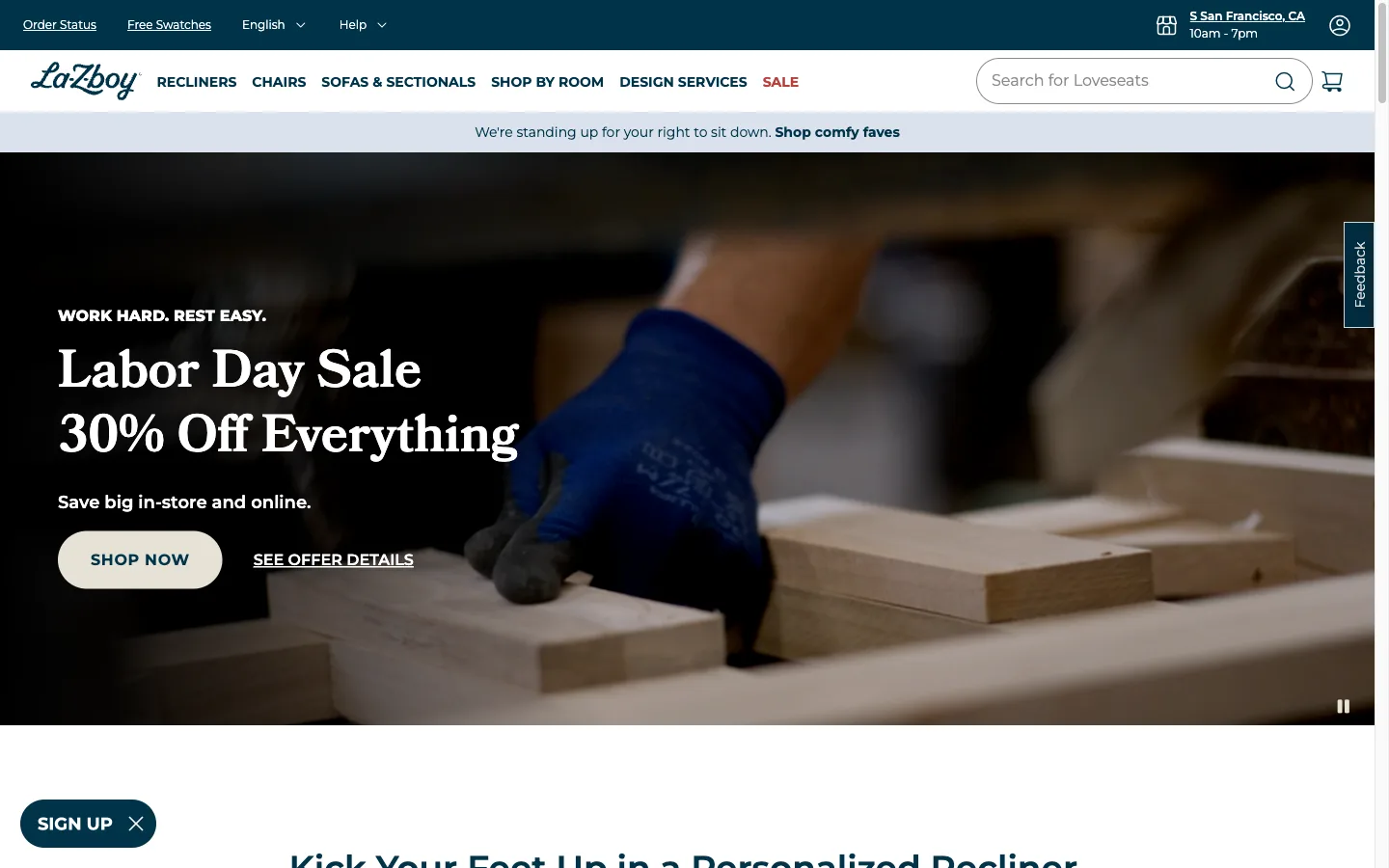
The homepage states the pattern plainly. A craft image and the line "Work hard. Rest easy." carry the brand; the headline underneath is a percentage. The store context in the corner is already personalized to a location, which is precisely the journey the campaign tagging does not follow through to a sale.
8 of 8 examples shown
Captured from public ad libraries and public web pages for comparative research and commentary. Creative work and trademarks belong to La-Z-Boy Incorporated and the named organizations.
Campaign taxonomies
One customer journey, four naming systems that never meet
This is the structural finding, and it is read entirely from public click-throughs. Anyone reconstructing which channel produced a gallery sale from the outside has to join four vocabularies that share no key.
Sampled corporate ads hand the click to a Campaign Manager 360 redirect on ad.doubleclick.net carrying its own numeric identifiers; the remainder land on a bare product URL with no query string whatsoever. There is no utm_source on either path.
Captured click-throughs carry gclid, gad_source and gbraid and nothing else. The destination knows a Google click happened; it does not know which campaign a human would recognize.
Internal navigation uses intpromo, formatted as module dot element - header.Recliners, HPServices.Financing, videoPano.LaborDay. Forty-three distinct values appear on the homepage alone. It is a fourth vocabulary, readable only in-house.
The subsidiary tags cleanly with utm_source, utm_medium and dynamic campaign, adset and ad macros. The one part of the company with a readable campaign taxonomy is the part that does not sell through the stores.
Dealer ads run from dealer accounts to dealer domains. Whatever they contribute to a gallery visit lives in systems separate from the parent brand's - a split that exists by construction, not by oversight.
Tag patterns describe what public click-throughs expose. Internal reporting may join these systems in ways an outside observer cannot see.
The subsidiary contrast
Joybird proves the capability exists in-house
Joybird - legally Stitch Industries Inc. - runs the modern stack: server-side tagging, a customer data platform, clean campaign tags, a working video library, and a content operation where a third of the sitemap is editorial. It shares a merchandising calendar with its parent and almost nothing else. It is also the business shrinking fastest - a reminder that clean measurement alone does not create demand.
The parent runs an Adobe measurement stack; the subsidiary runs Google Tag Manager with self-hosted server-side tagging and a separate CDP. The only vendor both share is their consent manager.
The parent's verified Google advertiser returns no video ads at all. The subsidiary's returns a working seasonal video library.
The parent's blog path returns 404. The subsidiary publishes 723 articles, about a third of its 2,171-URL sitemap.
On Instagram the subsidiary has roughly eight times the parent's following, and it leads on Pinterest too - while the parent leads on Facebook.
The better-instrumented brand posted a 17% decline in written sales last quarter, while the parent's harder-to-trace retail business grew same-store sales 3%.
Search and GEO
It owns its name; the category is open ground
Brand defence is solid: its own ad, the top organic result, and a comparison answer that treats it as the quality option. Step one word away from the brand and the footprint thins out fast. In a single-session check on August 25, the company had neither a paid nor a top organic presence for leather sofa, sectional sofa, sleeper sofa, furniture store near me, or in home design service furniture - all things it sells. The answer engine result is sharper still: asked for the best recliner, the AI Overview named competitors and not the company whose name is the household word for recliner.
The server-rendered HTML of a sampled store page contained no JSON-LD at all - not merely no LocalBusiness markup. A retailer anchored on 234 company-owned stores is publishing local pages that say nothing machine-readable about being a local business.
Product detail pages carry rich product markup. There is no blog behind them: the path returns 404. Nothing on the domain answers the questions people ask before they are ready to shop a SKU.
A local search ad renders an unresolved ad-customizer token where its headline should be. It is small and fixable - the kind of defect that slips through everywhere, and that feed-level creative monitoring exists to catch.
Search results and AI answers vary by user, location, device and date. This is one dated observation, not a ranking claim.
Verdict
What is working, and what the outside view leaves open
Retail written same-store sales grew 3% against a category that shrank 2.1% in the first half of 2026 and sits about 11% below its January 2023 peak. This is genuine outperformance in a recessionary category.
A category-defining name, a service moat in free in-home design, owned distribution, and a domestic supply chain that the current tariff cycle rewards rather than punishes.
A brand platform strong enough to sell on its own is paired with a percentage in every national spot. Premium equity is being spent on price events - a trade with a real return, and a real cost.
From public signals, four separate taxonomies and an off-network dealer layer mean the question 'what produced this gallery sale' has no answerable form. Internal reporting may close part of that gap; the public trail does not show it. Spend is about to increase into that same stretch of the journey.
Absent from the non-brand terms it sells and from the AI answer for its own product. This is the cheapest unclaimed ground on the map.
Independent analysis by Improvado from public sources. La-Z-Boy and related marks belong to their respective owners. This report is not sponsored by or affiliated with La-Z-Boy Incorporated.
Method and sources
Public evidence, re-verified, with the gaps named
Research passes collected the raw material; every figure that appears above was then re-probed from the authoring session before publication. Where a number could not be reproduced, the reproduced number is the one printed. Where nothing could be verified, the section was cut rather than estimated.
Public ad libraries for Google, Meta and LinkedIn, television creative tracking, both brands' websites and network requests, sitemaps and robots, SEC filings, and live search results.
Advertiser totals and format splits, the ad-customizer defect, the 404 blog path, store-page structured data, and both sitemaps were re-checked directly before publication.
Three counts produced by a research pass did not survive re-probing and were replaced with the verified values.
Page-speed field data, a page-scoped Meta census, an undated third-party television spend figure, social posting cadence behind login walls, and a full store enumeration. None were estimated in their place.
- La-Z-Boy FY2026 Form 10-K Gross advertising expense of $148.3M, $149.6M and $150.9M across FY2026-FY2024, and the dealer reimbursement of the national programme. ↗
- La-Z-Boy FY2027 Q1 results, filed August 18, 2026 Consolidated sales of $475.7M, retail written same-store sales up 3%, wholesale down 9%, Joybird written sales down 17%, and guidance naming incremental advertising. ↗
- Google Ads Transparency Center - La-Z-Boy, Incorporated Verified advertiser: about 200 ads, 33 image, zero video, and the live ad-customizer defect. Probed August 25, 2026. ↗
- Google Ads Transparency Center - Joybird Stitch Industries Inc.: about 300 ads including a working video library. Probed August 25, 2026. ↗
- Meta Ad Library - La-Z-Boy Corporate promo, in-stock and design-consultation sets, two evergreen ads running since May 1 2026, and the dealer layer. Keyword search, not a page-scoped census. ↗
- Meta Ad Library - Joybird Customization messaging, catalog ads, and the clean UTM tagging pattern. ↗
- LinkedIn Ad Library Advertiser-scoped results: recruiting, dealer hiring, and the healthcare-furniture sub-brand. No consumer creative. ↗
- iSpot.tv - La-Z-Boy brand page The national television creative library and the full list of spot titles, every one of which carries a discount or financing term. ↗
- La-Z-Boy store locator page Sampled store page whose server-rendered HTML contains no JSON-LD structured data. ↗
- La-Z-Boy sitemaps and robots.txt 1,629 product URLs, 376 store pages, 53 navigation and 14 static pages. The blog path returns 404. ↗
- Joybird sitemap 2,171 URLs of which 723 are blog articles. ↗
- US Census retail sales, furniture and home furnishings stores Category down 2.1% in H1 2026 year over year, about 11% below the January 2023 peak, still above 2019. ↗
- Trustpilot - la-z-boy.com The direct-experience rating, against markedly higher review scores at individual galleries. ↗