

.jpeg)

Seven out of ten shoppers use multiple channels before making a purchase. They browse on Instagram, compare prices on your website, check stock in-store, and complete the transaction via mobile app. Each touchpoint generates data — but in most retail organizations, that data lives in isolated systems that don't talk to each other.
This fragmentation creates blind spots. You can't see which marketing channel drove the in-store sale. You can't tell if your social ad budget is cannibalizing organic search. Inventory systems don't reflect real-time availability across warehouses, stores, and fulfillment centers. Performance marketers are left stitching together incomplete reports, making budget decisions with partial visibility, and losing attribution to the "dark funnel."
Omni channel retail solutions are built to solve this. They unify customer data, inventory, and transaction records across every sales and marketing touchpoint — online, mobile, in-store, marketplace, and social commerce. The result is a single source of truth that lets you measure true customer lifetime value, optimize cross-channel campaigns, and allocate budget based on actual contribution, not last-click guesswork.
✓ The omni channel retail market is growing at 12.03–14.4% annually through 2034, reaching a valuation of $10.13 billion in 2025.
✓ Unified commerce architectures address the core challenge: stock availability issues caused by disconnected sales and fulfillment systems.
✓ Performance marketing teams need platforms that centralize attribution data, automate cross-channel reporting, and preserve historical context when connectors change.
✓ The best solutions offer pre-built integrations to major retail platforms, marketplaces, and ad networks — reducing implementation time from months to days.
✓ Look for platforms with marketing-specific data models that normalize metrics across channels, enabling apples-to-apples performance comparison.
✓ Enterprise retail teams require governance features: budget validation, anomaly detection, and role-based access to prevent costly reporting errors.
Key Takeaways
- Omnichannel retail analytics unifies online browse, cart, store-visit, and in-store purchase events into a single customer journey — not two anonymous identities.
- Most marketing teams stitch together 3-5 standalone tools (web analytics, POS, loyalty, retail media, CRM) that never agree on attribution. Unified pipelines collapse this to one warehouse.
- The practical win is measurement parity: the same campaign ROI logic applies to digital spend, store traffic, and loyalty enrollment.
- Identity resolution (persistent customer ID across channels) is the gating capability — without it, omnichannel reporting stays directional, not definitive.
- Improvado connects retail media networks, POS systems, loyalty platforms, and 1,400+ marketing sources into a single data model — the agent answers campaign-to-store-visit questions without a data-engineering backlog.
What Is Omni Channel Retail?
Omni channel retail is a customer experience strategy that integrates every sales and service channel — physical stores, e-commerce platforms, mobile apps, social commerce, marketplaces, call centers — into a unified ecosystem. The goal is to let customers move seamlessly between channels without friction: they can order online and pick up in-store, check live inventory from a mobile app, return an online purchase at a physical location, or receive support via chat after browsing in person.
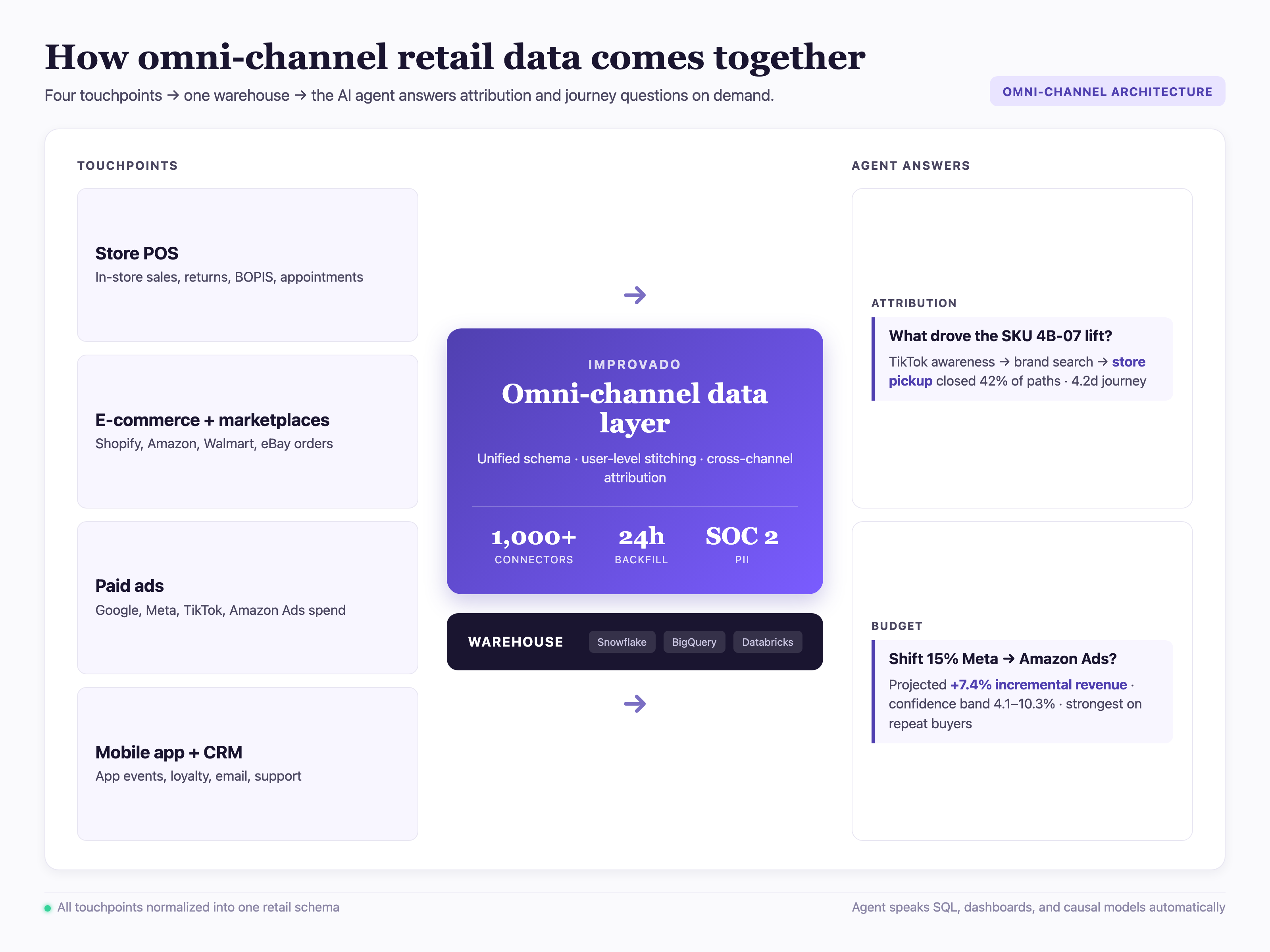
For performance marketers, omni channel retail creates a data challenge and an opportunity. The challenge: attribution gets murky when a customer sees your ad on TikTok, researches on Google, visits your store, then buys via your app. Traditional last-click models break down. The opportunity: if you can unify data from all these touchpoints, you gain complete visibility into the customer journey. You can measure true incremental lift, allocate budget to the channels that actually drive revenue, and identify which combinations of touchpoints convert most efficiently.
How to Choose an Omni Channel Retail Solution: Key Evaluation Criteria
Selecting the right platform depends on your retail stack, reporting requirements, and team structure. Here are the criteria that matter most for performance marketing teams:
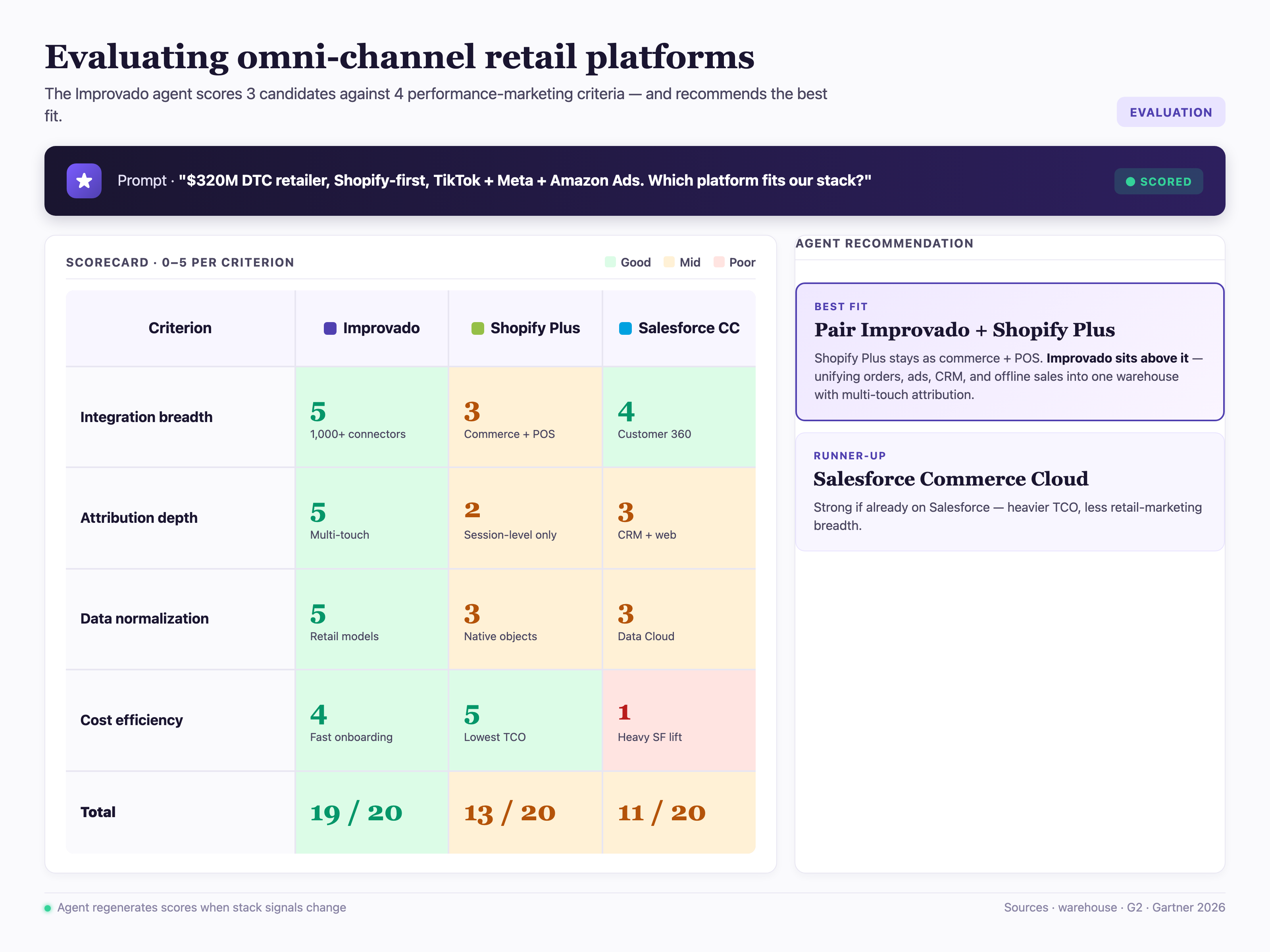
- Integration breadth. The platform must connect to your entire ecosystem: point-of-sale systems, e-commerce backends (Shopify, Magento, BigCommerce), marketplaces (Amazon, eBay, Walmart), advertising platforms (Google Ads, Meta, TikTok, Pinterest), CRMs, email marketing tools, and analytics systems. Pre-built connectors save weeks of custom API work. Ask how many retail-specific integrations are maintained and how often connector schemas are updated.
- Attribution capabilities. Can the platform unify online and offline transaction data? Does it support multi-touch attribution models, or only last-click? Can it track customer journeys that span weeks and multiple devices? Performance marketers need platforms that preserve user-level granularity while respecting privacy regulations — anonymizing PII but maintaining journey context.
- Data normalization. Different platforms use different naming conventions: "revenue" vs. "purchase value," "impressions" vs. "reach." The solution should map these into a unified schema automatically. Without normalization, you'll spend hours manually aligning metrics in spreadsheets before you can even start analysis.
- Historical data preservation. When a connector's API changes (and they do — Meta, Google, and Amazon update frequently), does the platform backfill historical data to maintain consistent time-series reporting? Or do you lose the ability to compare year-over-year performance? This is critical for seasonal retail businesses.
- Governance and validation. Enterprise retail teams need guardrails: pre-launch budget checks, anomaly detection for data quality issues, and role-based access controls. Without governance, one misconfigured campaign can drain budget, and bad data can lead to incorrect optimization decisions.
- Implementation speed. Custom integrations can take months. Pre-built solutions should be operational in days, not quarters. Ask for a realistic timeline from contract signature to first dashboard.
- Support model. Is customer success included, or an add-on? Do you get a dedicated account manager, or are you routed to a generic support queue? For high-stakes retail campaigns, direct access to a technical team is non-negotiable.
Improvado: Unified Marketing Data Platform with Retail-Specific Models
Improvado is a marketing analytics platform built for enterprises managing complex, multi-channel retail ecosystems. It connects to 1,400+ data sources — including all major advertising platforms, e-commerce backends, CRMs, and point-of-sale systems — and centralizes the data in a unified warehouse or BI tool of your choice.

Pre-Built Marketing Data Models and Automated Normalization
Improvado's Marketing Cloud Data Model (MCDM) is a pre-configured schema designed specifically for retail marketing use cases. It automatically maps metrics from disparate sources into a unified taxonomy: "cost" from Google Ads, "spend" from Meta, and "ad cost" from TikTok all become "cost" in your reporting layer. This eliminates the need for manual ETL scripting or brittle custom transformations.
The platform extracts 46,000+ metrics and dimensions across paid media, organic channels, e-commerce platforms, and CRM systems. You can analyze performance at the SKU level, compare channel efficiency across geographies, or calculate true customer acquisition cost by factoring in all touchpoints — online and offline.
For attribution, Improvado supports both rule-based models (first-touch, last-touch, linear) and custom multi-touch attribution frameworks. It preserves user-level journey data (anonymized for compliance) so you can trace a customer's path from initial ad exposure through store visit to final purchase. This is especially valuable for retail brands where online marketing drives in-store conversions.
Data governance is built in: more than 250 pre-configured validation rules catch issues like missing UTM parameters, budget overspend, or sudden traffic drops before they reach your dashboards. You can set alerts for anomalies — say, if cost-per-acquisition spikes 30% week-over-week — so your team can investigate and correct in real time.
Implementation is measured in days. Improvado's connectors are maintained by an internal engineering team, so when an API changes (as Google's and Meta's do frequently), updates are pushed automatically. The platform preserves two years of historical data even when connector schemas change, ensuring your year-over-year reporting doesn't break.
Limitations and Ideal Fit
Improvado is purpose-built for mid-market and enterprise companies with significant marketing spend and complex reporting needs. If you're a single-channel DTC brand with straightforward attribution, a lighter-weight tool may suffice. Pricing is custom and requires a conversation with the sales team — it's not a self-serve product.
The platform integrates with any BI tool (Looker, Tableau, Power BI, or custom dashboards), but it's not a visualization layer itself. You'll need to connect it to your existing analytics stack. For teams that prefer an all-in-one solution with built-in charts and reports, this adds a step.
Improvado is best suited for performance marketing teams managing omni channel retail campaigns across paid media, e-commerce, and brick-and-mortar — especially brands that need unified attribution, automated data normalization, and enterprise-grade governance.
| Feature | Details |
|---|---|
| Data Sources | 1,400+ pre-built connectors (Google Ads, Meta, Amazon Ads, Shopify, Salesforce, etc.) |
| Metrics Supported | 46,000+ marketing metrics and dimensions |
| Attribution | Multi-touch, custom models, user-level journey tracking |
| Data Governance | 250+ validation rules, pre-launch budget checks, anomaly alerts |
| Implementation Time | Operational within a week |
| Customer Support | Dedicated CSM and professional services included |
| Compliance | SOC 2 Type II, examined by BARR Advisory, signs Business Associate Agreements, and supports GDPR and CCPA obligations |
| Pricing | Custom pricing, contact sales |
| Best For | Enterprise retail brands managing multi-channel attribution and large-scale marketing data operations |
Shopify Plus: Commerce Platform with Built-In Omni Channel Tools
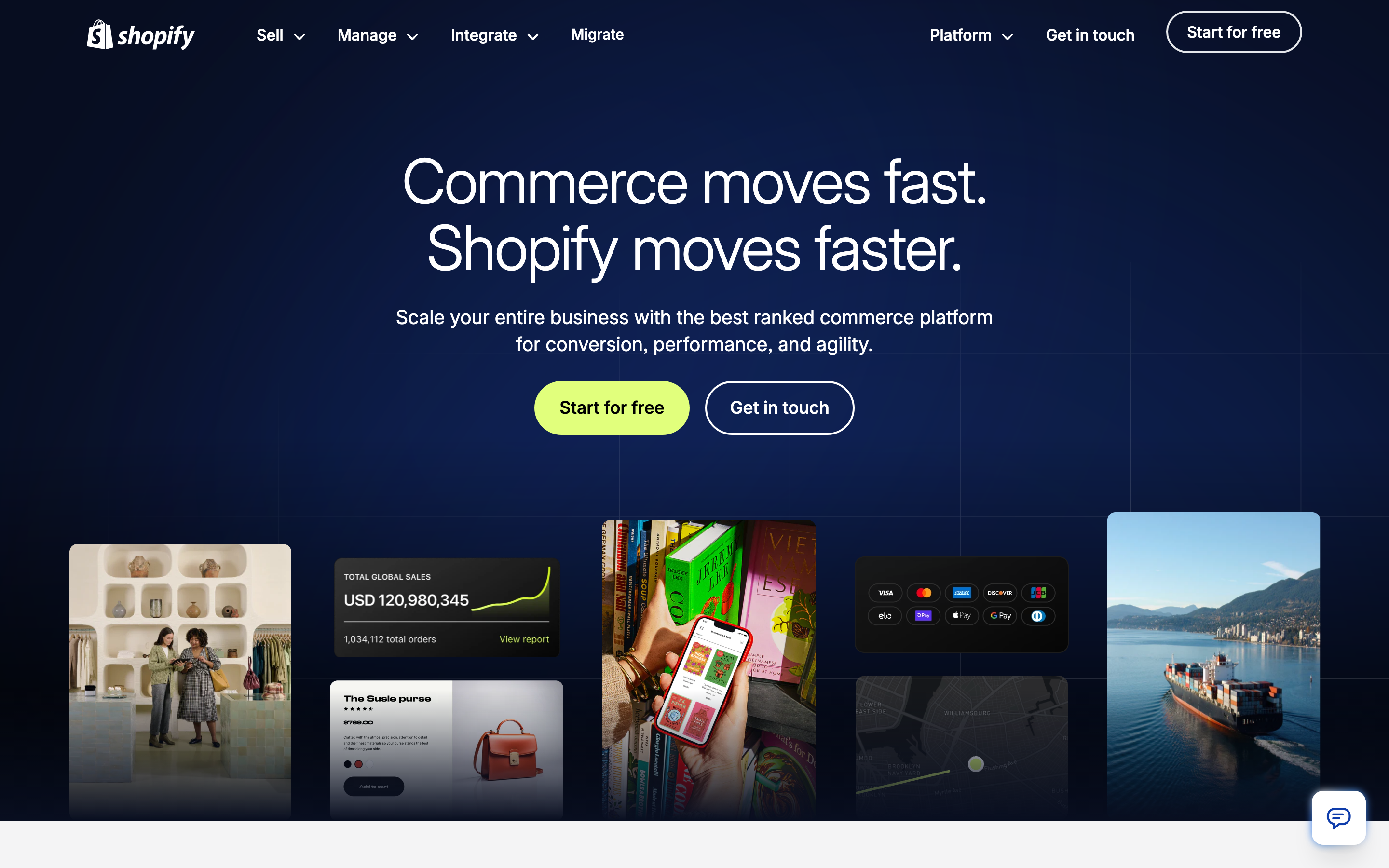
Shopify Plus is the enterprise tier of Shopify's e-commerce platform, designed for high-volume retailers managing online stores, physical retail locations, wholesale channels, and marketplace integrations from a single backend.
Unified Inventory and Point-of-Sale Integration
Shopify Plus centralizes inventory management across all sales channels. When a product sells in-store via Shopify POS, the stock count updates instantly across your website, mobile app, and any connected marketplaces. This prevents overselling and improves fulfillment accuracy — critical for retailers running buy-online-pickup-in-store (BOPIS) or ship-from-store models.
The platform includes native integrations with major marketplaces (Amazon, eBay, Walmart) and social commerce channels (Facebook Shops, Instagram Shopping, TikTok Shop). You can manage product listings, pricing, and orders from the Shopify admin without logging into each platform separately.
For marketing teams, Shopify Plus offers basic multi-channel attribution through its analytics dashboard. You can see which traffic sources (organic search, paid ads, email, social) drive the most revenue, and track customer lifetime value by cohort. However, attribution is limited to online channels — it doesn't connect in-store POS transactions to upstream marketing touchpoints unless you build custom integrations.
Shopify's Flow automation tool lets you create workflows that trigger actions based on customer behavior: tag high-value customers, send abandoned cart reminders, or route orders to specific fulfillment locations based on inventory availability. This reduces manual operational overhead for omni channel retail teams.
Limitations and Ideal Fit
Shopify Plus is a commerce platform first, a marketing analytics tool second. Its reporting is strong for transaction data and basic attribution, but it doesn't unify data from external advertising platforms (Google Ads, Meta, TikTok) or CRMs. You'll need to export data manually or use a third-party integration to connect Shopify to your BI stack.
The platform works best for retailers whose primary sales channel is online, with physical stores as a secondary component. If you operate a large brick-and-mortar footprint with e-commerce as a supplement, Shopify's store-first architecture may feel limiting.
Pricing starts at $2,000 per month, with additional fees for payment processing and third-party apps. For brands selling primarily on their own domain with a need for marketplace and social commerce expansion, Shopify Plus is a strong foundation.
| Feature | Details |
|---|---|
| Primary Use Case | E-commerce platform with omni channel inventory and POS |
| Channels Supported | Online store, mobile app, POS, marketplaces (Amazon, eBay, Walmart), social commerce |
| Attribution | Basic online attribution; does not natively connect POS to marketing touchpoints |
| Integrations | Native marketplace and social commerce integrations; third-party apps for CRM and advertising platforms |
| Implementation Time | Days to weeks, depending on customization |
| Pricing | Starts at $2,000/month plus transaction fees |
| Best For | E-commerce brands expanding into physical retail, marketplaces, and social commerce |
Oracle Retail Cloud Services: Enterprise Suite for Large-Scale Operations
Oracle Retail is a comprehensive suite of cloud applications covering merchandising, supply chain, store operations, and customer engagement for multi-location retailers. It's designed for enterprise organizations managing thousands of SKUs across hundreds of stores and multiple geographies.
End-to-End Retail Management with Advanced Planning
Oracle Retail handles the full retail lifecycle: demand forecasting, merchandise planning, allocation, pricing optimization, and fulfillment orchestration. Its strength is in supply chain complexity — if you operate distribution centers, third-party logistics partners, and direct-to-consumer fulfillment from stores, Oracle's planning modules can optimize inventory placement and reduce carrying costs.
The platform includes a customer data platform (CDP) that unifies transaction records, loyalty program activity, and engagement data from email, web, and mobile channels. Marketing teams can build segments based on purchase history, lifetime value, and behavioral signals, then activate those audiences across connected channels.
For omni channel fulfillment, Oracle supports BOPIS, curbside pickup, ship-from-store, and endless aisle (in-store staff can order out-of-stock items for home delivery). The order management system routes each order to the optimal fulfillment location based on inventory availability, shipping cost, and delivery speed.
Limitations and Ideal Fit
Oracle Retail is built for scale, which means complexity. Implementation timelines are measured in months, sometimes years. The platform requires dedicated IT resources to configure, integrate, and maintain. Pricing is custom and reflects the enterprise scope — this is not a tool for mid-market retailers.
Marketing attribution is limited to customer engagement within Oracle's ecosystem. To connect external advertising platforms or conduct multi-touch attribution across paid media and in-store transactions, you'll need to integrate Oracle with a marketing analytics layer — either by building custom data pipelines or using a third-party platform.
Oracle Retail is best suited for large, multi-brand retailers with complex supply chains, extensive physical footprints, and dedicated IT teams to manage the system.
| Feature | Details |
|---|---|
| Primary Use Case | Enterprise retail management (merchandising, supply chain, store ops, customer engagement) |
| Channels Supported | Physical stores, e-commerce, mobile, call center, marketplaces |
| Attribution | Customer engagement tracking within Oracle ecosystem; external ad platform integration requires custom work |
| Implementation Time | Months to years |
| Pricing | Custom enterprise pricing |
| Best For | Large retailers with complex supply chains and dedicated IT teams |
Salesforce Commerce Cloud: Unified Commerce and CRM Integration
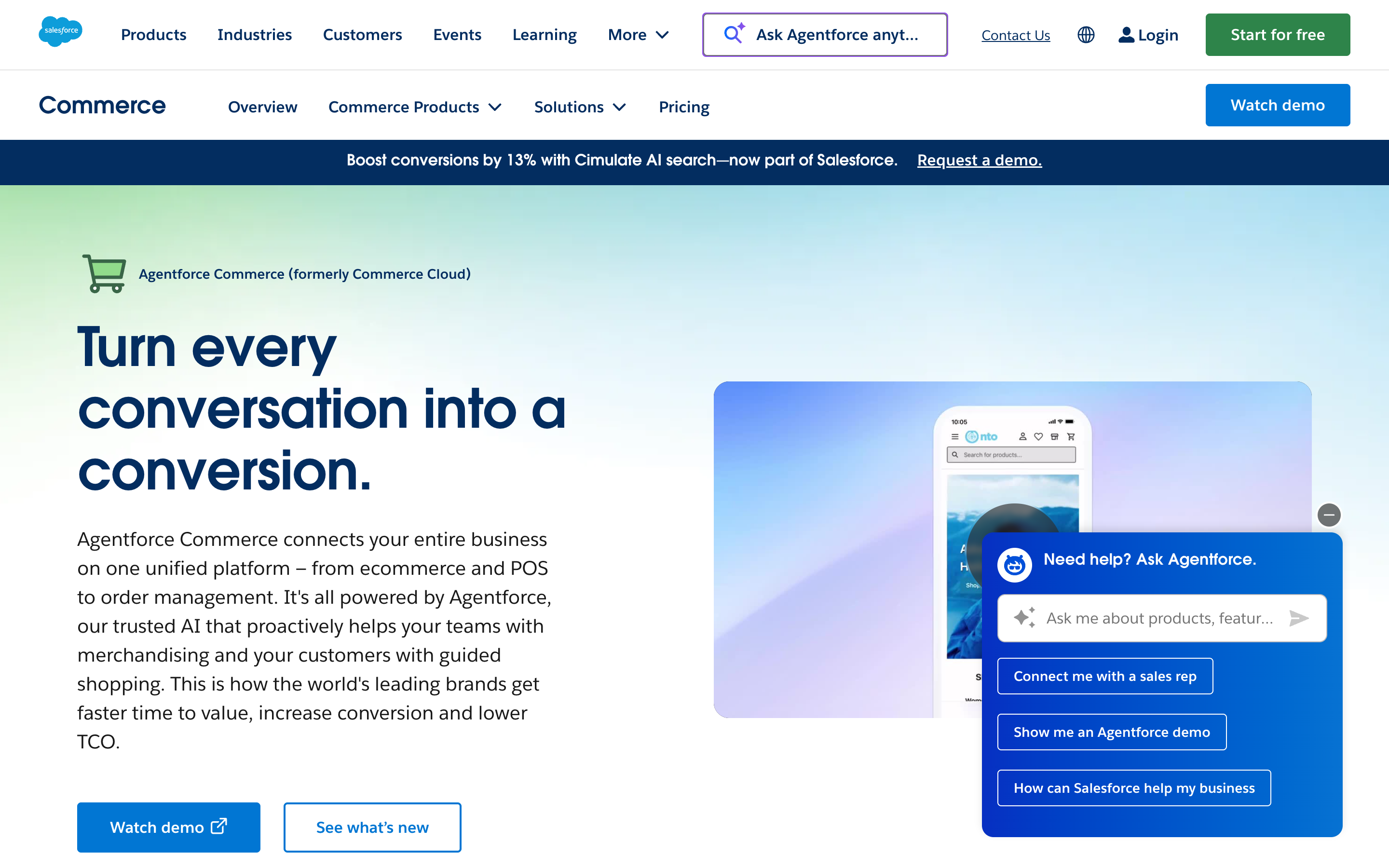
Salesforce Commerce Cloud is an e-commerce platform tightly integrated with Salesforce's broader ecosystem: Sales Cloud, Service Cloud, Marketing Cloud, and the Salesforce Customer 360 data platform. It's designed for retailers who want to unify commerce, marketing, sales, and service workflows in a single vendor stack.
Customer 360 and Integrated Marketing Automation
Salesforce's core value proposition is the unified customer record. When a shopper browses your site, makes a purchase, contacts support, or engages with a marketing email, all that activity flows into a single Customer 360 profile. Marketing teams can trigger personalized campaigns based on real-time behavior: abandoned cart emails, post-purchase cross-sell offers, or loyalty reward notifications.
Commerce Cloud supports both B2C and B2B use cases. You can manage multiple storefronts (regional sites, brand-specific domains) from one admin interface. The platform includes AI-driven product recommendations (Einstein), dynamic pricing, and merchandising tools that let marketers adjust site layouts and promotions without developer involvement.
For omni channel fulfillment, Commerce Cloud integrates with Order Management, which orchestrates inventory across warehouses, stores, and drop-ship vendors. You can offer BOPIS, ship-from-store, and curbside pickup, with real-time visibility into stock levels across all locations.
Limitations and Ideal Fit
Salesforce's strength is its integrated ecosystem, but that's also its limitation. The platform works best when you adopt multiple Salesforce products. If you're using a different CRM (HubSpot, Microsoft Dynamics) or marketing automation tool (Marketo, Braze), integrating with Commerce Cloud adds complexity.
Attribution is strong within the Salesforce stack — you can track journeys from email click to site visit to purchase — but connecting external advertising platforms (Google Ads, TikTok, programmatic DSPs) requires additional integration work or third-party tools.
Pricing is custom and scales with gross merchandise value (GMV). Implementation timelines vary widely: simple configurations can go live in weeks, but enterprise deployments with custom integrations can take months.
Commerce Cloud is best suited for mid-market to enterprise retailers already invested in the Salesforce ecosystem, or those planning a full platform consolidation around Salesforce.
| Feature | Details |
|---|---|
| Primary Use Case | E-commerce with integrated CRM, marketing automation, and service |
| Channels Supported | Online storefronts, mobile commerce, order management for BOPIS and ship-from-store |
| Attribution | Strong within Salesforce ecosystem; external ad platform integration requires additional tools |
| Integrations | Native Salesforce products; third-party apps via AppExchange |
| Implementation Time | Weeks to months |
| Pricing | Custom, scales with GMV |
| Best For | Retailers committed to the Salesforce ecosystem seeking unified commerce and CRM |
Adobe Commerce (Magento): Flexible Platform for Custom Retail Experiences
Adobe Commerce, formerly Magento, is an open-source e-commerce platform known for flexibility and customization. It's popular with retailers who need deep control over site functionality, user experience, and integration architecture.

Extensible Architecture and Adobe Experience Cloud Integration
Adobe Commerce supports multi-store, multi-language, and multi-currency setups out of the box. You can operate regional sites with localized pricing, inventory, and checkout flows from a single instance. The platform's API-first design makes it easy to build custom integrations with ERPs, warehouse management systems, and third-party logistics providers.
For omni channel retail, Adobe Commerce includes inventory management features that sync stock across online and offline locations. You can configure rules for order routing: prioritize ship-from-store for faster delivery, or allocate inventory to the location with the lowest fulfillment cost.
When integrated with Adobe Experience Cloud, Commerce connects to Adobe Analytics (for web analytics), Adobe Target (for personalization), and Adobe Real-Time CDP (for customer data unification). This gives marketing teams a full-stack solution for data collection, segmentation, testing, and activation — all within the Adobe ecosystem.
Limitations and Ideal Fit
Adobe Commerce's flexibility comes with a trade-off: you need developer resources to build and maintain the platform. Out-of-the-box functionality is limited compared to SaaS competitors like Shopify or BigCommerce. Most retailers hire an agency or maintain an in-house dev team to customize the storefront, integrate extensions, and manage upgrades.
Attribution capabilities depend on how you instrument tracking and which Adobe products you adopt. Adobe Analytics provides detailed web analytics, but connecting advertising platforms and offline transaction data requires additional configuration or third-party tools.
Pricing for Adobe Commerce is custom and reflects the complexity of your implementation. Hosting (cloud vs. on-premise), transaction volume, and required extensions all factor into cost.
Adobe Commerce is best suited for mid-market to enterprise retailers with technical teams who need a customizable platform and plan to adopt other Adobe Experience Cloud products for marketing and analytics.
| Feature | Details |
|---|---|
| Primary Use Case | Flexible e-commerce platform with extensive customization options |
| Channels Supported | Multi-store online commerce, integrations for POS and marketplaces |
| Attribution | Depends on Adobe Analytics implementation and external integrations |
| Integrations | Open API architecture; Adobe Experience Cloud native; extensive third-party marketplace |
| Implementation Time | Weeks to months, depending on customization |
| Pricing | Custom pricing based on transaction volume and feature requirements |
| Best For | Technical retail teams needing a highly customizable platform integrated with Adobe Experience Cloud |
Manhattan Active Omni: Fulfillment-Centric Platform for Complex Networks
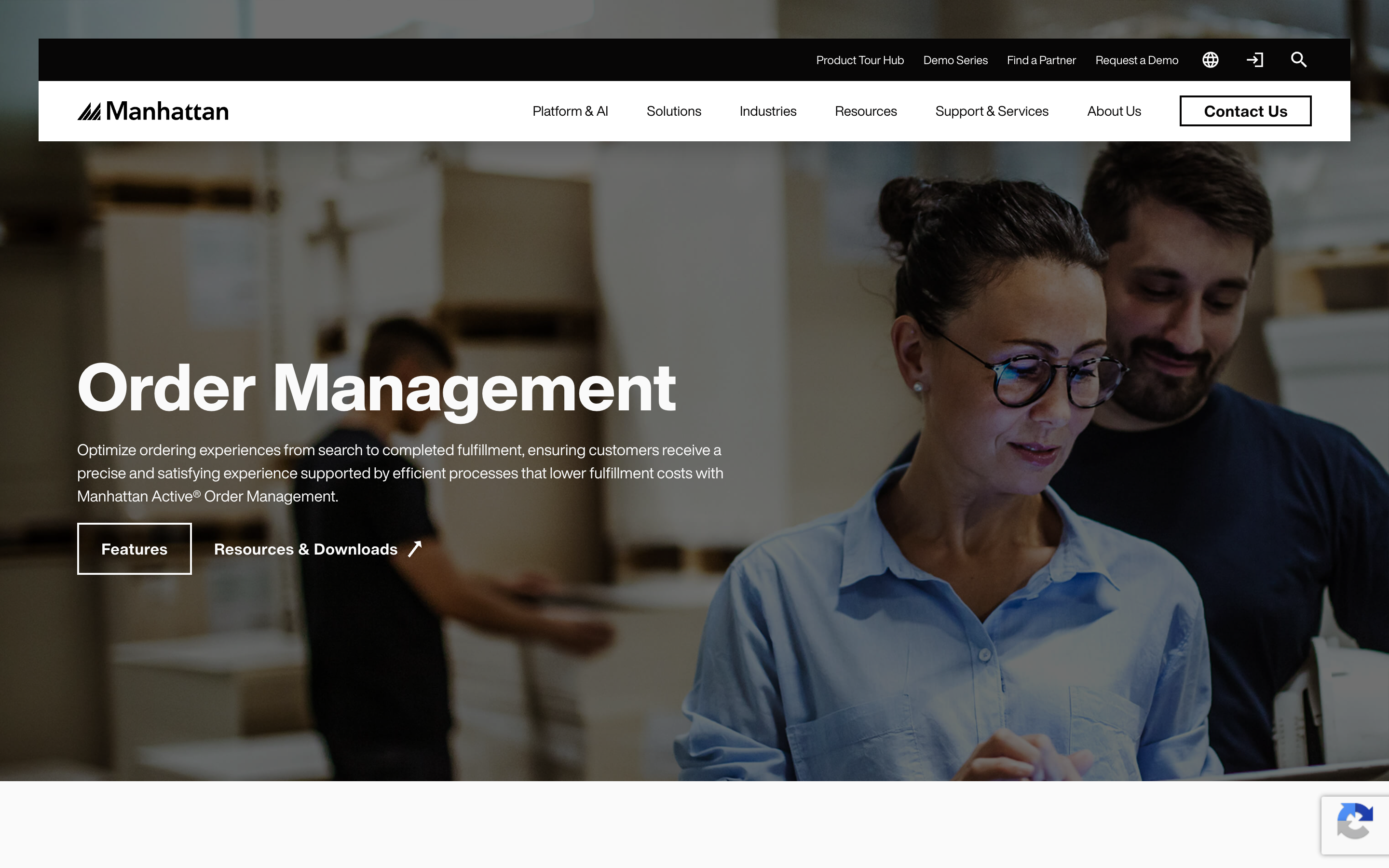
Manhattan Active Omni is a cloud-native order management and fulfillment platform designed for retailers operating dense networks of stores, warehouses, and third-party logistics partners. It focuses on the operational side of omni channel retail: routing orders to the optimal fulfillment location, managing inventory in real time, and coordinating ship-from-store, BOPIS, and curbside pickup.
Intelligent Order Orchestration and Real-Time Inventory Visibility
Manhattan's core strength is its order orchestration engine. When a customer places an order, the system evaluates every possible fulfillment option — ship from warehouse A, ship from store B, split the order across two locations — and selects the one that minimizes cost, meets the delivery promise, and balances inventory across the network.
The platform provides real-time inventory visibility across all locations. Store associates can see exactly what's in stock at nearby stores and distribution centers, enabling them to fulfill orders from the best source or offer alternative products if an item is out of stock locally.
Manhattan integrates with point-of-sale systems, e-commerce platforms, and warehouse management systems to synchronize data across the supply chain. For retailers with hundreds of stores, this level of coordination is critical to avoid stockouts, reduce markdowns, and improve customer satisfaction.
Limitations and Ideal Fit
Manhattan is a fulfillment and supply chain platform, not a marketing analytics tool. It excels at operational efficiency but doesn't provide attribution, campaign tracking, or customer journey insights. Marketing teams will need to integrate Manhattan with a separate analytics platform to connect fulfillment data to upstream marketing activity.
Implementation is complex and typically requires months of configuration, testing, and training. Manhattan is designed for large retailers with significant operational complexity — think hundreds of stores, millions of transactions per year, and dedicated supply chain teams.
Pricing is custom and reflects the scale of your operations. This is an enterprise-grade platform with enterprise-grade costs.
Manhattan Active Omni is best suited for large retailers prioritizing fulfillment speed, inventory optimization, and operational coordination across a complex store and warehouse network.
| Feature | Details |
|---|---|
| Primary Use Case | Order management and fulfillment orchestration for complex retail networks |
| Channels Supported | E-commerce, stores, warehouses, third-party fulfillment |
| Attribution | None; requires integration with separate marketing analytics tools |
| Integrations | POS systems, e-commerce platforms, WMS, ERPs |
| Implementation Time | Months |
| Pricing | Custom enterprise pricing |
| Best For | Large retailers with complex fulfillment networks and significant operational scale |
Kibo Commerce: Unified Commerce Platform with Built-In Order Management
Kibo Commerce is a cloud-based platform that combines e-commerce, order management, and point-of-sale functionality into a single system. It's designed for mid-market retailers who want a unified solution without stitching together multiple vendors.
All-in-One Architecture for Faster Deployment
Kibo's architecture unifies the commerce storefront, order management system, and inventory database. This eliminates the integration overhead that comes from connecting separate e-commerce, OMS, and POS platforms. Retailers can launch omni channel capabilities — BOPIS, ship-from-store, endless aisle — without coordinating data flows between disparate systems.
The platform includes a personalization engine that uses browsing behavior, purchase history, and customer segment data to tailor product recommendations, promotions, and content. Marketing teams can create targeted campaigns and measure their impact on conversion rates and average order value.
Kibo supports B2C and B2B commerce, making it a fit for retailers with both direct-to-consumer and wholesale channels. You can manage separate pricing, catalogs, and payment terms for business customers while using the same backend infrastructure.
Limitations and Ideal Fit
Kibo's all-in-one approach simplifies implementation but limits flexibility. If you want to use a best-of-breed order management system (like Fluent Commerce or Manhattan) or a specialized POS (like Lightspeed or Clover), integrating Kibo with external systems adds complexity that undermines the platform's core value proposition.
Marketing attribution is basic. Kibo tracks online conversions and customer behavior within its ecosystem, but connecting external advertising platforms or conducting multi-touch attribution requires additional tools or custom integration work.
Pricing is custom and scales with transaction volume. Implementation timelines are typically shorter than enterprise platforms like Oracle or SAP, but longer than lightweight SaaS tools like Shopify.
Kibo is best suited for mid-market retailers seeking a unified commerce platform with built-in order management, personalization, and support for both B2C and B2B sales.
| Feature | Details |
|---|---|
| Primary Use Case | Unified commerce platform with e-commerce, OMS, and POS in one system |
| Channels Supported | Online storefronts, physical stores, B2B portals |
| Attribution | Basic online conversion tracking; external ad platform integration requires additional work |
| Integrations | Native commerce, OMS, and POS; third-party integrations via API |
| Implementation Time | Weeks to months |
| Pricing | Custom pricing based on transaction volume |
| Best For | Mid-market retailers wanting a single-vendor solution for commerce, fulfillment, and POS |
SAP Commerce Cloud: Enterprise Platform for Global Operations
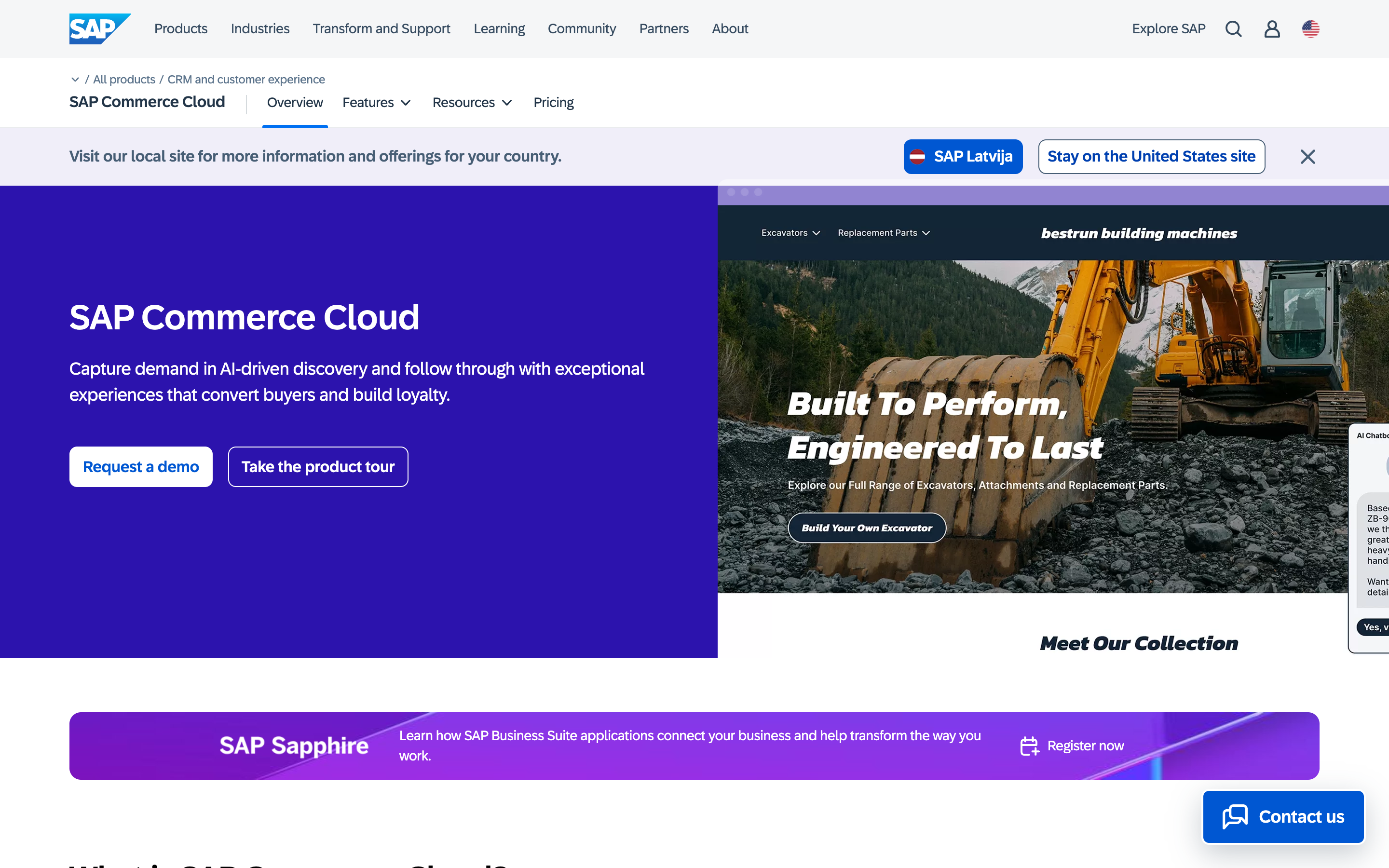
SAP Commerce Cloud, formerly Hybris, is an enterprise e-commerce platform built for global brands managing complex product catalogs, multiple currencies, and regional compliance requirements. It's part of the broader SAP Customer Experience suite, which includes marketing automation, customer data, sales, and service tools.
Deep ERP Integration and Multi-Brand Management
SAP Commerce Cloud integrates natively with SAP's ERP systems (SAP S/4HANA, SAP ECC), providing real-time access to inventory, pricing, and order data. For retailers already using SAP for financials, supply chain, or HR, this integration eliminates the need to build custom data pipelines between commerce and backend systems.
The platform supports multi-brand, multi-storefront architectures. You can operate separate websites for different brands or geographies, each with its own catalog, pricing rules, and checkout experience, while managing them all from a unified admin console.
SAP's customer data capabilities — part of the SAP Customer Data Platform — unify online and offline interactions into a single customer profile. Marketing teams can segment audiences based on purchase history, loyalty tier, and engagement behavior, then activate those segments across email, web, mobile, and service channels.
Limitations and Ideal Fit
SAP Commerce Cloud is built for scale and complexity, which means it's not fast or simple to deploy. Implementation timelines are measured in months, and the platform requires dedicated IT resources to configure, integrate, and maintain. Smaller retailers or those without existing SAP infrastructure will find the overhead difficult to justify.
Marketing attribution is limited to customer interactions within the SAP ecosystem. Connecting external advertising platforms (Google Ads, Meta, programmatic networks) or conducting cross-channel attribution requires additional integration work or third-party analytics tools.
Pricing is custom and reflects the enterprise scope of the platform. Licensing, hosting, and professional services add up quickly.
SAP Commerce Cloud is best suited for global enterprises with existing SAP infrastructure, complex product catalogs, and multi-brand operations.
| Feature | Details |
|---|---|
| Primary Use Case | Enterprise e-commerce with deep ERP integration and multi-brand management |
| Channels Supported | Online storefronts, mobile commerce, B2B portals |
| Attribution | Customer engagement tracking within SAP ecosystem; external ad platform integration requires custom work |
| Integrations | Native SAP products (ERP, CDP, marketing automation); third-party integrations via API |
| Implementation Time | Months |
| Pricing | Custom enterprise pricing |
| Best For | Global enterprises with SAP infrastructure and complex, multi-brand operations |
BigCommerce: Scalable SaaS Platform for Growing Retailers
BigCommerce is a SaaS e-commerce platform designed for mid-market retailers who need more flexibility than Shopify but less complexity than Adobe Commerce or SAP. It supports multi-channel selling (online store, marketplaces, social commerce) and integrates with a wide range of third-party tools for marketing, analytics, and fulfillment.
Headless Architecture and Multi-Channel Selling
BigCommerce offers both traditional storefront and headless commerce options. Headless architecture lets you separate the frontend (website, mobile app, in-store kiosk) from the backend commerce engine, giving developers full control over the customer experience while leveraging BigCommerce's APIs for cart, checkout, and order management.
The platform includes native integrations with major marketplaces (Amazon, eBay, Walmart, Google Shopping) and social commerce channels (Facebook, Instagram). You can manage product listings, inventory, and orders from the BigCommerce dashboard without logging into each external platform.
For omni channel fulfillment, BigCommerce partners with third-party order management systems (like Deposco or Fluent Commerce) to orchestrate ship-from-store, BOPIS, and multi-location inventory. These integrations are not native, so setup requires working with an agency or systems integrator.
Limitations and Ideal Fit
BigCommerce's marketing and analytics capabilities are basic. The platform provides standard e-commerce reports (traffic, conversion, revenue by channel) but doesn't offer advanced attribution or customer journey mapping. Marketing teams need to integrate BigCommerce with external analytics tools (Google Analytics, Segment, or Improvado) to get deeper insights.
While BigCommerce supports multi-channel selling, it doesn't unify online and offline data natively. Connecting POS transactions to online marketing activity requires custom integration work.
Pricing is tiered based on annual sales volume, starting at $39/month for small businesses and scaling up for enterprise plans. Transaction fees are not charged if you use BigCommerce's native payment gateway.
BigCommerce is best suited for growing retailers who need a flexible, scalable e-commerce platform with marketplace and social commerce integrations, but don't require deep enterprise features like advanced ERP integration or native order management.
| Feature | Details |
|---|---|
| Primary Use Case | Scalable e-commerce platform with multi-channel selling and headless options |
| Channels Supported | Online store, marketplaces (Amazon, eBay, Walmart), social commerce |
| Attribution | Basic e-commerce analytics; advanced attribution requires third-party tools |
| Integrations | Native marketplace and social commerce integrations; OMS via third-party partners |
| Implementation Time | Days to weeks |
| Pricing | Starts at $39/month, scales with sales volume; no transaction fees with native gateway |
| Best For | Growing retailers needing flexible e-commerce with marketplace and social selling |
Deposco: Warehouse-Centric OMS for High-Volume Fulfillment
Deposco is a cloud-based warehouse management and order management platform built for high-volume omni channel retailers. It focuses on the backend: receiving inventory, picking and packing orders, and coordinating fulfillment across multiple warehouses, stores, and third-party logistics providers.
Real-Time Inventory and Fulfillment Automation
Deposco provides real-time visibility into inventory across all locations — warehouses, stores, drop-ship vendors. Its order management engine routes each order to the optimal fulfillment source based on rules you configure: proximity to the customer, stock availability, or shipping cost.
The platform integrates with e-commerce systems (Shopify, BigCommerce, Magento), marketplaces (Amazon, eBay, Walmart), and shipping carriers (UPS, FedEx, USPS) to automate the entire fulfillment workflow. When an order is placed, Deposco automatically generates pick lists, prints shipping labels, and updates tracking information in the e-commerce system.
For retailers using stores as fulfillment centers, Deposco enables ship-from-store and BOPIS. Store associates receive pick lists on mobile devices, locate inventory on the sales floor, and pack orders for shipping or customer pickup.
Limitations and Ideal Fit
Deposco is a fulfillment and supply chain tool, not a marketing platform. It excels at operational efficiency but provides no marketing analytics, attribution, or customer journey tracking. Marketing teams will need to integrate Deposco with a separate analytics platform to connect fulfillment data to campaign performance.
Implementation requires significant operational change management. If your warehouse staff are accustomed to manual processes or legacy WMS systems, transitioning to Deposco involves retraining, process redesign, and potentially physical layout changes to support automated workflows.
Pricing is custom and based on order volume and the number of warehouses or stores connected. This is a high-volume solution designed for retailers processing thousands of orders per day.
Deposco is best suited for high-volume retailers with multiple fulfillment locations who need to optimize picking, packing, and shipping operations across warehouses and stores.
| Feature | Details |
|---|---|
| Primary Use Case | Warehouse management and order fulfillment for high-volume omni channel retail |
| Channels Supported | E-commerce, marketplaces, ship-from-store, BOPIS |
| Attribution | None; requires integration with separate marketing analytics tools |
| Integrations | E-commerce platforms, marketplaces, shipping carriers, ERP systems |
| Implementation Time | Weeks to months |
| Pricing | Custom pricing based on order volume and fulfillment locations |
| Best For | High-volume retailers optimizing warehouse operations and multi-location fulfillment |
Omni Channel Retail Solutions Comparison Table
| Platform | Primary Use Case | Attribution Capabilities | Implementation Time | Best For |
|---|---|---|---|---|
| Improvado | Unified marketing data platform with retail-specific models | Multi-touch, custom models, user-level journey tracking | Operational within a week | Enterprise marketing teams managing multi-channel attribution and large-scale data operations |
| Shopify Plus | E-commerce platform with omni channel inventory and POS | Basic online attribution; does not natively connect POS to marketing touchpoints | Days to weeks | E-commerce brands expanding into physical retail, marketplaces, and social commerce |
| Oracle Retail | Enterprise retail management suite | Customer engagement tracking within Oracle ecosystem; external ad platform integration requires custom work | Months to years | Large retailers with complex supply chains and dedicated IT teams |
| Salesforce Commerce Cloud | E-commerce with integrated CRM and marketing automation | Strong within Salesforce ecosystem; external ad platform integration requires additional tools | Weeks to months | Retailers committed to the Salesforce ecosystem seeking unified commerce and CRM |
| Adobe Commerce | Flexible e-commerce platform with extensive customization | Depends on Adobe Analytics implementation and external integrations | Weeks to months | Technical retail teams needing a highly customizable platform integrated with Adobe Experience Cloud |
| Manhattan Active Omni | Order management and fulfillment orchestration | None; requires integration with separate marketing analytics tools | Months | Large retailers with complex fulfillment networks and significant operational scale |
| Kibo Commerce | Unified commerce platform with built-in OMS | Basic online conversion tracking; external ad platform integration requires additional work | Weeks to months | Mid-market retailers wanting a single-vendor solution for commerce, fulfillment, and POS |
| SAP Commerce Cloud | Enterprise e-commerce with deep ERP integration | Customer engagement tracking within SAP ecosystem; external ad platform integration requires custom work | Months | Global enterprises with SAP infrastructure and complex, multi-brand operations |
| BigCommerce | Scalable e-commerce with multi-channel selling | Basic e-commerce analytics; advanced attribution requires third-party tools | Days to weeks | Growing retailers needing flexible e-commerce with marketplace and social selling |
| Deposco | Warehouse management and order fulfillment | None; requires integration with separate marketing analytics tools | Weeks to months | High-volume retailers optimizing warehouse operations and multi-location fulfillment |
How to Get Started with Omni Channel Retail Solutions
Implementing an omni channel retail solution is not a one-step process. It requires auditing your current systems, defining clear use cases, selecting the right platform, and coordinating data flows across multiple tools. Here's a structured approach:
- Step 1: Map your current data landscape. Document every system that touches customer or transaction data: e-commerce platform, POS, CRM, email marketing tool, advertising platforms, inventory management, order management, and any middleware or custom integrations you've built. Identify which systems share data today and where manual processes fill the gaps.
- Step 2: Define your priority use cases. What problems are you solving first? Common starting points include unified inventory visibility (so customers see accurate stock counts online and in-store), cross-channel attribution (so you can measure which touchpoints drive conversions), or fulfillment optimization (so you can route orders efficiently across warehouses and stores). Rank these by business impact and feasibility.
- Step 3: Evaluate platforms based on your stack and requirements. If you're already invested in Salesforce, Commerce Cloud may be the path of least resistance. If you operate hundreds of stores and need advanced fulfillment orchestration, Manhattan or Deposco may be necessary. If your primary need is marketing attribution across online and offline channels, a data platform like Improvado connects directly to advertising, e-commerce, and POS systems without requiring a full commerce platform migration.
- Step 4: Plan for data normalization and historical preservation. Different platforms name metrics differently. Make sure your chosen solution includes automated normalization so you're not manually mapping fields in spreadsheets. Ask how the platform handles API changes — when Google Ads or Meta updates its schema, does your historical data remain comparable, or do you lose the ability to run year-over-year reports?
- Step 5: Build incrementally. Don't try to unify every channel and every data source in one implementation cycle. Start with the highest-impact connections — say, online sales data and paid media platforms — prove the value, then expand to POS, email, and additional marketplaces. This reduces risk and lets you iterate based on what your team actually uses.
- Step 6: Invest in governance early. As you centralize data, errors compound faster. Implement validation rules to catch issues like missing UTM parameters, budget overruns, or inventory discrepancies before they propagate downstream. Define access controls so team members only see the data relevant to their role. Document naming conventions for campaigns, SKUs, and customer segments to prevent chaos as your data scales.
Conclusion
Omni channel retail is no longer optional for brands competing in 2026. Customers expect to move fluidly between online and offline channels, and marketing teams need the data infrastructure to measure, optimize, and attribute performance across every touchpoint. The platforms reviewed here address different parts of the omni channel challenge: commerce management, fulfillment orchestration, customer data unification, or marketing attribution.
For performance marketers, the core requirement is attribution visibility. You need to connect advertising spend to revenue — whether that revenue happens online, in-store, or via a third-party marketplace. Platforms like Improvado, Salesforce Commerce Cloud, and Adobe Commerce offer the strongest integration between marketing activity and transaction data, though each approaches the problem differently.
If your priority is operational efficiency — optimizing inventory placement, reducing fulfillment costs, enabling ship-from-store — Manhattan Active Omni and Deposco excel. If you're building a commerce platform from scratch or migrating from an aging system, Shopify Plus, BigCommerce, or Adobe Commerce provide the core infrastructure with varying levels of flexibility and customization.
The right choice depends on your starting point, your team's technical capabilities, and where the biggest pain points live in your organization. Most enterprises end up with a combination: a commerce platform for the storefront, an order management system for fulfillment, and a marketing data platform to unify attribution and reporting. The key is ensuring those systems talk to each other without requiring an army of engineers to maintain brittle integrations.
Frequently Asked Questions
What is the difference between omni channel and multi-channel retail?
Multi-channel retail means selling through multiple channels — online store, physical locations, marketplaces — but those channels operate independently. Inventory systems don't sync, customer data stays siloed, and marketing teams can't track journeys across touchpoints. Omni channel retail unifies those channels: a customer can browse online, buy in-store, and return via app, with all data flowing into a single system. The retailer sees one complete view of the customer, and the customer experiences one consistent brand across all touchpoints.
Can small businesses implement omni channel retail solutions?
Yes, but the scope differs from enterprise implementations. Small businesses can start with platforms like Shopify Plus or BigCommerce, which offer affordable entry points and include basic omni channel features like inventory sync and marketplace integrations. The key is starting with one or two high-impact connections — say, linking your online store to Instagram Shopping and enabling in-store pickup — rather than attempting a full enterprise-grade implementation. As revenue scales, you can add more sophisticated tools for attribution, fulfillment optimization, and customer data unification.
How do you measure the success of an omni channel retail strategy?
Success metrics depend on your goals, but common KPIs include customer lifetime value (measuring whether omni channel customers spend more than single-channel customers), attribution accuracy (can you trace revenue back to specific marketing touchpoints?), fulfillment efficiency (are you reducing shipping costs by enabling ship-from-store?), inventory turnover (are you reducing stockouts and markdowns by optimizing inventory placement?), and customer satisfaction (are return rates, support tickets, and Net Promoter Score improving?). The core principle: measure outcomes, not activity. Don't track "number of channels connected" — track whether those connections drive revenue, reduce costs, or improve customer experience.
What is the biggest challenge in implementing omni channel retail?
Data unification. Most retailers have accumulated a patchwork of systems over years: an e-commerce platform from one vendor, a POS from another, a CRM from a third, and custom integrations holding it together. These systems don't share a common data model, so unifying customer records, transaction data, and inventory across platforms requires significant engineering effort. The second challenge is organizational: omni channel retail requires marketing, operations, and IT to coordinate closely, but many companies still operate in functional silos. Solving the technical problem without addressing the organizational one leads to expensive platforms that don't get used effectively.
How do you connect online marketing to offline sales in omni channel retail?
The most common approach is to unify customer identifiers across online and offline systems. When a customer creates an account online, that email or phone number becomes their identifier. If they later make an in-store purchase using that email (via loyalty program, receipt capture, or POS login), the transaction links back to their online profile. Marketing platforms can then attribute in-store revenue to the campaigns that drove initial awareness. More advanced implementations use device graphs or probabilistic matching to connect anonymous website visitors to in-store transactions, but this requires sophisticated data infrastructure and careful privacy compliance. Most mid-market retailers start with email or phone-based matching and expand from there.
What role does inventory management play in omni channel retail?
Inventory management is the operational backbone of omni channel retail. Customers expect accurate stock counts online, in-store, and on marketplaces. They want to order online and pick up in-store, or return an online purchase at a physical location. None of this works without real-time inventory visibility across all locations. Effective inventory management also enables fulfillment optimization: routing orders to the warehouse or store closest to the customer, balancing stock levels to avoid markdowns, and ensuring high-demand SKUs are available where customers are most likely to buy. Without unified inventory, omni channel retail becomes a customer experience liability — you promise availability but can't deliver.
How do omni channel retail solutions handle data security and privacy?
Enterprise-grade platforms are certified for major compliance standards: SOC 2 Type II (for data security), GDPR (for European customer data), CCPA (for California residents), and in some cases HIPAA (for health-related retail). They implement encryption at rest and in transit, role-based access controls to limit who can view sensitive data, and audit logging to track every access event. For marketing teams, the practical concern is ensuring customer consent: if you're tracking behavior across online and offline channels, you need clear opt-in mechanisms and the ability to honor deletion requests. Platforms that unify customer data should provide tools to manage consent, anonymize PII where appropriate, and respond to data subject access requests.
What is a realistic timeline and ROI expectation for omni channel retail implementation?
Implementation timelines range from weeks to years depending on scope. Lightweight SaaS platforms (Shopify Plus, BigCommerce) can be operational in weeks. Mid-market platforms with custom integrations (Kibo, Adobe Commerce) typically take months. Enterprise suites (Oracle Retail, SAP Commerce Cloud, Manhattan) often require a year or more. ROI depends on your starting point: if you're currently running manual reports and losing attribution to the dark funnel, a marketing data platform that automates reporting and unifies attribution can pay for itself in months through better budget allocation. If you're implementing a full commerce platform migration, ROI is harder to isolate but typically shows up as increased conversion rates, reduced fulfillment costs, and higher customer lifetime value over 12–24 months.