Marketing analytics grows more complex every year. New channels, stricter privacy rules, higher expectations. In our recent webinar with Jim Sterne, Janelle Olmer, and Roman Vinogradov, we asked a direct question:
What’s actually changing in marketing analytics, and what will matter most in 2026?
This recap distills the five shifts our speakers emphasized. Together, they outline how reporting, decision-making, and stakeholder communication will evolve in the year ahead. If you’re rethinking your marketing analytics workflow, start here.
Trend #1: Dashboards aren’t dying, but static reporting is
Dashboards still matter—but not in the way teams once relied on them. For years, teams produced elaborate, static dashboards meant to answer every possible reporting question. Most of those dashboards became shelfware: time-consuming to build, slow to update, and rarely used after launch.
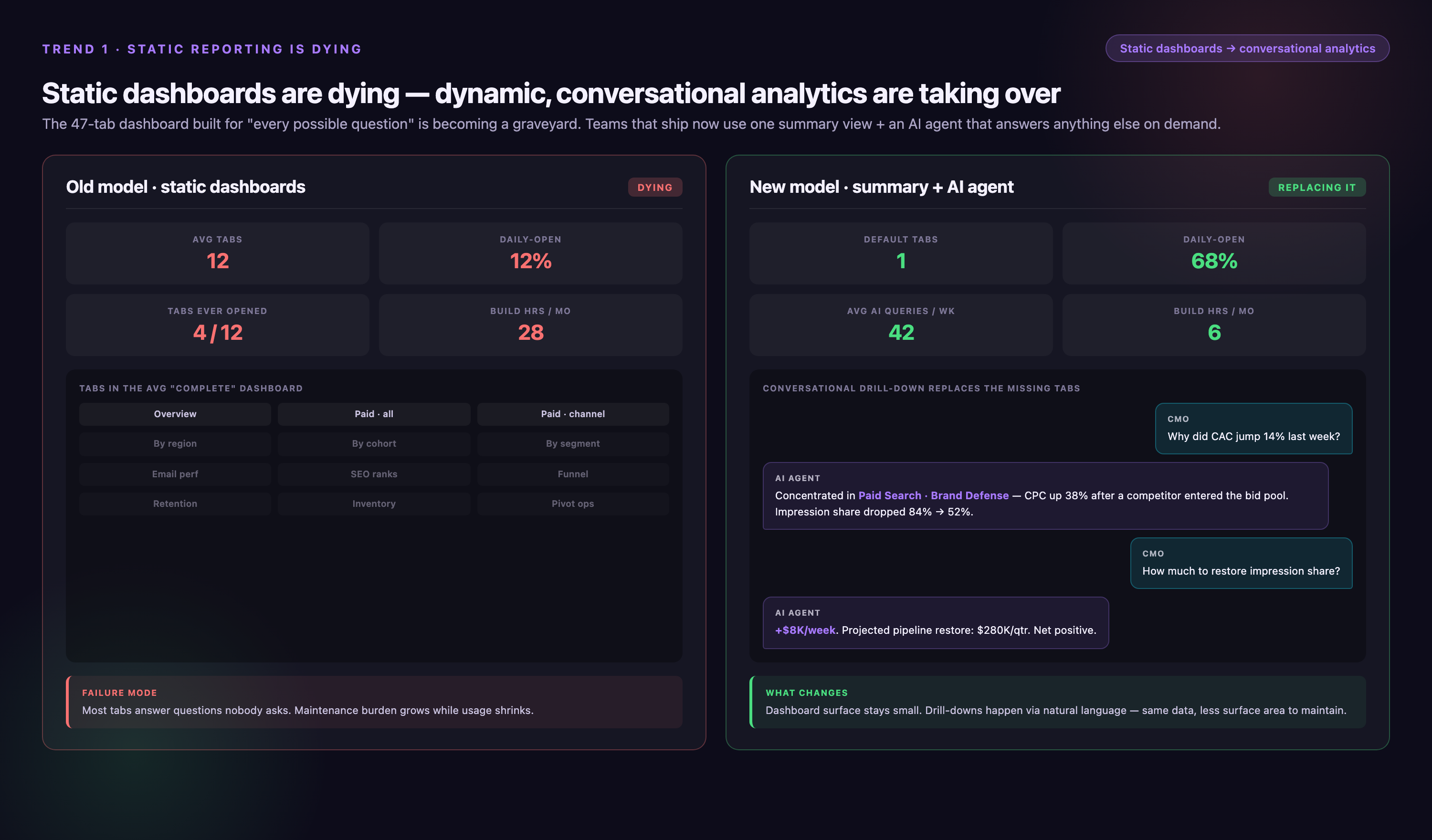
The shift happening now is structural. Stakeholders still want a clear, shared view of performance, but they no longer want to dig through layers of charts to figure out what changed. They want tools that react in real time, explain anomalies, surface drivers, and generate the specific view they need in the moment.
A dashboard has become the starting point, not the final product.
Instead of producing a dashboard for every angle of the business, teams use a few core dashboards, and get everything else on demand:
- performance snapshots,
- instant comparisons,
- contextual explanations,
- and AI-driven deep dives triggered by a single question.
It also solves a long-standing operational problem: dashboards go stale the moment something changes—a new campaign, a new structure, a new KPI. Dynamic insight layers reduce that maintenance burden dramatically. You don’t rebuild dashboards every time the business shifts; you let the system flex with the data.
The most important shift is that dashboards are no longer expected to explain performance. They provide the view, but the interpretation—the why, the meaning, and the next step—comes from real-time analysis and insight layers built on top of the dashboard.
“Instead of building dashboards for every granularity, you get ad-hoc snapshots with the insights you need in the moment. It’s not static anymore. You find the answer, move on, and pull a new snapshot the next time you need to dig deeper.”

Trend #2: Strong relationship management is among the few things AI can’t automate
Analytics is becoming increasingly automated, but one part of the work remains entirely human: getting people aligned. Before any report, dashboard, or AI agent can create value, teams must agree on what “success” actually means.
That alignment doesn’t happen inside a dashboard. It happens in conversations.
Marketing analytics teams now spend more time upfront defining the KPIs that matter, separating daily optimization metrics from real business objectives, and making sure every team understands how those numbers tie back to revenue. Without that shared understanding, teams default to whatever their platform shows them (impressions, CPMs, click volume), even when those numbers don’t move the business.
Teams—especially agencies—must act as advisors, mediators, and translators (even therapists)—spotting competing goals, surfacing misalignment early, and steering teams toward a unified definition of performance. It’s work that relies on trust, context, and interpersonal skills.
Acronym worked with a large company made up of “a trench coat of brands”: many individual products, product lines, and independently run operations. Each brand had its own marketing stack—dozens of separate Salesforce instances, some teams on Adobe Analytics, others on Google Analytics. The data was scattered, but the company wanted to operate as one organization while still allowing each brand to remain distinct.
The project required building a unified operating model that could streamline reporting, paid media optimization, and campaign management across all of these disconnected teams and tools. One of the biggest challenges was proving why this unification was worth the effort.
It became a long, ongoing project—not just technical, but coordination-first. Once the groundwork was in place, the value was clear: reduced wasted spend, fewer overlaps, better collaboration across teams, visibility into where brands were bidding against one another or targeting conflicting audiences, and a fully streamlined KPI model and campaign taxonomy flowing through all reporting and ways of working.

Trend #3: Data democratization is here, but data literacy matters more than ever
Modern analytics tools make data easier to access. Dashboards are simpler to navigate, metrics are standardized through semantic layers, and AI agents can explain performance in plain language. But greater access creates a new problem: everyone can see the data, yet not everyone knows how to interpret it.
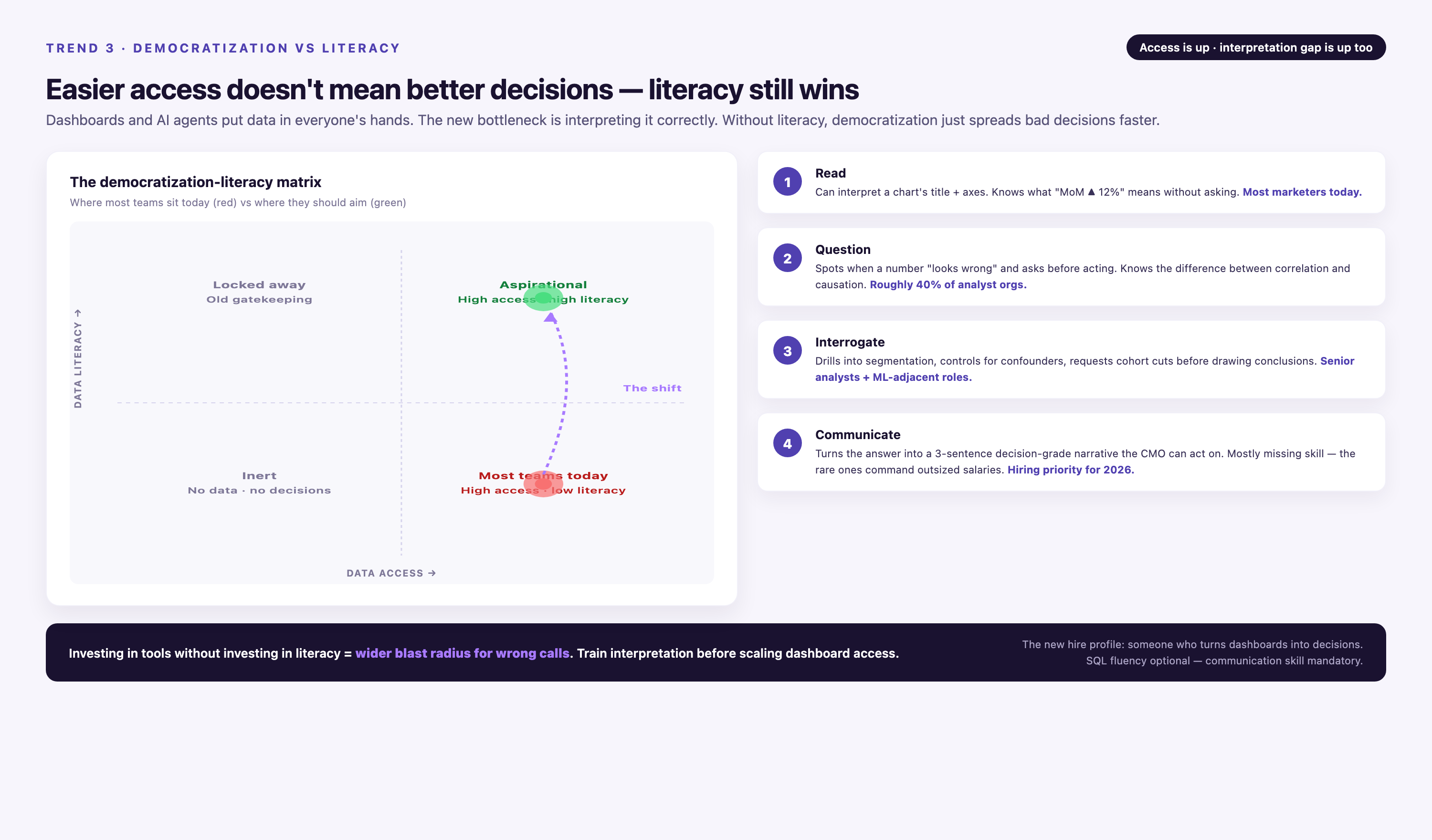
Teams often ask for something “clear and beautiful,” without recognizing that clarity means different things to different groups. A metric the media team cares about may mean little to finance or brand. When each stakeholder applies their own definitions and preferences, democratized data creates confusion instead of alignment.
AI lowers the barrier to working with data, but it raises the bar for understanding it. Teams must know how metrics influence one another, why they matter, and how they connect to business outcomes. Without that literacy, AI agents simply reinforce misunderstandings. They learn from user inputs; if prompts and feedback loops are misguided, the insights drift the same way.
Business users still need guidance on how to read the data, prioritize what matters, and avoid the trap of “everything is important.” AI can generate analysis, but only a data-literate team can judge whether that analysis is correct, relevant, or tied to business objectives.
“LLMs know everything, which means they know nothing. You have to laser-focus them on the things that are important to you. At Acronym, we build robust knowledge blocks about our clients—their operations, products, competitors, and goals. That context is what makes the agent’s insights relevant in media planning and deeper analysis.”
Trend #4: Critical thinking and effective communication are new hiring priorities
AI is automating the technical side of analytics so quickly that the value of human work is shifting. Skills that once set candidates apart—SQL fluency, ETL expertise, dashboard building—are no longer differentiators. Machines can generate queries, write boilerplate code, build first-pass dashboards, and surface anomalies in seconds.
What AI still can’t do is decide whether any of it makes sense.
Marketing analytics teams now hire for the skills that sit above execution:
- The ability to interpret results
- The ability to spot when something feels wrong
- The ability to question assumptions
- The ability to understand model bias
- The ability to communicate clearly (to both humans and AI systems)
- The ability to validate or contextualize machine output
This is the emerging reality: AI produces more, while humans must judge more.
For analytics roles, the work shifts from “write the query” to “verify the query, pressure-test the logic, and ensure the output aligns with business reality.” For engineering roles, it shifts from “build it” to “audit it, debug it, and understand where the model might fail.”
Reviewing AI-generated work requires sharper reasoning than producing it manually ever did.
It also raises the importance of communication. Business users have little patience for long explanations, so insights must be concise, trustworthy, and instantly actionable. Clear communication is becoming the interface between machine intelligence and human decision-making.
“I find intelligent responses are always needed and appreciated... if they're VERY 1) concise, 2) consistent, and 3) easily/quickly actionable. Violate those three rules, and we lose their trust, and clients tune out. Not easy to find staffers who can do that, though.”

Trend #5: Many want advanced AI analytics, but their data foundations aren’t ready yet
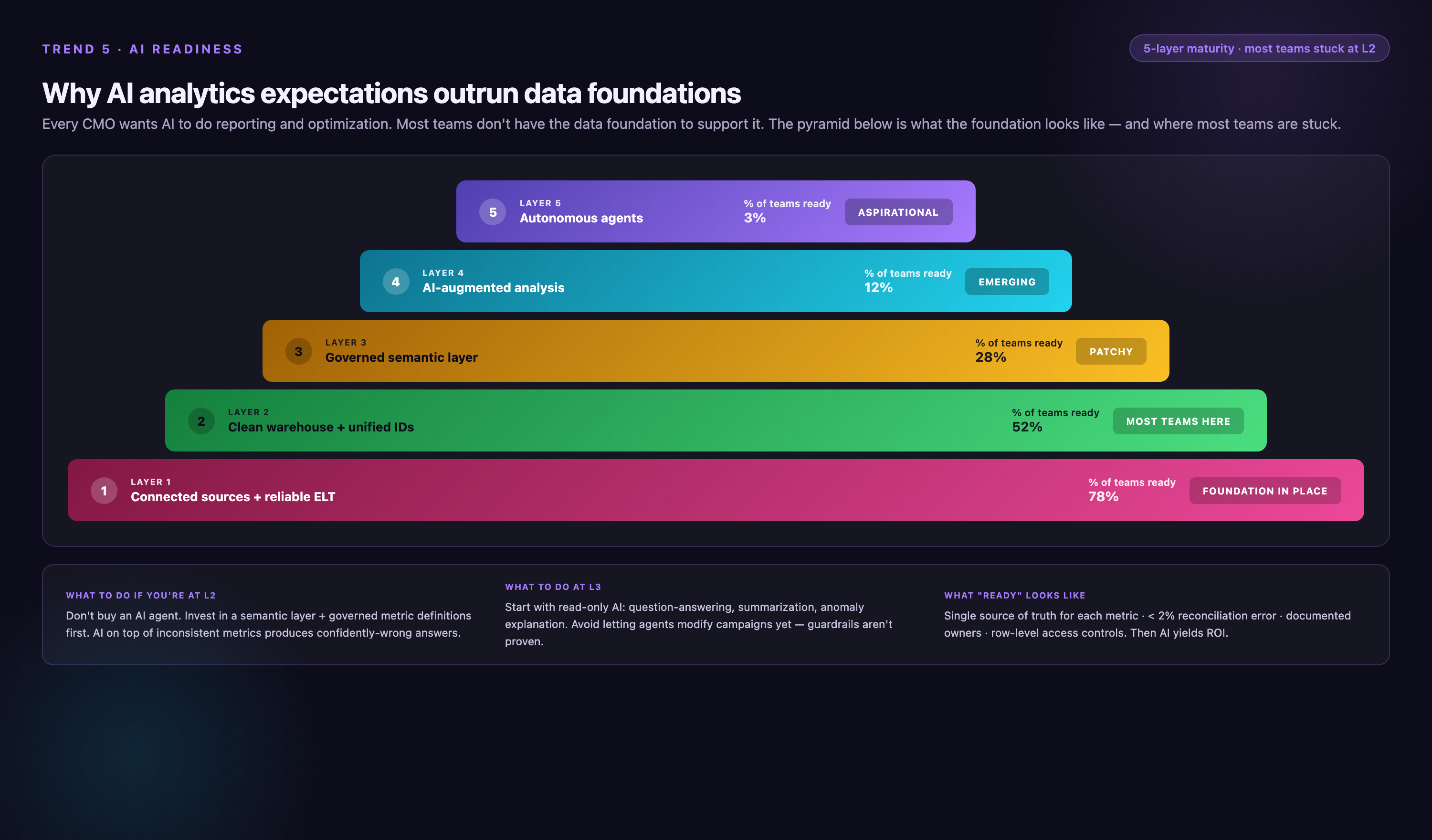
AI has raised expectations for marketing data. Business users want automated reporting, autonomous optimization, and intelligent agents that can run meaningful parts of their marketing programs. But none of that is possible without a strong data foundation—and most organizations aren’t there yet.
“Oftentimes, especially the higher you go, there’s less appreciation for what it actually takes to get there. I still run into clients who haven’t fully implemented consent management or the basic processes you need in place. There are steps you have to take to lay down that foundation. But we’re at a place where everybody wants transformation, like there’s almost an easy button.”
The missing pieces are usually the basics. The business context AI needs to make correct decisions often isn’t documented or aligned. Much of it lives in disconnected systems or, more commonly, in people’s heads.
Data fragility widens the gap. Performance numbers are increasingly modeled, attribution is less precise, cookies are fading, and opt-outs create blind spots. Teams could do far more with first-party data, but only once the groundwork is in place to support it.
Business users may want an “easy button,” but without a reliable foundation, advanced AI can’t deliver consistent outcomes. The unglamorous work—data hygiene, consistent structures, documented context—is what makes automation possible in the first place. Marketing analytics teams are the ones who must bridge that gap, setting expectations and guiding stakeholders through the foundational investments required for meaningful results.
“Right now, Improvado helps us make reporting and dashboarding the easiest thing we do with clients—it’s something that just happens. In the past, we needed dedicated resources extracting and transforming data. Now we can take those same team members and focus them on more advanced work like audience modeling, mix modeling, and deeper analysis with AI agents.”
Want better marketing analytics in 2026? Start preparing today
The throughline across all five trends is simple: AI isn’t replacing marketing teams, but teams that know how to work with AI will outperform those that don’t. Our roundup of marketing technology trends covers ten more shifts in MarTech beyond analytics.
Organizations that embrace dynamic insights, stronger data foundations, and a modern analytics skillset will move faster, uncover deeper context, and deliver more value. The greatest win is freeing teams from “data plumbing” so they can focus on the work that actually drives results:
Better strategy.Better insights.Better performance.If you’re looking to strengthen your analytics foundation or level up your AI capabilities in 2026, Improvado can help. Get your demo to see how modern data infrastructure and AI-powered analytics can accelerate your growth.