

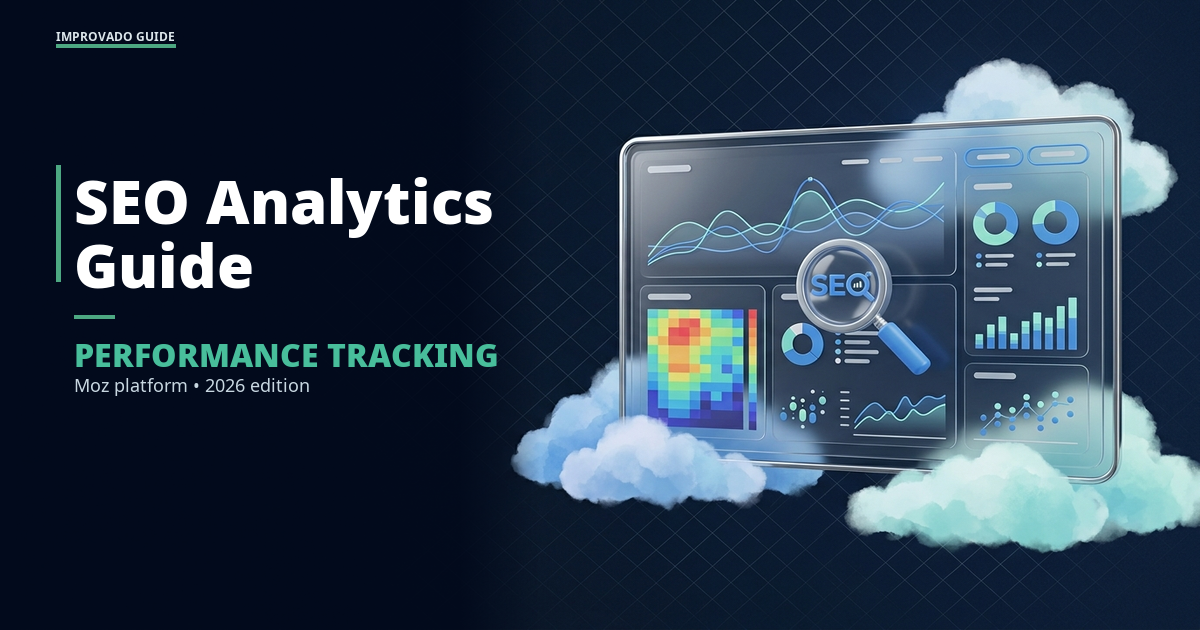
Moz analytics is the set of SEO tracking tools inside Moz Pro that report keyword rankings, backlink profiles, site-crawl health, and competitive research in one dashboard. Search analysts sometimes call it analytics Moz or look for it at analytics.moz.com; either way, it turns raw crawl data into rank, link, and traffic signals marketing teams can act on.
Moz analytics provides a suite of tools designed to track organic search performance — from keyword rankings and backlink profiles to on-page optimizations and competitive intelligence. For marketing data analysts, Moz Pro offers granular data that informs content strategy, technical SEO priorities, and resource allocation across channels.
This guide walks through everything you need to know about Moz analytics: how the platform works, which metrics matter most, how to set up tracking, and how to integrate Moz data into your broader marketing reporting infrastructure. By the end, you'll understand how to turn SEO signals into strategic decisions — and where automation can eliminate manual reporting work.
Key Takeaways
✓ Moz analytics tracks organic search performance through keyword rankings, backlink profiles, site audits, and competitive benchmarking across your SEO program.
✓ Domain Authority and Page Authority scores provide quick heuristics for link equity, though they're predictive metrics rather than direct ranking factors used by search engines.
✓ Rank tracking shows position changes over time, but interpreting movement requires context — seasonality, algorithm updates, and competitor actions all influence rankings.
✓ Link Explorer reveals which domains link to your site, anchor text distribution, and new/lost backlinks, giving you data to prioritize outreach and disavow toxic links.
✓ Integrating Moz data with CRM, analytics, and BI platforms unifies SEO metrics with revenue outcomes, enabling attribution models that connect organic rankings to pipeline.
✓ Manual CSV exports from Moz create reporting bottlenecks; automated connectors pull fresh data daily, eliminating spreadsheet maintenance and version-control issues.
What Is Moz Analytics and Why It Matters for Marketing Teams
Moz analytics refers to the data collection, tracking, and reporting tools inside Moz Pro — the company's flagship SEO software platform. It covers four main areas: keyword rank tracking, backlink analysis, site crawl audits, and competitive research. Marketing teams use Moz to answer questions like "Which keywords are we gaining or losing ground on?" "Who's linking to our competitors but not us?" and "What technical errors are blocking our pages from ranking?"
Unlike Google Analytics, which tracks user behavior after someone arrives on your site, Moz focuses on the before — visibility in search results, link equity, and crawlability. For data analysts, this makes Moz a critical upstream data source. Organic traffic in GA4 only tells you volume; Moz tells you why that volume moved. When rankings drop, Moz data shows whether you lost positions, competitors overtook you, or search demand shifted.
The platform operates through a combination of proprietary web crawlers (which index billions of URLs to build link graphs) and direct integrations with Google Search Console. Moz crawls the web to discover backlinks, then scores domains and pages using its Domain Authority (DA) and Page Authority (PA) metrics — logarithmic scores from 1 to 100 that predict ranking potential. While DA and PA aren't used by Google's algorithm, they correlate with actual ranking performance strongly enough to serve as shorthand for link equity.
For marketing operations teams managing dozens of campaigns across paid, organic, and content channels, Moz analytics provides the SEO layer. It answers attribution questions that tools like HubSpot or Salesforce can't: which blog posts drive qualified leads from search? Which competitor content consistently outranks ours? Where should we invest link-building budget to move the needle fastest? The next section breaks down the specific tools inside Moz Pro and what each one measures.
Core Moz Analytics Tools and What They Measure
Moz Pro bundles several analytics modules under one subscription. Each serves a distinct function in the SEO workflow. Understanding what each tool measures (and what it doesn't) prevents misinterpretation and helps you choose the right metric for the question you're answering. Together, they form a complete Moz website analysis: rankings, links, technical health, and keyword opportunity in one place.
Rank Tracker: Monitoring Keyword Position Over Time
Rank Tracker monitors where your pages appear in Google search results for a list of target keywords. You configure campaigns by domain, then add keywords you want to track. Moz checks rankings weekly (or on-demand for higher-tier plans) and logs historical data so you can see trends over months or years.
The tool reports absolute position (e.g., #4 on page one) and change since the last check (e.g., +3 positions). It also segments by search engine (Google, Bing, Yahoo), location, and device (desktop vs. mobile). For multi-location brands, this means you can track "plumber Chicago" rankings separately from "plumber Miami" even if they target the same root keyword.
Key Moz metrics in Rank Tracker include:
• Average rank — mean position across all tracked keywords
• Visibility score — weighted metric that accounts for both rank and search volume; a #1 ranking for a 10k-volume keyword contributes more than a #1 for a 100-volume keyword
• Share of voice — estimated percentage of clicks your domain captures vs. competitors for the same keyword set
• SERP feature tracking — flags when your pages appear in featured snippets, local packs, or image carousels
Rank Tracker doesn't measure traffic or conversions. A keyword can rank #1 but drive zero revenue if it attracts the wrong audience. Always cross-reference rank data with GA4 landing page reports to validate that movement correlates with business outcomes.
Link Explorer: Analyzing Backlink Profiles
Link Explorer maps the backlink landscape for any domain or URL. It shows which external sites link to you, the anchor text they use, the authority of linking domains, and whether links are followed or nofollowed. Moz's index updates continuously, so you can track new links gained and old links lost over time.
Core metrics in Link Explorer:
• Linking domains — total count of unique domains pointing to your site; more valuable than total link count because ten links from one domain carry less weight than one link each from ten domains
• Domain Authority (DA) — Moz's 1–100 score predicting a site's ranking strength; links from high-DA sites pass more equity
• Spam Score — 0–17% risk flag based on traits Moz associates with penalized sites; helps identify toxic backlinks to disavow
• Anchor text distribution — breakdown of keywords used in link text; over-optimized anchor text (e.g., 80% exact-match keywords) can trigger manual penalties
• Link type — editorial, UGC, sponsored, or other; Google treats these differently, and Moz flags them for context
Link Explorer also offers competitive analysis: enter a competitor's domain to see their backlink profile, then filter for links you don't have. This reveals outreach opportunities — sites that already link to similar content and might link to yours if you pitch them.
One limitation: Moz's link index is smaller than Ahrefs' or Majestic's. Expect to find 60–80% of the backlinks other tools report. For comprehensive audits, cross-reference Moz data with Google Search Console's Links report, which shows every link Google has discovered.
Site Crawl: Identifying Technical SEO Issues
Site Crawl is Moz's technical audit tool. It simulates how Googlebot crawls your website, then flags errors that block indexing or hurt rankings. You configure a crawl by domain, set a page limit (the Medium plan covers 2 million pages/month), and Moz runs weekly scans automatically.
The tool categorizes issues by severity:
• Errors — critical problems that prevent indexing (e.g., 404s, redirect chains, blocked resources)
• Warnings — issues that degrade performance but don't fully block crawling (e.g., slow load times, duplicate title tags, missing alt text)
• Notices — best-practice recommendations (e.g., meta descriptions over 160 characters, H1 tags used multiple times)
Site Crawl tracks metrics like crawl depth (how many clicks from the homepage to reach a page), internal link count, and HTTP status codes. It also visualizes your site architecture, showing which sections have too many orphaned pages or shallow link equity distribution.
For large sites, prioritize errors first. Fixing a redirect loop that affects 5,000 URLs delivers more impact than rewriting meta descriptions. Export the crawl report as CSV, then join it with GA4 landing page data to see which high-error pages also drive meaningful traffic — those warrant immediate attention.
Keyword Explorer: Research and Opportunity Analysis
Keyword Explorer helps you find new keywords to target. Enter a seed keyword, and Moz returns related terms along with search volume, difficulty score (0–100, indicating how hard it is to rank), and organic CTR estimates (percentage of searches that result in clicks rather than zero-click answers).
The tool segments keywords by intent — informational, navigational, transactional — and shows SERP analysis for each term: which domains currently rank, their DA scores, and how many backlinks those pages have. This reveals whether a keyword is realistically winnable given your site's authority.
Keyword Explorer also generates content ideas by clustering semantically related terms. If you're targeting "email marketing software," Moz surfaces adjacent queries like "email automation tools," "best email platforms for small business," and "MailChimp alternatives." You can export these clusters to build content briefs that cover the full semantic range Google expects.
One critical metric here: Priority Score. Moz combines search volume, difficulty, and CTR into a single 0–100 number that estimates overall opportunity. High-priority keywords have decent volume, manageable difficulty, and strong CTR potential. Use this to rank your content roadmap when you have more ideas than resources.
Step 1: Set Up Your Moz Campaigns and Define Tracking Scope
Before Moz can track anything, you need to configure campaigns — containers that define which domains, keywords, and competitors you're monitoring. Each campaign corresponds to one website or subdomain. If you manage multiple brands, you'll create separate campaigns for each.
Start by logging into Moz Pro and navigating to the Campaigns dashboard. Click "Add a Campaign" and enter your root domain (e.g., improvado.io). Moz automatically pulls basic site data from Google Search Console if you've verified ownership there. If not, you'll need to verify via DNS or HTML file upload.
Next, define your keyword list. Moz prompts you to add 5–10 seed keywords to start. These should represent your core business terms — the phrases that drive the majority of your organic traffic. For a marketing analytics platform, that might include "marketing data pipeline," "ad spend tracking," and "attribution modeling." You can expand the list later; most plans allow 150–300 tracked keywords depending on tier.
Set tracking preferences: choose search engines (Google is the default, but Bing and Yahoo are options), geographic location (country and city), and device type (desktop, mobile, or both). If your audience is local, pin rankings to specific metro areas. If you're global, consider creating multiple campaigns segmented by region to avoid conflating US rankings with EU rankings.
Add competitors. Moz allows you to track up to three competitor domains per campaign. Enter their root domains, and Moz will benchmark your performance against theirs — comparing DA scores, keyword overlap, and backlink growth. Choose competitors carefully: pick brands that target the same audience and rank for the same keywords, not just anyone in your industry.
Finally, configure crawl settings in Site Crawl. Set a max crawl depth (how many clicks from the homepage Moz should follow), define URL patterns to exclude (e.g., staging subdomains, paginated archives), and enable JavaScript rendering if your site relies on client-side frameworks like React. Moz's crawler handles JS better than older tools, but it's not perfect — test with a small crawl first to ensure dynamic content renders correctly.
Save the campaign. Moz runs an initial crawl and rank check within 24 hours. You'll receive a summary email once baseline data is ready. From there, updates occur weekly unless you manually trigger on-demand refreshes.
Step 2: Track Keyword Rankings and Interpret Movement
Once your campaign is live, Rank Tracker begins logging keyword positions weekly. The dashboard displays each keyword's current rank, change since last check, and historical trend line. Green arrows indicate upward movement; red arrows indicate drops.
To make sense of this data, filter by rank ranges. Start with keywords ranking #4–#10 — these are on the cusp of page-one dominance and represent the highest ROI opportunities. Small optimizations (better internal linking, updated content, a few quality backlinks) can push them into top-three positions, which capture the majority of clicks.
Next, review keywords that dropped significantly (e.g., -5 positions or more in one week). Check the SERP feature column: if Google added a featured snippet or local pack for that query, your organic result may have been pushed down even if your absolute ranking didn't change. Context matters. A drop from #3 to #8 is alarming; a drop from #3 to #4 because a new featured snippet appeared is less urgent.
Compare movement across keyword groups. If all branded keywords dropped, you might have a technical issue (site downtime, crawl block, penalty). If one topic cluster dropped while others stayed flat, a competitor likely published stronger content or earned authoritative backlinks. Use Link Explorer to investigate: did a rival gain high-DA links pointing to pages that compete with yours?
Track share of voice over time. Moz calculates this by weighting your rankings against search volume for each keyword. A rising share of voice means you're capturing more total search demand, even if individual keyword ranks fluctuate. This metric smooths out noise and reveals whether your overall SEO trajectory is upward.
Export rank data as CSV weekly and join it with GA4 landing page performance. Match each tracked keyword to its target URL, then compare rank position against sessions, bounce rate, and conversions. Some keywords rank well but convert poorly; others rank modestly but drive high-intent traffic. This analysis tells you where to double down and where to deprioritize.
Step 3: Analyze Backlink Profiles and Prioritize Link-Building
Backlinks remain one of the strongest ranking signals. Link Explorer shows you which sites link to yours, but raw link count is a vanity metric. What matters is the quality, relevance, and diversity of linking domains.
Start by reviewing your top linking domains. Sort by Domain Authority to surface the most valuable links. A single link from a DA 80 news site carries more weight than fifty links from DA 20 directories. Audit these links for relevance: does the linking site cover topics related to yours? A backlink from a marketing blog to a marketing analytics platform is strong; a backlink from a recipe blog is not.
Check anchor text distribution. Healthy backlink profiles have varied anchor text: some exact-match keywords, some branded terms, some generic phrases like "click here" or "learn more." If more than 30% of your anchors are exact-match commercial keywords (e.g., "best marketing analytics software"), you risk triggering a manual review. Diversify by earning editorial links that use natural language.
Identify toxic links using Spam Score. Filter for links with scores above 10%. Review these manually — some are harmless (e.g., outdated directories), but others come from link farms or hacked sites. Export the toxic list and submit it to Google via the Disavow Tool to prevent penalties.
Run competitive backlink analysis. Enter a competitor's domain in Link Explorer, then filter for links they have that you don't. Sort by DA to find the highest-value opportunities. If three competitors all have links from the same industry publication, that's a strong outreach target. Draft a pitch explaining why your content deserves coverage, then follow up persistently.
Track new and lost links weekly. Moz flags recently discovered backlinks and links that disappeared (either removed by the site owner or the page went offline). Celebrate new links from authoritative domains; investigate lost links if they came from high-DA sources. Sometimes a site redesign breaks backlinks; other times, a competitor negotiates removal. Reach out to site owners to restore lost links when possible.
Set up link alerts. Moz emails you when your site gains backlinks from domains above a DA threshold you specify (e.g., DA 50+). This lets you thank link providers, build relationships, and monitor whether PR campaigns or content marketing efforts are generating link equity as expected.
Step 4: Run Site Crawls and Fix High-Impact Technical Issues
Technical SEO issues block even great content from ranking. Site Crawl surfaces these problems automatically, but fixing everything at once is overwhelming. Prioritize by impact: errors first, warnings second, notices last.
Start with 4xx and 5xx errors. These are pages that return "not found" or "server error" responses. If Moz discovers 100 404 pages, export the list and cross-reference it with GA4 landing page traffic. Fix 404s that historically drove traffic by implementing 301 redirects to relevant replacement pages. Ignore 404s with zero historical traffic unless they're important for site architecture (e.g., category pages linked from navigation).
Review redirect chains. A chain occurs when URL A redirects to URL B, which redirects to URL C. Search engines may not follow chains beyond two hops, and each redirect dilutes link equity slightly. Consolidate chains into direct redirects: A → C.
Check for duplicate content. Moz flags pages with identical or near-identical title tags, meta descriptions, or body content. Duplicate content confuses search engines about which version to rank. Resolve duplicates by canonicalizing (using rel=canonical tags to point all versions to one authoritative URL), noindexing non-essential pages, or consolidating similar pages into one comprehensive resource.
Audit page speed. Site Crawl reports load times for each URL. Pages that take longer than three seconds to load suffer ranking penalties, especially on mobile. Export slow pages and pass them to your dev team with recommendations: compress images, minify JavaScript, enable browser caching, or migrate to a faster hosting provider.
Fix missing or duplicate H1 tags. Every page should have exactly one H1 tag that describes the page's primary topic. Moz flags pages with zero H1s or multiple H1s. Update templates to enforce single H1s site-wide.
Review internal linking. Moz's site architecture visualization shows how link equity flows through your site. Orphaned pages (those with no internal links pointing to them) won't rank well because search engines can't discover them easily. Add internal links from related content to surface orphaned pages. Likewise, identify pages with hundreds of internal links pointing to them — these are your strongest pages and should be leveraged to pass equity to newer content.
Re-crawl after fixes. Make a batch of corrections, then trigger a manual crawl in Moz to verify that errors are resolved. Track error count over time: a healthy site shows a downward trend as you systematically address issues.
Step 5: Use Keyword Explorer to Research Content Opportunities
Rank Tracker shows how existing content performs; Keyword Explorer shows what content you should create. Use it to discover keywords your competitors rank for but you don't, find semantic clusters to expand existing articles, and validate content ideas before investing in production.
Start with seed keywords. Enter a broad term related to your business (e.g., "marketing attribution"). Keyword Explorer returns hundreds of related queries along with volume, difficulty, and CTR estimates. Sort by Priority Score to surface high-opportunity keywords — those with decent volume, manageable competition, and strong click-through potential.
Analyze the SERP for each keyword. Moz shows which domains currently rank, their DA scores, and how many backlinks they have. If the top-ten results all have DA 70+ and 500+ referring domains, ranking will require significant investment. If the top ten include DA 40 sites with 50 backlinks, you have a realistic shot.
Look at SERP features. If Google shows a featured snippet, image pack, or video carousel for a keyword, your organic listing competes for attention with those features. Keywords dominated by featured snippets may have lower CTR even if you rank #1. Conversely, winning the featured snippet can deliver traffic from positions #2–5.
Export keyword clusters. Moz groups semantically related keywords automatically. If you're writing about "data integration," Moz might cluster "ETL tools," "data pipeline," and "API connectors" together. Build content briefs that cover the entire cluster to signal topical authority to search engines.
Validate existing content gaps. Export your current keyword rankings from Rank Tracker, then upload the list to Keyword Explorer. Moz highlights keywords your competitors rank for that you don't. These are content gaps. Prioritize gaps where you have existing pages that could rank with optimization, rather than gaps requiring net-new content.
Use the "Questions" filter to find long-tail queries. Moz surfaces question-based keywords (e.g., "what is marketing attribution?") that map to informational search intent. These are ideal for blog content, FAQ sections, and featured snippet optimization. Answer these questions directly in your content with clear, concise definitions in the opening paragraph.
Step 6: Integrate Moz Data with Your Marketing Analytics Stack
Moz analytics is most valuable when it sits alongside CRM, ad platform, and web analytics data. Isolated, Moz tells you about rankings and backlinks. Integrated, it connects SEO performance to pipeline, revenue, and customer acquisition cost.
The simplest integration is manual: export Moz reports as CSV weekly, then join them with GA4 and Salesforce data in Google Sheets or Excel. Match keywords to landing page URLs, then append conversion and revenue data from your CRM. This shows which keywords drive not just traffic, but qualified traffic that converts.
The problem with manual exports is maintenance. CSV schemas change when Moz updates its API. Team members forget to pull reports on schedule. Version control becomes a nightmare when multiple analysts work in the same spreadsheet. Within months, your "automated" reporting workflow requires daily babysitting.
Automated data pipelines solve this. Tools that connect Moz's API to your data warehouse pull fresh data daily without human intervention. They handle schema changes, retry failed requests, and log every transformation for auditability. Once the pipeline is live, your BI dashboards always reflect current rankings, backlink counts, and site health metrics.
Common integration patterns include:
• Moz + GA4 + BigQuery — join keyword rankings with landing page sessions and conversions to calculate cost-per-acquisition by keyword
• Moz + HubSpot — append keyword data to contact records so sales teams see which organic search terms brought each lead into the funnel
• Moz + Salesforce — attribute closed-won revenue to specific keywords by linking landing page URLs to opportunity sources
• Moz + Looker/Tableau — build executive dashboards that show organic visibility trends alongside paid media spend and email performance
APIs introduce complexity. Moz's API requires authentication, rate-limit handling, and pagination logic for large datasets. If your engineering team lacks bandwidth to build and maintain connectors, consider platforms that offer pre-built integrations. Improvado, for example, connects Moz alongside 1,000+ other marketing data sources, automatically normalizing schemas and handling API changes so your pipeline never breaks.
- →Analysts spend 10+ hours per week manually exporting Moz CSVs and joining them with GA4 in spreadsheets
- →Rank tracking reports are outdated by the time stakeholders see them because refresh cycles lag by days
- →You can't connect keyword rankings to revenue because Moz data lives separately from Salesforce opportunity data
- →Schema changes in Moz's API break your custom scripts every quarter, requiring dev time to fix
- →Executive dashboards show paid performance but exclude organic visibility, making true ROI impossible to calculate
Step 7: Build SEO Performance Dashboards That Drive Decisions
Once Moz data flows into your warehouse or BI tool, build dashboards that answer the questions your stakeholders actually ask. Generic SEO reports (keyword count, total backlinks) don't drive action. Decision-focused dashboards do.
Start with an executive summary dashboard. Include:
• Organic visibility trend — Moz's share-of-voice metric over 12 months
• Top-10 keyword count — how many keywords rank in positions 1–10
• New backlinks (30 days) — total linking domains added this month
• Critical errors — count of errors flagged in Site Crawl that block indexing
• Organic traffic — sessions from Google Search (from GA4) plotted alongside visibility
This dashboard should load in under three seconds and fit on one screen. Executives don't scroll.
Build a keyword performance dashboard for content teams. Include:
• Keyword rank distribution — bar chart showing how many keywords rank in positions 1–3, 4–10, 11–20, etc.
• Biggest movers (up) — keywords that gained 5+ positions this week with target URLs
• Biggest movers (down) — keywords that lost 5+ positions with links to investigate competitors
• Opportunity keywords — keywords ranking #4–#10 with high search volume, sorted by potential traffic gain
Content teams use this to prioritize updates. A keyword on page two (#11–20) needs a content refresh, better internal links, or a targeted backlink campaign to break onto page one.
Create a link-building dashboard for outreach teams:
• Linking domains (trend) — monthly new linking domains vs. lost linking domains
• Top linking domains — table of highest-DA sites linking to you
• Competitor gap — domains linking to competitors but not you, sorted by DA
• Toxic backlinks — count of links with Spam Score >10% awaiting disavow
This dashboard guides outreach: who to pitch, which links to replicate, and which toxic links to clean up.
For technical SEO, build a site health dashboard:
• Critical errors (trend) — line chart showing errors over time; downward = good
• Crawl depth distribution — histogram of how many pages sit at each click depth from the homepage
• Page speed percentiles — P50, P90, P99 load times for key landing pages
• Indexation status — pages crawled vs. pages indexed (from Google Search Console) to spot index bloat
Dev teams use this to prioritize fixes. If critical errors spike after a deploy, roll back immediately.
Common Mistakes to Avoid When Using Moz Analytics
Even experienced analysts make errors interpreting Moz data. Here are the most frequent missteps and how to avoid them.
Obsessing Over Domain Authority as a Success Metric
Domain Authority is a useful heuristic for link equity, but it's not a ranking factor. Google doesn't use DA in its algorithm. A 10-point DA increase doesn't guarantee ranking gains. Worse, DA is relative: if your DA rises from 40 to 45 but competitors rise from 50 to 60, you're losing ground.
Instead, track metrics that correlate directly with business outcomes: keyword rankings in the top three positions, organic traffic to high-intent landing pages, and conversion rate from organic sessions. DA is context — not a goal.
Ignoring Search Intent When Analyzing Keyword Performance
A keyword can rank #1 and drive zero conversions if it mismatches user intent. "Salesforce" has massive search volume, but most searchers want to log into the CRM, not read about it. If you rank for that term on a blog post, traffic will bounce.
Always cross-reference Moz keyword data with GA4 behavior metrics. High rankings + low time-on-page + high bounce rate = wrong intent. Either optimize the page for a different keyword that matches its content, or accept that the keyword isn't valuable despite its volume.
Neglecting Mobile Rankings in a Mobile-First Index
Google's index is mobile-first: it ranks pages based on their mobile versions. If your Moz campaign only tracks desktop rankings, you're missing the full picture. Set up parallel tracking for mobile, especially for local and e-commerce keywords where mobile traffic dominates.
Compare desktop vs. mobile ranks for each keyword. Discrepancies signal mobile usability issues: slow load times, unresponsive design, or pop-ups that block content on small screens.
Treating Spam Score as an Absolute Judgment
Spam Score is a predictive model, not a Google penalty list. A link with a 15% Spam Score isn't automatically toxic — it just shares traits with sites Google has penalized in the past. Review flagged links manually before disavowing. Legitimate local directories, old forums, and niche blogs often trigger false positives.
Only disavow links from obvious spam: link farms, hacked sites, or domains with no editorial content. Over-disavowing can hurt more than help by removing legitimate link equity.
Running Site Crawls Without Actually Fixing Issues
Site Crawl identifies hundreds of errors, but many teams review the report and do nothing. Errors accumulate faster than fixes, and the problem compounds. Assign ownership: one person owns technical SEO and is accountable for reducing error count month-over-month.
Break fixes into sprints. Target 20–50 errors per week. Track progress on a dashboard so stakeholders see the trend line moving downward. Celebrate milestones: zero critical errors is a win.
Comparing Moz Data Directly to Other Tools Without Adjusting for Index Differences
Moz's link index is different from Ahrefs', which is different from Semrush's. You'll see different backlink counts, DA equivalents, and keyword volumes across platforms. This doesn't mean one tool is wrong — they crawl different slices of the web.
Pick one tool as your source of truth for longitudinal tracking. Use others for cross-validation and discovery, but don't panic when numbers don't match. What matters is the trend within a single tool over time, not absolute parity across tools.
Tools That Help with Moz Analytics Integration and Reporting
Moz Pro provides the data, but turning that data into insights requires additional infrastructure. Here are tools that complement Moz for different use cases, from manual reporting to fully automated pipelines.
Improvado: Automated Marketing Data Integration
Improvado connects Moz alongside 1,000+ marketing data sources — ad platforms, CRMs, analytics tools — into a unified data warehouse. It pulls fresh data daily, normalizes schemas automatically, and handles API changes without manual intervention. For teams managing SEO alongside paid, email, and social campaigns, Improvado eliminates the spreadsheet layer entirely.
Key capabilities include pre-built Moz connectors (no coding required), custom data transformations to join SEO metrics with revenue data, and out-of-the-box dashboards for Looker, Tableau, and Power BI. Implementation typically takes days, not months. Marketing operations teams use Improvado to build attribution models that connect keyword rankings to closed-won revenue, calculate true cost-per-acquisition for organic channels, and automate executive reporting.
Improvado is ideal for mid-market and enterprise B2B companies running complex, multi-channel campaigns where SEO is one piece of a larger attribution puzzle. It's not designed for small businesses managing only one or two data sources.
| Tool | Best For | Integration Complexity | Pricing Model |
|---|---|---|---|
| Improvado | Enterprise marketing teams needing unified cross-channel reporting with SEO + paid + CRM data | No-code setup; operational in days | Custom pricing |
| Google Data Studio | Small teams with basic reporting needs; free but requires manual connector setup | Medium; requires Google Sheets add-ons or API scripting | Free |
| Supermetrics | Mid-market teams pulling Moz into Google Sheets or BigQuery; strong for ad platform data | Low; pre-built connectors, limited transformation logic | $99–$1,200/month |
| Fivetran | Engineering teams building custom data warehouses; handles Moz + 100s of sources | High; requires data engineering resources | Volume-based, starts ~$1,500/month |
| Looker Studio | Visualization layer on top of BigQuery or other warehouses; pairs well with Improvado or Fivetran | Medium; requires SQL knowledge for custom queries | Free (Pro version available) |
Google Data Studio / Looker Studio
Google's free visualization tool connects to BigQuery, Google Sheets, and some third-party APIs via connectors. For Moz, you'll need a workaround: export Moz data to Google Sheets using a Sheets add-on or Zapier, then connect Data Studio to that sheet. It's clunky but works for small teams with limited budgets.
Limitations: manual refresh cycles, no data transformation logic, and connectors break when Moz updates its API. Best for proof-of-concept dashboards, not production reporting.
Supermetrics
Supermetrics offers a pre-built Moz connector that pulls data into Google Sheets, BigQuery, or Snowflake. It's cheaper than enterprise platforms and easier than coding your own API integration. However, transformation capabilities are limited — you get raw Moz data, but joining it with Salesforce or HubSpot requires manual SQL or Sheets formulas.
Good for mid-market teams that need Moz in their warehouse but don't require complex transformations or real-time syncs.
Fivetran
Fivetran is an ELT platform that replicates Moz data (and 200+ other sources) into your data warehouse. It's more technical than Improvado — you're responsible for data modeling, transformation, and dashboard design. But it's also more flexible: you control the entire pipeline and can customize it for edge cases.
Best for companies with dedicated data engineering teams who want full ownership of the data stack. Not ideal for marketing ops teams that need turnkey solutions.
How Improvado Simplifies Moz Analytics at Scale
For marketing teams managing Moz data alongside dozens of other sources, manual reporting becomes the bottleneck. Improvado eliminates that bottleneck by automating the entire pipeline — from extraction to transformation to loading into your BI tool of choice.
Improvado's Moz connector pulls rank tracking, backlink profiles, and site crawl data daily. It normalizes inconsistent schemas (e.g., Moz calls a metric "Domain Authority" while Ahrefs calls it "Domain Rating") so you can compare apples to apples across platforms. It also enriches SEO data with context from Google Ads, Facebook, Salesforce, and HubSpot, enabling attribution models that connect keyword rankings to revenue.
The platform includes pre-built marketing data models tailored to common use cases: multi-touch attribution, campaign ROI analysis, and executive dashboards. You don't start from a blank BigQuery table — you start with 80% of the work done, then customize for your business logic.
Implementation is fast. Most customers are operational within a week. Improvado's team handles connector configuration, schema mapping, and initial dashboard builds as part of onboarding — no six-month professional services engagements.
For marketing operations leaders tired of spreadsheet hell, Improvado turns Moz from a reporting burden into a strategic asset. Your team stops babysitting CSV exports and starts answering the questions that drive growth: which content investments deliver ROI? Where should we allocate link-building budget? How does organic performance trend against paid acquisition cost?
Conclusion
Moz analytics gives marketing teams the data they need to prioritize SEO investments intelligently. Rank Tracker shows which keywords move the needle. Link Explorer reveals where to focus outreach. Site Crawl flags the technical issues blocking rankings. Keyword Explorer uncovers content opportunities your competitors haven't capitalized on yet.
But data in a silo doesn't drive decisions. The real value emerges when you integrate Moz with your broader marketing stack — joining rankings with conversions, backlinks with pipeline, and crawl errors with page speed from real-user monitoring. That integration layer determines whether SEO data becomes a strategic lever or just another report no one reads.
The best teams automate this layer entirely. They don't waste analyst time on CSV exports and manual joins. They build pipelines that update dashboards daily, alert stakeholders when critical metrics shift, and connect every keyword ranking back to revenue. That's how SEO analytics becomes a growth engine instead of a compliance checkbox.
Frequently Asked Questions
What is Moz analytics and how does it differ from Google Analytics?
Moz analytics refers to the SEO tracking and reporting tools inside Moz Pro, including rank tracking, backlink analysis, site crawls, and keyword research. Unlike Google Analytics, which measures user behavior after someone reaches your site, Moz focuses on visibility before the click — where you rank in search results, which sites link to you, and what technical issues might block indexing. GA4 tells you how much traffic you received; Moz tells you why that traffic moved up or down. For complete performance insight, you need both: Moz for search visibility and GA4 for on-site behavior and conversions.
How often should I run Moz site crawls to catch technical SEO issues?
Weekly crawls are standard for most sites. Moz automates this by default when you create a campaign. If you run frequent deploys or manage a large e-commerce catalog with regular inventory changes, consider triggering manual crawls after major releases to catch issues immediately. For static sites that rarely change, bi-weekly crawls suffice. The key is consistency: tracking error count over time reveals whether your site health is improving or degrading. After fixing a batch of issues, run an on-demand crawl to validate that errors cleared — don't wait a full week to confirm the fixes worked.
Can Moz track rankings for local SEO and multi-location businesses?
Yes. When setting up a Rank Tracker campaign, you can specify city-level tracking for keywords. This is critical for multi-location businesses where "plumber" ranks differently in Seattle vs. Miami. Create separate campaigns for each location, or use Moz Local (a separate product) for comprehensive local SEO management including Google Business Profile monitoring, citation tracking, and review management. Standard Moz Pro campaigns track organic rankings in the location you specify, but they don't monitor map pack visibility or local citation consistency — those require Moz Local or manual audits.
What is a good Domain Authority score and how quickly can I improve it?
Domain Authority is relative, not absolute. A DA of 40 is strong for a new startup but weak for an established media brand. Compare your DA against direct competitors, not against Wikipedia (DA 94) or Forbes (DA 92). Improving DA requires earning high-quality backlinks from authoritative domains over time. Expect months, not weeks — DA rises as you consistently publish valuable content that attracts editorial links, build relationships with journalists and bloggers, and fix technical issues that make your site crawlable. Chasing quick DA gains through link schemes will backfire: Google penalizes manipulative link building, and Moz's algorithm eventually catches spammy link patterns too.
How do I integrate Moz data with Google Analytics and my CRM?
Integration methods range from manual to fully automated. The simplest approach: export Moz keyword rankings as CSV weekly, then join them with GA4 landing page data and CRM opportunity sources in Google Sheets. This works for small teams but breaks down at scale due to version control and schema changes. The scalable approach: use a data integration platform like Improvado, Fivetran, or Supermetrics to pull Moz data into your data warehouse (BigQuery, Snowflake, Redshift) daily. From there, join Moz tables with GA4 exports and Salesforce tables using SQL, then build dashboards in Looker, Tableau, or Power BI. Automated pipelines eliminate manual work and ensure your dashboards always reflect current data.
Does Moz analytics track competitor performance automatically?
Partially. When you add competitor domains to your Rank Tracker campaign, Moz benchmarks their rankings for your tracked keywords, shows their DA scores, and alerts you when they gain or lose positions. However, Moz doesn't automatically discover new competitors — you define the competitor list manually. For broader competitive intelligence, use Link Explorer to analyze any competitor's backlink profile on demand: see which domains link to them, what anchor text they use, and identify link-building opportunities they've captured that you haven't. This manual analysis is more flexible than automated tracking but requires active effort each time you want updated insights.
What should I do if my keyword rankings drop suddenly in Moz?
First, check whether the drop is real or a data anomaly. Verify rankings manually using an incognito browser window in the target location. If the drop is confirmed, investigate four areas: (1) Google algorithm updates — check SEO news sites for reports of ranking volatility that week; (2) SERP feature changes — did Google add a featured snippet or local pack that pushed organic results down?; (3) competitor actions — use Link Explorer to see if a rival earned high-DA backlinks recently; (4) technical issues — run an on-demand Site Crawl to check for new errors, server downtime, or crawl blocks introduced by recent code changes. If rankings dropped across many keywords simultaneously, suspect a technical or penalty issue. If only one or two keywords moved, it's likely competitive displacement or content freshness.