

Marketing teams today face a paradox: demand for output grows exponentially while headcount stays flat or shrinks. The result is a structure problem: roles blur, priorities conflict, and the team drowns in execution instead of strategy.
This isn't a hiring problem. It's an architecture problem. The way you structure your marketing team determines whether you scale efficiently or collapse under complexity. Get it right and a team of six operates like twelve. Get it wrong and adding headcount only creates more chaos.
This guide breaks down exactly how to structure a marketing team that scales: from first hire to 50+ people. You'll see proven org models, role definitions that eliminate overlap, and decision frameworks for when to specialize versus consolidate. Every section includes real-world examples of what works and what breaks at each growth stage.
Key Takeaways
✓ Marketing team structures must evolve through three distinct phases: founder-led (0-2 people), specialist (3-15 people), and pod-based (15+ people), each requiring different org models and decision-making frameworks.
✓ The specialist transition point (typically 5-7 headcount) is where most teams break: generalists become bottlenecks, and adding more generalists only creates coordination overhead instead of output gains.
✓ Role clarity matters more than titles, overlapping responsibilities between content, product marketing, and demand gen create 3-5 hours per week of duplicated work per person, compounding as the team grows.
✓ Data infrastructure determines team velocity. Teams spending 15–25% or more of their time on manual reporting, data pulls, or spreadsheet reconciliation are structurally constrained, not under-resourced.
✓ Pod structures (campaign pods, channel pods, or product pods) scale efficiently past 15 people by creating autonomous units with clear metrics, but require centralized data and ops layers to prevent fragmentation.
✓ Hiring order matters more than speed. The wrong second or third hire creates technical debt that takes two years and three additional hires to unwind, particularly in analytics and operations roles.
✓ Marketing operations isn't overhead. It's the function that makes everyone else 2-3x more productive by eliminating manual work, standardizing processes, and maintaining the data infrastructure that powers decision-making.
✓ Cross-functional dependencies (sales handoff, product launches, customer marketing) fail without explicit ownership, most structural problems trace back to unclear accountability at team boundaries rather than individual performance issues.
Why Traditional Marketing Structures Break
The traditional marketing department org chart: CMO at the top, directors in the middle, specialists at the bottom. It was designed for a world where campaigns launched quarterly and attribution meant counting form fills. That world no longer exists.
Modern marketing operates across dozens of channels simultaneously. A single campaign touches paid media, organic content, email sequences, retargeting flows, sales enablement, and customer advocacy. The traditional structure assumes each function operates independently. In reality, every initiative requires coordination across five to seven people.
The coordination tax becomes unbearable around 10-12 headcount. Slack messages multiply. Meetings stack. The team ships less despite having more people. This is the point where most VPs of Marketing realize they need a different model.
The Generalist Bottleneck
Early-stage marketing teams default to generalists. People who can write copy, run ads, build landing pages, and analyze performance. This works brilliantly from zero to three people. The problem emerges at hire four and five.
Two generalists collaborate naturally. Four generalists create overlap. Six generalists spend more time negotiating who owns what than executing. The instinct is to hire a manager to coordinate. But adding management overhead before specializing roles just creates a new bottleneck.
The better move: specialize before you manage. Convert two generalists into a content specialist and a paid media specialist. Let them own their domains completely. Add management only after you have 5-7 specialized roles that need coordination.
The Data Infrastructure Gap
Marketing teams treat data infrastructure as an IT problem. It's not. It's a structural dependency that determines whether your team operates at 40% capacity or 90% capacity.
Without centralized data infrastructure, every campaign requires manual pulls from six platforms. Every weekly report takes four hours to compile. Every attribution question becomes a three-day spreadsheet project. The team spends a significant share of their time on data plumbing instead of marketing. In our experience, often 15–25% or more, according to HubSpot's State of Marketing.
This isn't a tools problem. You already have Google Analytics, your CRM, your ad platforms. The problem is integration, connecting those tools so data flows automatically instead of requiring manual ETL (or ELT) cycles every time someone needs an answer.
Three Structural Models That Scale
Marketing team structures evolve through predictable phases. Each phase requires a different org model, different role definitions, and different decision-making frameworks. Trying to skip phases or apply a later-stage model too early creates dysfunction.
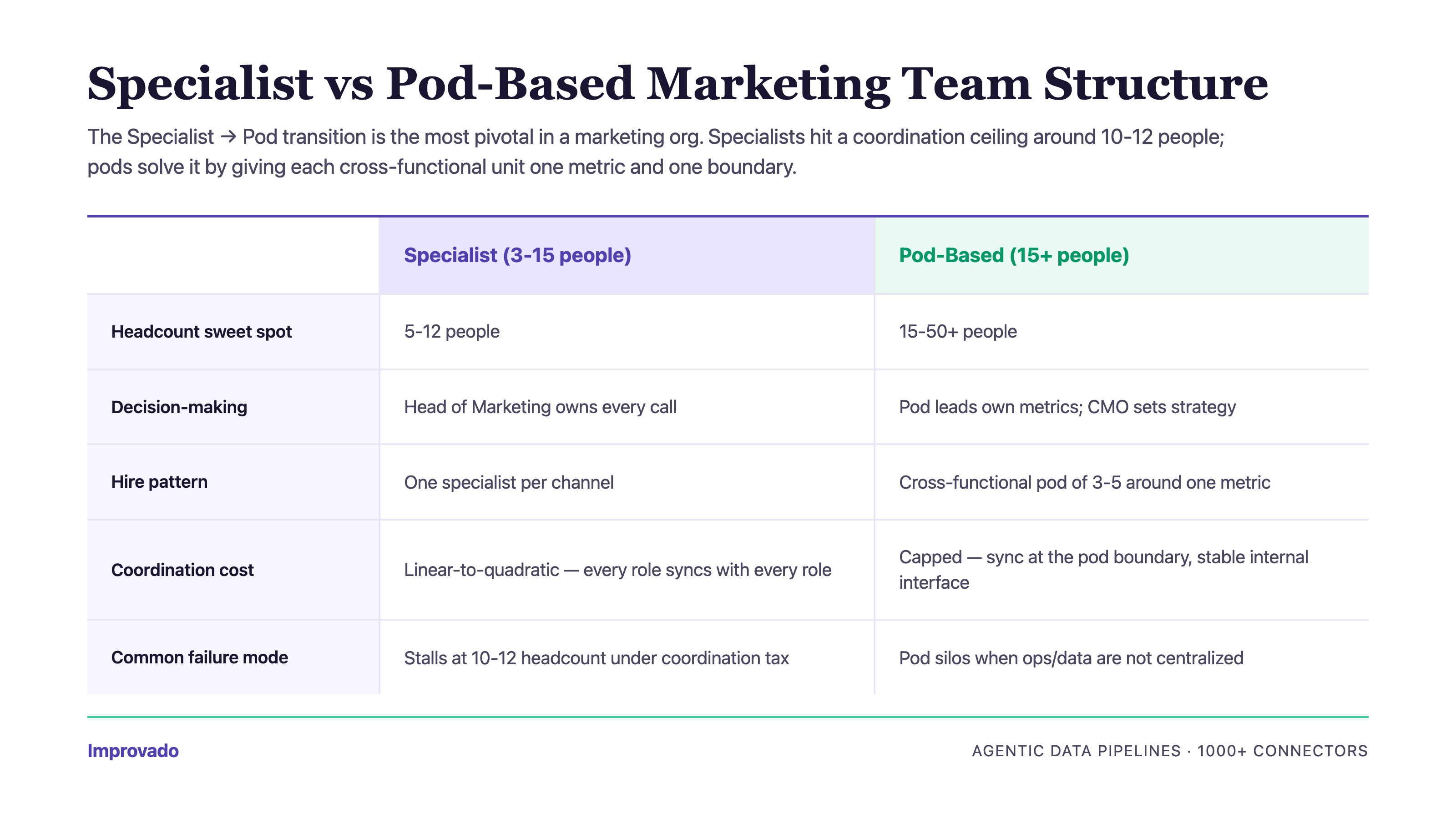
Phase 1: Founder-Led (0-2 People)
The first marketing hire reports directly to the founder or CEO. This person is a full-stack generalist who can execute across content, paid acquisition, email, and basic analytics. They're building the foundation: initial positioning, first campaigns, measurement frameworks.
Key characteristics:
• Single-threaded ownership. One person owns the entire funnel
• High experimentation velocity. Testing channels, messages, audience segments
• Minimal process. Decisions happen in real-time, documentation is lightweight
• Direct founder collaboration, weekly or daily syncs on strategy and priorities
The goal at this stage isn't scale. It's finding repeatable channels and proving unit economics. The team graduates to Phase 2 when one or two channels consistently deliver pipeline and the founder can't keep up with demand for marketing support.
Phase 2: Specialist (3-15 People)
The specialist phase is where most teams struggle. You're too big for everyone to be generalists but too small for formal management layers. The solution is functional specialization with clear swim lanes.
A typical 8-person specialist team:
• Head of Marketing (player-coach, owns strategy + one channel)
• Content Lead (blog, guides, SEO, owned media)
• Demand Gen Lead (paid media, email campaigns, conversion optimization)
• Product Marketing (positioning, launches, sales enablement)
• Marketing Operations (CRM, automation, reporting, data infrastructure)
• Designer (brand, web, campaign assets)
• 2× channel specialists (SDR coordination, partner marketing, events, or additional content/paid resources depending on what's working)
Critical rule: every initiative has exactly one DRI (Directly Responsible Individual). No shared ownership. No matrix reporting. If a campaign needs three people, one person is accountable for the outcome and coordinates the others.
The trap at this stage is adding management before you need it. A team of 8-10 specialists doesn't need a VP and three directors. It needs clear roles, good process documentation, and weekly prioritization meetings.
Phase 3: Pod-Based (15+ People)
Past 15 people, functional silos become inefficient. Campaign pods, channel pods, or product-line pods work better. Each pod is a cross-functional unit with clear metrics and autonomy to execute.
Example pod structure for a 25-person team:
• Growth Pod (5 people: paid acquisition, conversion optimization, lifecycle email, analytics support, designer) — owns new logo pipeline
• Content Pod (4 people: SEO content, thought leadership, distribution, designer) — owns organic traffic and brand awareness
• Product Marketing Pod (4 people: positioning, launches, sales enablement, competitive intelligence) — owns product narrative and sales support
• Customer Marketing Pod (3 people: advocacy, case studies, community, upsell campaigns) — owns expansion pipeline
• Marketing Operations (4 people: CRM/automation, data infrastructure, reporting, tech stack) — supports all pods
• Creative Services (3 people: brand, video, web) — supports all pods
• CMO + 2 Pod Leads (strategic leadership layer)
Each pod operates semi-independently. They have dedicated resources, clear OKRs, and decision-making authority. The Ops and Creative layers provide shared infrastructure so pods don't duplicate tools or reinvent processes.
The key to making pods work: data must flow freely across all pods. Without centralized data infrastructure, pods become information silos. Every pod needs real-time visibility into pipeline, attribution, and campaign performance without manual data requests.
Essential Roles and When to Add Them
Hiring order matters more than hiring speed. The wrong second or third hire creates structural problems that take years to fix. Here's the optimal sequencing for each critical role.
Marketing Operations (Hire 3 or 4)
Most teams wait too long to hire marketing ops. They add three content people and two paid specialists before realizing no one owns the CRM, reporting is manual, and campaign tracking is broken. By then, you're unwinding six months of technical debt.
Hire marketing ops as your third or fourth person — right after you have two channel specialists. This person builds the infrastructure that makes everyone else 2-3x more productive.
What marketing ops owns:
• CRM architecture and data hygiene (lead scoring, lifecycle stages, field definitions)
• Marketing automation workflows (nurture sequences, event triggers, lead routing)
• Campaign tracking and attribution (UTM taxonomy, conversion tracking, multi-touch attribution models — including linear, time-decay, position-based, and data-driven variants)
• Reporting infrastructure (dashboards, data integration, performance analytics)
• Tech stack management (tool selection, vendor relationships, integration maintenance)
Without this role, every specialist becomes part-time ops. Your paid media person spends five hours a week fixing broken tracking. Your content lead manually pulls traffic reports. Your demand gen manager can't answer basic attribution questions without a two-day spreadsheet project.
Marketing ops isn't overhead. It's the leverage that turns a team of five into a team that operates like ten.
Product Marketing (Hire 5 to 7)
Product marketing bridges the gap between what you build and how you sell it. Most teams don't need this role until they have multiple products, complex buying cycles, or a sales team larger than five people.
Hire product marketing when:
• Sales reps can't articulate differentiation consistently
• Product launches create internal confusion instead of market momentum
• Competitive losses trace back to positioning gaps, not product gaps
• Customer conversations reveal messaging misalignment between marketing and reality
Product marketing owns:
• Core positioning and messaging frameworks
• Launch strategy and cross-functional coordination
• Sales enablement (pitch decks, battle cards, demo scripts)
• Competitive intelligence and win/loss analysis
• Buyer research and persona development
The trap with product marketing: hiring too junior. This role requires strategic thinking and cross-functional influence. A junior PMM becomes a deck-builder instead of a positioning strategist. Hire senior (5+ years experience) or don't hire at all.
Content Marketing (Hire 1 or 2)
Content is often the first specialist hire after the founding marketer. The rationale is sound: content scales, builds authority, and supports every other channel. But content requires patience. Most content strategies take 9-12 months to show meaningful pipeline impact.
Hire content when:
• You've validated that your ICP actively searches for educational content in your category
• You can commit to 18 months of consistent publishing (frequency will vary by domain authority and competitive landscape — many teams start with 1–2 high-quality pieces per week and scale from there)
• You have product-market fit and can articulate clear differentiation (content amplifies positioning; it doesn't create it)
Content marketing owns:
• Blog strategy and editorial calendar
• SEO research and optimization
• Long-form guides and pillar content
• Content distribution (email, social, partnerships)
• Thought leadership and executive visibility
Content works best when tightly coupled with demand gen. The content lead identifies topics, the demand gen lead builds conversion paths and nurture sequences around those topics. Without that coordination, you generate traffic that doesn't convert.
Demand Generation (Hire 2 or 3)
Demand gen is the engine: paid acquisition, email campaigns, conversion optimization, pipeline acceleration. This is typically your second or third hire after the founding marketer.
Demand gen owns:
• Paid media strategy and execution (search, social, display, retargeting)
• Email campaign strategy (newsletters, nurture tracks, event promotion)
• Conversion rate optimization (landing pages, forms, CTAs)
• Campaign analytics and attribution reporting
• Pipeline marketing (ABM campaigns, opportunity acceleration)
The demand gen hire must be quantitatively strong. This person lives in dashboards, runs multivariate tests, and can articulate CAC payback and pipeline velocity without a calculator. If they can't model unit economics in a spreadsheet, they're not ready for this role.
Field Marketing and Events (Hire 8 to 12)
Field marketing and events are high-cost, high-touch channels. Only add this role when you have proven event ROI and enough pipeline capacity to justify dedicated headcount.
Hire field marketing when:
• You're spending $200K+ annually on events and conferences
• Sales leadership wants consistent regional presence
• Enterprise deals require in-person relationship building
Field marketing owns:
• Event strategy and vendor management
• Roadshow planning and execution
• Sales dinner series and executive engagement
• Regional campaign activation
• Event lead follow-up and pipeline tracking
The mistake teams make: treating field marketing as event logistics. The role should drive pipeline, not just booth setup. Measure this person on meetings booked and pipeline sourced, not events executed.
How to Structure Cross-Functional Dependencies
Marketing doesn't operate in isolation. Every initiative touches sales, product, customer success, or revenue operations. The structural failures most teams experience trace back to unclear ownership at these boundaries.
- →Every campaign requires five people and three meetings before anything ships — coordination overhead exceeds execution time
- →Top performers spend 20%+ of their week on manual reporting, data pulls, or spreadsheet reconciliation instead of marketing
- →New hires take 60+ days to ramp because roles are unclear, tools are fragmented, and no one owns onboarding
- →Sales complains about lead quality but marketing can't trace which programs drive closed-won revenue
- →Strategic initiatives consistently miss deadlines despite adequate headcount because reactive requests consume all capacity
Marketing and Sales Alignment
The marketing-sales handoff is where most pipeline leaks. Marketing generates leads, sales complains about quality, marketing blames sales for poor follow-up. The cycle repeats until someone fixes the structural dependency.
Clear ownership model:
• Marketing owns: top-of-funnel volume, lead enrichment, qualification criteria, MQL definition, handoff SLA
• Sales owns: contact within SLA, qualification conversations, opportunity creation, pipeline velocity
• Joint ownership: lead scoring model, MQL-to-SQL conversion rate, closed-loop attribution, win/loss analysis
The handoff mechanism matters more than the SLA. Use a routing system that assigns leads in real-time based on territory, account ownership, or rep capacity. Manual handoffs create delays and dropped leads.
Weekly sync structure:
• Monday: pipeline review (what converted, what stalled, leading indicators for the week)
• Friday: lead quality review (sales feedback on MQL batch, marketing adjustments for next week)
• Monthly: deep-dive on conversion rates, win rates, and program ROI by source
The key cultural shift: marketing is accountable for pipeline, not just leads. If you're measured on MQL volume but not SQL conversion or close rate, the incentives misalign and quality suffers.
Marketing and Product Collaboration
Product launches fail when marketing learns about the launch two weeks before GA. Successful product marketing requires months of lead time: beta customer recruitment, messaging development, sales enablement, content production, and campaign planning.
Structured collaboration model:
• 90 days before launch: positioning workshop with product and sales leadership
• 60 days before launch: messaging framework finalized, beta customers identified
• 45 days before launch: sales enablement materials in draft, content calendar locked
• 30 days before launch: launch campaign assets complete, analyst briefings scheduled
• Launch day: coordinated announcement (blog, email, PR, social, sales kickoff)
• Post-launch: weekly pipeline review, monthly messaging refinement based on customer feedback
Product marketing should attend product planning meetings and roadmap reviews. They're not observers, they represent the market perspective and customer voice in prioritization decisions.
Marketing Operations and Revenue Operations
The line between marketing ops and revenue ops blurs at scale. Both work in the CRM, both build reports, both manage data flows. Without clear boundaries, work gets duplicated or dropped.
One common division of labor (most useful in organizations with a dedicated RevOps function):
• Marketing Ops owns: campaign tracking, marketing automation, lead lifecycle management, attribution models, marketing analytics
• Revenue Ops owns: CRM platform administration, sales process automation, territory management, forecasting models, sales analytics
• Shared ownership: lead-to-account matching, scoring models, conversion reporting, tech stack integration
These teams should have weekly syncs focused on data quality, process gaps, and shared roadmap priorities. Most cross-functional initiatives, implementing ABM, launching partner programs, building attribution models: require both teams working in lockstep.
Data Infrastructure as Structural Dependency
Marketing team structure only scales if data infrastructure scales with it. Without centralized data, every new hire creates exponential coordination overhead instead of linear output gains.
The Hidden Cost of Manual Reporting
Most marketing teams spend 15–25% of their time on reporting, data pulls, and spreadsheet reconciliation, roughly one full day per week per person spent on data plumbing instead of marketing. (Source: HubSpot State of Marketing.)
The compounding effect:
• 5-person team: 5 days/week lost to manual data work
• 10-person team: 10 days/week lost (equivalent to 2 full-time roles)
• 20-person team: 20 days/week lost (equivalent to 4 full-time roles)
Teams experiencing this treat it as a headcount problem. They hire an analyst. The analyst spends 80% of their time pulling data and 20% analyzing it. The structural constraint remains.
The root cause: data lives in silos. Campaign performance in Google Ads. Conversion data in Google Analytics. Lead data in the CRM. Closed-won revenue in the data warehouse. Every analysis requires stitching these sources together manually.
Centralized Data Infrastructure Requirements
Centralized data infrastructure means all marketing data flows into a single source of truth automatically. No manual exports. No spreadsheet reconciliation. No waiting three days for IT to pull a custom report.
Core components:
• Data integration layer: connectors that pull data from every marketing platform (ad networks, analytics tools, CRM, email, social) on a scheduled cadence
• Transformation layer: standardized schemas that normalize data across sources (unified UTM taxonomy, consistent field mapping, deduplication rules)
• Storage layer: centralized warehouse where all marketing data lives (typically your data warehouse or a marketing data platform)
• Access layer: dashboards, BI tools, and query interfaces that let marketers self-serve insights without IT tickets
The business case: a team of 10 spending 15% of their time on manual reporting loses 1.5 FTE to data work. Automating that saves 60+ hours per week. Those hours go back to campaign optimization, content creation, and strategic projects.
Implementation typically takes days, not months. Modern data integration platforms connect to existing tools via API and start flowing data within a week. The barrier isn't technical complexity, it's recognizing that this is a structural dependency, not a nice-to-have.
When to Build Versus Buy
Marketing leaders face a common decision point: build custom data infrastructure in-house or adopt a platform that handles integration, transformation, and storage.
Build in-house when:
• You have dedicated data engineering resources (2+ engineers) who can own the system long-term
• Your data sources are stable and you rarely add new platforms
• You need deep customization that off-the-shelf platforms don't support
• You're already operating a mature data warehouse with strong governance
Buy a platform when:
• Your engineering team is resource-constrained and can't dedicate headcount to marketing infrastructure
• You frequently add or change marketing tools
• You need to be operational within weeks, not quarters
• You want vendor-maintained connectors that adapt automatically when platforms change APIs
The hidden cost of building: ongoing maintenance. Every platform API update requires engineering time. Every new tool requires custom connector development. Most in-house systems take 6-12 months to build and require 0.5-1.0 FTE to maintain.
Marketing data platforms provide 1,000+ pre-built connectors, handle schema changes automatically, and include customer success support. For teams without dedicated data engineering resources, the ROI is immediate.
Hiring and Team Development Strategy
The best marketing team structure in the world fails if you hire the wrong people. Hiring strategy for marketing differs from engineering or sales, the skill profiles are less standardized and the quality distribution is wider.
Specialist Versus Generalist Profiles
Early hires should be T-shaped: deep expertise in one area plus enough breadth to contribute across the function. Hire pure specialists too early and you create coordination overhead. Hire only generalists and no one owns outcomes.
Hiring profile by stage:
• Hires 1-3: T-shaped generalists with 1-2 deep skills (e.g., strong paid media + functional content abilities)
• Hires 4-10: Specialists with clear domain ownership (dedicated content lead, dedicated demand gen lead, dedicated ops person)
• Hires 11-20: Mix of senior specialists and player-coaches who can lead small teams
• Hires 20+: Balance of individual contributors, team leads, and strategic leadership
The mistake most teams make: hiring too junior too fast. Three junior marketers don't equal one senior marketer. They create management overhead, require more direction, and ship slower. In major US tech markets as of 2026, it is often better to hire one senior person (typically commanding meaningfully higher compensation) than three junior people whose combined cost may appear lower but whose combined output rarely matches a senior hire.
Assessing Technical Depth
Marketing roles increasingly require technical fluency. Demand gen must understand API-based attribution. Content marketers need technical SEO knowledge. Marketing ops requires CRM data modeling skills.
Technical assessment questions by role:
• Demand Gen: "Walk me through how you'd set up conversion tracking for a multi-step signup flow. What tools would you use and how would you validate accuracy?"
• Content: "Show me your process for keyword research. How do you prioritize topics when you have 200 potential keywords?"
• Marketing Ops: "Explain how you'd build a lead scoring model. What signals would you include and how would you weight them?"
• Product Marketing: "How do you validate messaging? Walk me through your research process and how you test positioning with target buyers."
The goal isn't to test memorization. It's to assess systematic thinking and depth of experience. Strong candidates explain tradeoffs, edge cases, and how they'd validate their approach.
Building Career Ladders
Marketing career paths are notoriously unclear. Most companies have three levels: specialist, senior specialist, manager. That's insufficient for retaining high performers.
Functional career ladder example:
• Associate (0-2 years experience): executes defined projects with guidance
• Specialist (2-4 years): owns outcomes for specific initiatives, minimal supervision
• Senior Specialist (4-7 years): owns strategy for a channel or program area, mentors junior team members
• Lead/Principal (7-10 years): sets strategic direction for a domain, influences cross-functional priorities
• Director (10+ years): manages team of 3-8, owns P&L for a major function
• Senior Director / VP (12+ years): manages managers, owns multi-year strategy
Individual contributor (IC) tracks should extend as high as manager tracks. A Principal Demand Gen Specialist should be compensated equivalently to a Demand Gen Manager. Both are senior roles; they just have different leverage models.
Metrics and Team Performance
Marketing team structure only works if you measure the right outcomes. Teams measured on vanity metrics optimize for the wrong things and create misaligned incentives.
Team-Level Metrics
Aggregate team performance should roll up to business impact: pipeline, revenue, and efficiency.
Primary team-level KPIs:
• Marketing-sourced pipeline ($ value of opportunities where marketing touchpoints influenced the deal)
• Marketing-sourced revenue (closed-won $ from marketing-sourced pipeline)
• CAC payback period (months to recover the cost of acquiring a customer)
• Pipeline velocity (days from MQL to closed-won)
• Marketing efficiency ratio (pipeline generated / marketing spend)
These metrics answer the question: is marketing driving predictable, efficient growth? They're lagging indicators, they move slowly and reflect cumulative efforts across months. Track them monthly or quarterly, not weekly.
Role-Specific Metrics
Individual contributors need leading indicators they can influence directly. Holding a content marketer accountable for revenue four months downstream creates learned helplessness.
Metrics by role:
• Content Marketing: organic traffic, keyword rankings, content-influenced pipeline, engagement rate (time on page, scroll depth)
• Demand Gen: MQL volume, MQL-to-SQL conversion rate, cost per MQL, campaign ROI
• Product Marketing: win rate, sales cycle length, competitive win rate, message adoption (% of sales calls using new positioning)
• Marketing Ops: data accuracy rate, report delivery SLA, campaign tracking coverage (% of campaigns with full attribution data)
• Field Marketing: event pipeline, event ROI, meetings booked per event, post-event conversion rate
Each role should have 2-3 primary metrics they're directly accountable for and 2-3 secondary metrics they influence but don't fully control. This creates clarity without creating tunnel vision.
Dashboard and Reporting Cadence
Reporting structure should match decision-making cadence. Daily metrics for tactical adjustments. Weekly metrics for program health checks. Monthly metrics for strategic reviews.
Recommended cadence:
• Daily dashboard (automated, self-serve): campaign spend, lead volume, website traffic, conversion rates
• Weekly review (30-minute team meeting): channel performance, A/B test results, upcoming launches
• Monthly business review (60-90 minute leadership meeting): pipeline trends, win rates, program ROI, strategic initiatives
• Quarterly planning review (half-day session): goal attainment, resource allocation, roadmap priorities
Most teams over-report and under-analyze. They generate 40-slide decks every week that no one reads. Cut reporting volume in half and double the time spent on insights and recommendations.
Common Structural Failures and How to Fix Them
Marketing teams fail in predictable ways. The same structural problems appear across companies, regardless of industry or size. Recognizing these patterns early lets you course-correct before they become existential.
The Coordination Tax
Symptom: every initiative requires five people, three meetings, and two weeks of back-and-forth before anything ships. The team has more headcount but lower output.
Root cause: unclear ownership and no DRI (Directly Responsible Individual) model. When everyone owns something, no one owns it. Decisions get socialized instead of made.
Fix:
• Assign a single DRI for every project, campaign, and initiative
• DRI has decision-making authority and accountability for outcomes
• Other team members are consulted or informed, but the DRI drives
• Weekly prioritization meeting to stack-rank initiatives and assign DRIs
The cultural shift: move from consensus-driven to consultation-driven. The DRI seeks input but makes the final call. This cuts decision latency from weeks to days.
The Tool Sprawl Problem
Symptom: the team uses 15+ marketing tools, but no two people can access the same data. Every tool has a different login, a different schema, and a different definition of a "lead."
Root cause: tools get added reactively without integration planning. Each team member picks their favorite tool for their function, creating a fragmented stack.
Fix:
• Audit current tool usage (what's actually used versus what's paid for)
• Define integration requirements before adding any new tool
• Consolidate overlapping tools (two email platforms, three analytics tools)
• Implement a centralized data layer that integrates all remaining tools
• Establish a tool approval process (marketing ops reviews integration feasibility before procurement)
Target state: 8-12 core tools, all integrated into a central data warehouse or marketing data platform. Every tool serves a clear purpose and data flows between them automatically.
The Reactive Death Spiral
Symptom: the team spends 80% of their time on reactive requests (sales wants a one-pager, the CEO wants a campaign for next week, product needs launch support tomorrow). Strategic work never happens.
Root cause: no intake process and no prioritization framework. Every request feels urgent, so the team operates in constant firefighting mode.
Fix:
• Implement a request intake system (form, ticket, or Slack channel)
• Weekly triage meeting to review requests and assign priority
• Prioritization framework: business impact × urgency × effort
• Capacity reservation: 60% planned work, 30% reactive work, 10% strategic bets
• SLA by priority tier (P0 = same day, P1 = this week, P2 = this month, P3 = backlog)
The key mindset shift: not every request is a priority. Saying no to low-impact work is how you protect time for high-impact work. Leadership must reinforce this or the team will default back to reactive mode.
The Attribution Blackhole
Symptom: marketing can't explain which programs drive revenue. Leadership questions marketing's value. Budget decisions become political instead of data-driven.
Root cause: no attribution model and no closed-loop reporting between marketing campaigns and closed-won revenue.
Fix:
• Implement UTM tracking across all campaigns (consistent taxonomy, no exceptions)
• Build closed-loop reporting (CRM connects to ad platforms and analytics tools)
• Choose an attribution model (first-touch, last-touch, or a multi-touch variant such as linear, time-decay, U-shaped/position-based, W-shaped, or data-driven — consistency matters more than perfection)
• Report on marketing-influenced pipeline (every deal that had a marketing touchpoint)
• Monthly analysis: $ pipeline by source, $ revenue by source, CAC by channel
Attribution doesn't have to be perfect. It has to be consistent. A simple first-touch model you use religiously is better than a complex multi-touch model you never trust.
When to Restructure
Marketing team structures are not static. You'll restructure 2-3 times as the company grows. Knowing when to restructure and how to execute the change without destroying morale is a critical leadership skill.
Signals It's Time to Restructure
• Team headcount doubles in 12 months (old structure can't absorb new people efficiently)
• Key initiatives consistently miss deadlines despite adequate resourcing
• Cross-functional dependencies create constant bottlenecks
• Top performers express frustration with unclear roles or lack of ownership
• Leadership spends more time resolving conflicts than setting strategy
• Data or reporting requests take multiple days despite having the right tools
If three or more of these are true, the structure is constraining growth. Waiting another quarter to restructure just compounds the problem.
Restructuring Execution Plan
Restructuring marketing requires clear communication and fast execution. Drawn-out restructures create uncertainty and distract the team for months.
Timeline:
• Week 1: Leadership designs new structure (org chart, role definitions, reporting lines)
• Week 2: One-on-one conversations with every team member ("here's your new role, here's why")
• Week 3: Team announcement (new org chart, new meeting cadence, new priorities)
• Week 4: First week operating in new structure (daily check-ins to resolve confusion)
• Week 8: Retrospective (what's working, what needs adjustment)
The keys to successful restructuring:
• Clarity on why: explain the business context and what the new structure solves
• Speed: announce and implement within 2-3 weeks, don't let it drag
• Stability: commit to 12 months before the next restructure
• Support: over-communicate in the first month, address confusion immediately
Expect a 2-4 week productivity dip as people adjust. That's normal. If productivity is still down after six weeks, the structure has a flaw that needs fixing.
Conclusion
Marketing team structure is the invisible architecture that determines whether you scale efficiently or collapse under complexity. The right structure creates clarity, eliminates coordination overhead, and makes every new hire a multiplier instead of a drag.
The core principles:
• Specialize before you manage — clear roles beat management layers
• Data infrastructure is structural, not optional — centralize before you hit 10 people
• Hire marketing ops early (hire 3 or 4) — this role makes everyone else 2x more productive
• Define ownership at every boundary — no shared accountability for outcomes
• Measure the right things — pipeline and revenue, not vanity metrics
Your structure will evolve. Founder-led works for 0-2 people. Specialist models scale from 3-15 people. Pod structures work past 15 people. Each phase requires different org design, different roles, and different coordination mechanisms.
The constraint most teams ignore: data infrastructure. Without centralized data, every new hire creates exponential coordination tax instead of linear output gains. Teams spending 15–25% or more of their time on manual reporting are structurally constrained, not under-resourced. Fix the infrastructure first, then add headcount.
Structure is never finished. You'll restructure 2-3 times as you grow. Plan for it. When coordination overhead spikes, when top performers get frustrated, when initiatives consistently miss deadlines despite adequate resourcing — those are the signals. Restructure fast, communicate clearly, and commit to 12 months of stability before the next change.
The teams that scale efficiently recognize that structure isn't org charts and titles. It's decision rights, data flows, and accountability models. Get those right and a team of six operates like twelve. Get them wrong and twenty people can't ship what six should.
FAQ
What is the ideal marketing team structure?
There is no universal ideal structure — it depends on company stage, product complexity, and go-to-market motion. Early-stage teams (0-5 people) work best as generalists with one leader. Mid-stage teams (5-15 people) need functional specialists: content, demand gen, product marketing, and marketing ops. Late-stage teams (15+ people) benefit from pod structures where cross-functional squads own specific outcomes like growth, product launches, or customer expansion. The common thread across all stages: clear ownership, minimal coordination overhead, and centralized data infrastructure that eliminates manual reporting.
When should I hire a marketing operations person?
Hire marketing ops as your third or fourth team member — right after you have two channel specialists (e.g., content and demand gen). Most teams wait too long and accumulate 6-12 months of technical debt: broken tracking, manual reporting, CRM chaos, no attribution model. Marketing ops builds the infrastructure that makes everyone else 2-3x more productive by automating data flows, maintaining the tech stack, and providing self-serve analytics. Without this role, every specialist becomes part-time ops, spending five to ten hours weekly on data plumbing instead of marketing. The ROI is typically immediate: in our experience, a senior ops hire can save many hours per week across a five-person team by eliminating manual reporting and automating data flows.
How do I structure marketing and sales collaboration?
Clear ownership at the handoff point prevents 90% of marketing-sales friction. Marketing owns top-of-funnel volume, lead enrichment, MQL definition, and handoff SLA. Sales owns contact within SLA, qualification, opportunity creation, and pipeline velocity. Joint ownership applies to lead scoring, MQL-to-SQL conversion rate, and win/loss analysis. Use automated lead routing to assign leads in real-time based on territory or account ownership — manual handoffs create delays and dropped contacts. Weekly syncs should cover pipeline review (Monday) and lead quality feedback (Friday). Monthly deep-dives analyze conversion rates and program ROI by source. The cultural shift: marketing is accountable for pipeline, not just lead volume.
What metrics should marketing teams track?
Team-level metrics should connect directly to business outcomes: marketing-sourced pipeline (dollar value of influenced opportunities), marketing-sourced revenue (closed-won dollars), CAC payback period, pipeline velocity, and marketing efficiency ratio (pipeline divided by spend). These are lagging indicators reviewed monthly or quarterly. Individual roles need leading indicators they can influence directly: content marketing tracks organic traffic and content-influenced pipeline; demand gen tracks MQL volume, cost per MQL, and MQL-to-SQL conversion; product marketing tracks win rate and sales cycle length; marketing ops tracks data accuracy and campaign tracking coverage. Each role should have two to three primary metrics they own and two to three secondary metrics they influence but don't fully control.
How many people should report to the head of marketing?
Optimal span of control for marketing leadership is five to eight direct reports. Below five and you're likely missing critical functions or under-delegating. Above eight and you become a coordination bottleneck with insufficient time for strategy or people development. At 8-12 total headcount, the head of marketing often has six to seven direct reports (all individual contributors or player-coaches). Past 15-20 people, insert a management layer: directors or team leads who own specific functions, each managing three to five people. The head of marketing then has three to four directors as directs. Avoid creating manager roles prematurely — a team of eight specialists doesn't need three directors; it needs clear role definition and good process documentation.
Should marketing own revenue targets?
Marketing should own pipeline targets, not closed-won revenue targets, unless you operate a fully self-serve product-led growth motion where marketing controls the entire buyer journey. In sales-led or hybrid models, revenue outcomes depend on sales execution, pricing, product quality, and factors outside marketing's control. Holding marketing accountable for revenue they can't directly influence creates misaligned incentives and finger-pointing. The better model: marketing owns marketing-sourced pipeline (dollar value and volume), pipeline quality (MQL-to-SQL conversion rate), and efficiency (cost per dollar of pipeline). Sales owns pipeline-to-revenue conversion. Both are jointly accountable for total company pipeline coverage and velocity. This creates shared responsibility without assigning accountability for outcomes a team can't control.
How do I decide between hiring specialists versus generalists?
Hire T-shaped generalists for your first three marketing roles — people with deep expertise in one domain plus enough breadth to contribute across multiple areas. This gives you flexibility while roles and priorities solidify. At hire four onward, shift to specialists with clear domain ownership: a dedicated content lead, a dedicated demand gen lead, a dedicated marketing ops person. Pure generalists create overlap and unclear accountability past five headcount. The exception: player-coach roles at 10-15 people, where senior specialists take on mentorship or light management responsibilities. At 20+ people, hire for depth over breadth — you need experts who can drive strategy in their domain, not generalists who contribute everywhere but own nothing.
What is the right marketing budget allocation?
Budget allocation depends on growth stage and go-to-market strategy, but one common starting split for B2B SaaS (an illustration, not a survey benchmark): roughly 40–50% on demand generation (paid media, events, ABM programs), 20–25% on content and brand (content production, SEO tools, brand campaigns), 15–20% on tools and infrastructure (martech stack, data platforms, automation), 8–12% on headcount support (agencies, freelancers, contractors), and 3–5% on analytics and attribution. (Ranges are approximate; midpoints are designed to sum to 100%.) Early-stage companies skew heavily toward demand gen (60-70%) to prove unit economics. Later-stage companies invest more in brand (30-40%) for long-term market positioning. The critical rule: tool and infrastructure spend should scale with headcount. A 20-person team spending less than 10% of budget on data infrastructure will lose 15-20% of productivity to manual reporting and broken tracking.
How do I build a marketing team with limited budget?
Start with one senior full-stack marketer (hire 1) who can execute across content, paid acquisition, and basic analytics. This person typically has 5–7 years of experience; in major US tech markets as of 2026, a senior generalist commands meaningfully higher compensation than two or three junior hires combined. Prioritize someone with technical depth over someone with management experience — you need execution, not oversight. Add marketing ops as hire 2 or 3 to build data infrastructure and eliminate manual work. Outsource specialized tasks (design, video production, PR) to agencies or freelancers rather than hiring full-time until you have consistent volume. Use contractors to fill gaps in demand gen or content while you prove channel ROI. Once two to three channels are working reliably, hire specialists to own those channels full-time. The mistake budget-constrained teams make: hiring three junior people instead of one senior person. Three junior marketers require more management, ship slower, and create coordination overhead you can't afford.
When should we implement a pod structure?
Pod structures work best at 15-20+ headcount when functional silos create coordination overhead and slow decision-making. Below 15 people, a functional org (content team, demand gen team, ops team) is simpler and more efficient. Pods make sense when you have multiple products, multiple customer segments, or regional markets that require dedicated focus. Each pod should be a self-sufficient cross-functional unit with clear metrics: a growth pod owns new customer pipeline, a product marketing pod owns launches and enablement, a customer marketing pod owns expansion revenue. The structural requirement for pods: centralized data and ops layers. Without shared data infrastructure, pods become information silos and duplicate tools, processes, and reporting. Implement centralized marketing ops, data infrastructure, and creative services before splitting into pods.