

Global advertisers are on pace to lose more than $100B to invalid traffic, click fraud, and sophisticated bot networks in 2026 — a number that has continued to climb each year, with Juniper Research forecasting industry losses reaching $172B by 2028 (up from an estimated $84B in 2023). For any team running programmatic, paid search, social, CTV, or mobile campaigns, ad fraud detection software has shifted from a nice-to-have verification checkbox to a line item sitting next to DSP fees and measurement. This guide walks through how the best ad fraud detection software actually works in 2026, what the market looks like, and ten platforms worth evaluating — presented alphabetically rather than ranked, because "best" depends entirely on whether you are protecting a modest PPC budget or an enterprise omnichannel media plan. Pharma teams buying HCP-targeted programmatic media face extra exposure, which our guide to pharma programmatic ad fraud detection covers.
Key Takeaways
• Post-bid dashboards catch only visible fraud — most dollars leak pre-bid inside SSP auctions where most teams have zero visibility.
• Procurement must cover both General Invalid Traffic (GIVT) and Sophisticated Invalid Traffic (SIVT) — one vendor rarely does both equally.
• MRC accreditation is the baseline trust signal; pair with IAB Tech Lab ads.txt / app-ads.txt enforcement.
• Expect 3-8% invalid traffic on display, 10-20% on programmatic video for unprotected campaigns.
• Tool choice depends on buy-side role (advertiser, agency, DSP); a full-stack solution usually requires 2-3 vendors.
What Is Ad Fraud?
Ad fraud is any deliberate attempt to generate invalid impressions, clicks, installs, or conversions from non-human or non-intended traffic in order to collect advertising revenue or deplete a competitor's budget. The Interactive Advertising Bureau (IAB) and Media Rating Council (MRC) group invalid traffic into two top-level categories — General Invalid Traffic (GIVT) and Sophisticated Invalid Traffic (SIVT) — with specific techniques (click fraud, spoofing, attribution fraud) organized as sub-types that detection platforms map their taxonomies against.
• Click fraud is the most familiar category — automated scripts, click farms, or competitors repeatedly clicking paid search or social ads to burn through daily budgets. It shows up disproportionately on high-CPC keywords in legal, finance, insurance, and B2B SaaS, where a single click can exceed $50.
• Bot traffic and general invalid traffic (GIVT) covers known crawlers, data-center IPs, and basic automated tools. MRC accreditation standards require measurement vendors to filter GIVT before reporting impressions.
• Sophisticated invalid traffic (SIVT) is the harder problem: residential-proxy botnets, mobile device farms, hijacked CTV apps, and malware-infected endpoints that mimic real user behavior. SIVT is where most 2026 detection research dollars are going.
• Domain spoofing, app spoofing, and attribution fraud round out the taxonomy — a fraudster claiming to be nytimes.com on an exchange, an SDK pretending a cheap app is a premium one, or a last-click hijacker inserting itself into the attribution path between ad exposure and install.
How Ad Fraud Detection Software Works
Modern ad fraud detection software combines three overlapping technique families, and most commercial platforms blend all three rather than relying on any one.
• Signature-based detection maintains known-bad lists — data-center IP ranges, flagged user-agent strings, malware signatures, spoofed domain fingerprints. It is fast, cheap, and catches GIVT reliably. It is also the easiest layer for sophisticated actors to evade, which is why no serious platform ships signature-only.
• Behavioral analytics scores sessions against what a human visitor actually does: mouse movement entropy, touch-event patterns, scroll velocity, time-on-page distributions, and conversion funnel shape. Click fraud monitoring software leans heavily on behavioral signals because a bot clicking a Google Ads result almost never reproduces a plausible post-click sequence on the landing page.
• Machine learning and anomaly detection is the layer that keeps up with SIVT. Models are trained on labeled fraud corpora (often billions of events) and score new traffic on dozens to hundreds of features — IP reputation, ASN, device fingerprint stability, geolocation plausibility, time-of-day patterns, click-to-install time, and cohort deviation. Vendors like HUMAN, DoubleVerify, and IAS publish enough detail in their MRC accreditation reports to make clear that advanced ensemble models are now standard, though vendors rarely disclose specific algorithmic approaches publicly.
What to Look For in Ad Fraud Detection Software
Evaluating click fraud prevention software in 2026 is less about "does it block bots" (every serious vendor does) and more about fit. Six criteria matter in most RFPs.
• Channel coverage. Some platforms focus on paid search and social (ClickCease, ClickGUARD, Lunio (the platform formerly known as Lunio (formerly PPCProtect), rebranded 2022)). Others are built for programmatic display and video (DoubleVerify, IAS). A few are mobile-first (TrafficGuard, Fraud Blocker). The right tool for a B2B SaaS team running Google Ads and LinkedIn is rarely the right tool for a DSP-heavy brand running CTV.
• MRC accreditation. For impression-level measurement, Media Rating Council accreditation is the baseline credential. DoubleVerify, IAS, and HUMAN hold broad MRC accreditations across invalid traffic detection, viewability, and sometimes brand safety.
• Integration depth. Pre-bid filtering (blocking a fraudulent impression before the bid is placed) requires direct integrations with DSPs and SSPs. Post-bid detection is easier but only refunds what has already been spent.
• Reporting granularity. Can the platform export raw event-level data, or only aggregated dashboards? For teams with a data warehouse, row-level access matters.
• False-positive rate. Over-blocking legitimate traffic is as expensive as letting fraud through. Ask vendors for their published IVT rates and how they measure precision.
• Pricing model. Click fraud protection software typically charges per-click or as a percentage of ad spend for SMB-focused tools. Enterprise verification vendors (DoubleVerify, IAS, HUMAN) use per-impression or SaaS tiers, often with managed-service components.
10 Best Ad Fraud Detection and Click Fraud Protection Platforms (2026)
Listed alphabetically. Each vendor is described by what it is designed for, typical target segment, and primary data sources — not ranked.
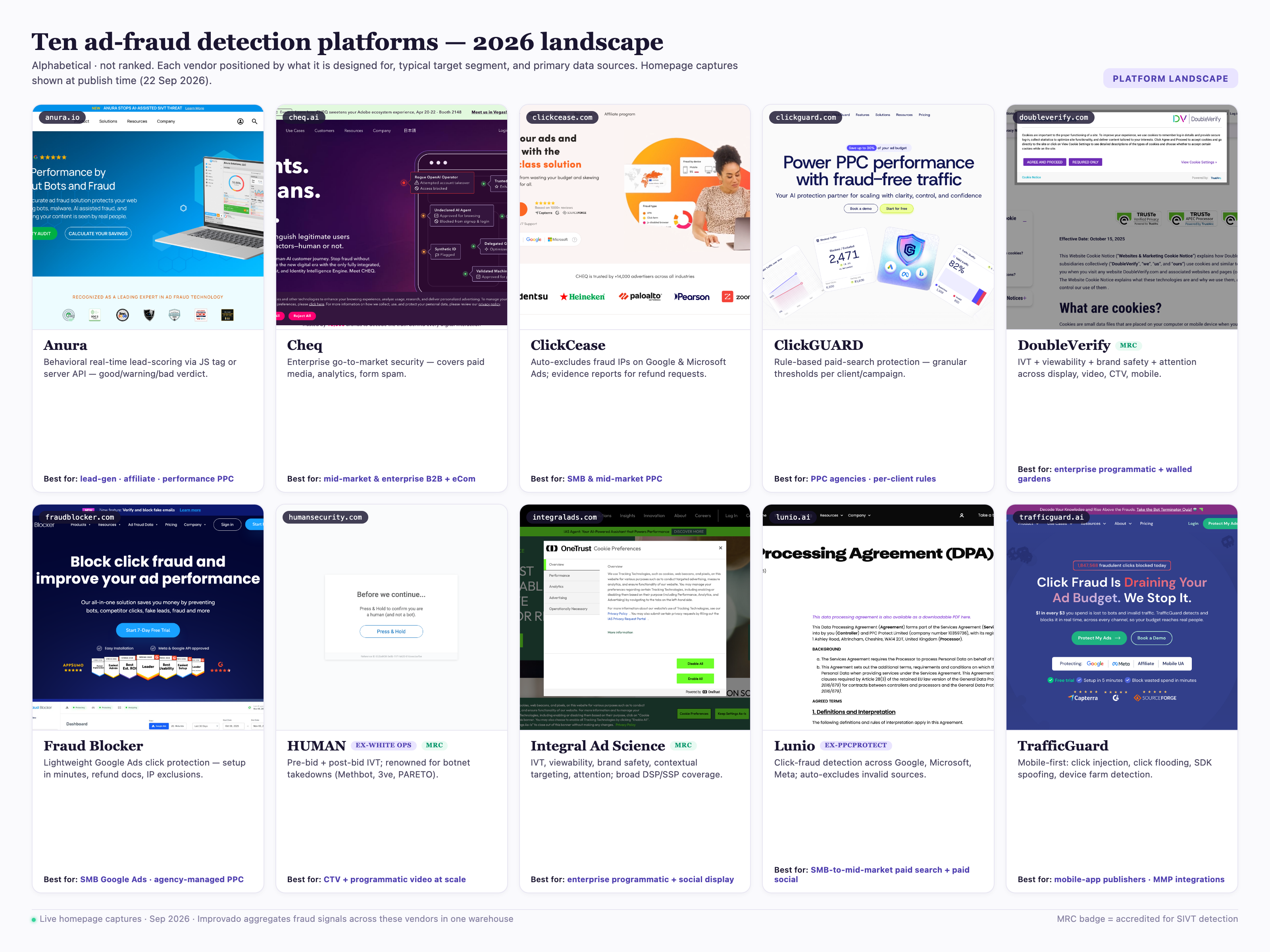
• Anura is a behavioral ad fraud detection platform focused on lead-gen, affiliate, and performance-marketing channels. It scores visitors in real time against a behavioral model and returns a simple good/warning/bad verdict via JavaScript tag or server-side API. Anura is commonly used by agencies and affiliate networks that need to clean up lead forms before passing leads to clients, and by direct-response advertisers running high-volume PPC. Data sources include proprietary behavioral signals, IP and device telemetry, and a labeled fraud corpus. Strength area is real-time lead scoring.
• Cheq is an enterprise go-to-market security platform that grew out of click fraud protection into a broader "fake traffic" stack covering paid media, analytics pollution, and form spam. Cheq sits pre-click or at the landing page and blocks invalid visitors across a brand's marketing technology surface. Typical customers are mid-market to enterprise B2B and eCommerce teams that want a single vendor covering paid search, paid social, and site analytics integrity. Data sources include device fingerprinting, behavioral analytics, and IP intelligence.
• ClickCease is one of the most widely used click fraud protection tools in the SMB and mid-market PPC segment. It monitors Google Ads and Microsoft Ads click-by-click, auto-adds fraudulent IPs to exclusion lists, and produces evidence reports for refund requests. ClickCease is designed for teams running paid search without a dedicated fraud specialist — setup is a few minutes and the product optimizes around the advertiser's daily budget. Data sources are primarily click-stream from ad platforms plus IP and device signals.
• ClickGUARD targets the same paid-search protection use case as ClickCease but leans into rule-based customization. Advertisers can set granular thresholds on clicks-per-IP, time-between-clicks, geographic filters, and device patterns. ClickGUARD is commonly picked by PPC agencies that want to apply different fraud rules per client campaign. Target segment is SMB through mid-market agencies.
• DoubleVerify (DV) is a publicly listed digital media measurement and verification company whose platform spans invalid traffic, viewability, brand safety and suitability, and attention metrics across display, video, CTV, and mobile. DoubleVerify holds MRC accreditations across SIVT detection, viewable impression measurement, and has integrations with every major DSP and SSP for pre-bid and post-bid protection. Target segment is enterprise brands and agencies running programmatic and walled-garden inventory. Data sources include a measured-impression footprint reported in the trillions per year.
• Fraud Blocker is a click fraud detection software platform positioned for SMB Google Ads advertisers, with a focus on easy setup, refund documentation, and integrations with Google's IP exclusion list. It is commonly paired with agency-managed PPC accounts that want a lightweight fraud layer on top of Google's own invalid click filtering. Data sources are click-stream plus proprietary bot-signature libraries.
• HUMAN (formerly White Ops) is the verification vendor best known for taking down large botnet operations — Methbot, 3ve, PARETO — in partnership with the FBI and ad industry. HUMAN's Advertising Integrity product covers pre-bid and post-bid IVT detection across display, video, and CTV, with particular strength in sophisticated-bot detection. HUMAN holds MRC accreditations and is a common choice for agencies and brands where CTV and programmatic video dominate the plan. Data sources include a reported ten trillion verified interactions per week across its Human Defense Platform.
• Integral Ad Science (IAS) is a publicly listed verification company offering IVT detection, viewability, brand safety, contextual targeting, and attention measurement. IAS is broadly integrated with DSPs and SSPs and holds MRC accreditations similar to DoubleVerify and HUMAN. Typical customers are enterprise brands and agencies running programmatic and social display. IAS and DoubleVerify are frequently compared side-by-side in enterprise RFPs; the choice often comes down to integration specifics, social-platform certifications, and commercial terms rather than headline feature parity.
• Lunio (formerly PPCProtect) (now part of Lunio) is a click fraud protection software platform aimed at mid-market PPC and lead-gen advertisers. It monitors Google Ads, Microsoft Ads, and Meta, scores traffic, and auto-excludes invalid sources. Target segment is teams running SMB-to-mid-market paid search and paid social budgets. Data sources are click-stream plus proprietary behavioral models.
• TrafficGuard focuses on mobile-first ad fraud detection with particular depth in mobile app install fraud — click injection, click flooding, SDK spoofing, and device farm detection. TrafficGuard integrates with major mobile measurement partners (MMPs) and is commonly used by performance marketers and mobile-app publishers. It also offers PPC protection for Google Ads. Data sources include MMP event streams and proprietary mobile-device intelligence.
Ad Fraud Detection Companies by Use Case
Not every ad fraud detection company fits every channel. A rough mapping of the market helps shorten an RFP.
• Programmatic display, video, and CTV. DoubleVerify, IAS, HUMAN. These are the verification vendors with DSP/SSP integrations, MRC accreditation depth, and impression-level measurement at scale. Enterprise brands running omnichannel plans typically pick one of the three as primary and occasionally run a second in parallel for validation.
• Paid search and paid social (SMB and mid-market). ClickCease, ClickGUARD, Fraud Blocker, Lunio (formerly PPCProtect). These products are purpose-built for Google Ads, Microsoft Ads, and Meta and optimize for fast setup, IP exclusion automation, and refund documentation.
• Mobile app install and in-app. TrafficGuard, Adjust Fraud Prevention Suite, Kochava Fraud Console. Mobile install fraud has its own taxonomy (click injection, click flooding, SDK spoofing) and is typically caught at the MMP layer rather than through generic ad verification.
• Lead-gen and affiliate. Anura, Cheq, Fraudlogix. These platforms score leads and form submissions rather than just impressions or clicks, which matters when the KPI is cost-per-lead rather than CPM or CPC.
• Enterprise go-to-market security. Cheq, HUMAN Enterprise. The broader category of "bot management plus ad fraud plus analytics pollution plus form spam" — useful for brands that want one vendor securing the full paid-media-to-CRM pipeline.
Detection Techniques Deep Dive
The ad fraud detection techniques that matter in 2026 have converged across vendors, but the implementation details still differ enough to matter in an RFP.
• Behavioral analysis looks at session-level human-likeness: mouse movement, scroll cadence, form-interaction timing, and post-click engagement shape. Behavioral signals are particularly effective against click fraud and lead-form fraud because even sophisticated bots struggle to reproduce the long tail of a plausible on-site journey.
• Device fingerprinting builds a probabilistic identifier from browser, OS, font, canvas, WebGL, and network signals. It is the backbone of deduplication in click-fraud protection (catching the same device clicking repeatedly through a VPN) and in mobile install fraud (catching device farms reinstalling apps).
• IP intelligence combines data-center detection, residential proxy detection, ASN reputation, and geolocation plausibility. Residential-proxy networks are the 2026 arms race: fraudsters route bot traffic through compromised home routers to make data-center IPs look like real consumers, and IP intelligence vendors counter with behavior-plus-network composite signals.
• Machine-learning anomaly detection is the layer that ties everything together. Models ingest hundreds of features per event and score against a labeled fraud corpus and unsupervised anomaly baselines. Good implementations continuously retrain and publish drift metrics. Weak implementations ship a static model and call it AI.
• Cross-campaign and cross-channel pattern detection is the newest frontier. A CTR spike on one publisher might look innocent in isolation but suspicious when the same campaign shows a flat conversion rate, zero time-on-site, and a sudden shift in geographic distribution. Surfacing those cross-channel patterns is what connects fraud detection to broader marketing analytics.
The Improvado Angle — Cross-Channel Fraud Signal Aggregation
Improvado is not an ad fraud detection vendor. It is the analytics layer that sits downstream of the ad platforms and the verification vendors, pulling spend, delivery, and verification data into one warehouse so fraud signals can be analyzed alongside everything else the marketing team cares about.
The practical pattern looks like this. A brand runs DoubleVerify or IAS on its programmatic inventory, ClickCease on its paid search, and TrafficGuard on its mobile installs. Each of those tools produces its own dashboard, its own IVT percentage, and its own flagged-traffic report. Improvado's 1,400+ agentic connectors pull the raw data from all of them — plus the native invalid-click reports from Google Ads, Microsoft Ads, and Meta — into a governed warehouse (Snowflake, BigQuery, Redshift, or a delivery into Looker, Tableau, or Power BI). The Marketing Data Governance layer normalizes vendor-specific taxonomies (so "SIVT" on one platform lines up with "sophisticated invalid traffic" on another), and the AI Agent answers natural-language questions on top of the unified dataset.
What this is good for, specifically: auditing cross-platform spend patterns to catch campaigns whose invalid-traffic rate is drifting up across multiple channels simultaneously, reconciling vendor IVT percentages with platform-reported invalid clicks, and building net-of-fraud CPM and CPC views that reflect only the traffic the verification stack accepted. New connectors are added in days, not weeks, so adding a newly chosen fraud vendor to the stack does not become a quarterly integration project.
How to Implement Ad Fraud Detection
A practical sequence for a team that does not yet have an ad fraud detection solution in place, or is re-evaluating an existing one.
1. Baseline current invalid traffic. Pull invalid click reports from each ad platform, MMP fraud reports from mobile, and any existing verification vendor reports. Quantify current IVT percentage and estimated wasted spend by channel.
2. Scope by channel mix. The right vendor list for a CTV-heavy enterprise brand is a enterprise evaluation typically narrows to HUMAN, DoubleVerify, and IAS. For an SMB running Google Ads, the list is ClickCease, ClickGUARD, Fraud Blocker, Lunio (formerly PPCProtect).
3. Pilot two vendors in parallel. On a representative campaign, run two candidate tools for 30 to 60 days and compare flagged-traffic rates, false-positive rates, and workflow fit. Ask each vendor to provide raw event-level data for the pilot period.
4. Integrate downstream. Export flagged-traffic and verification data into the warehouse alongside spend and performance. This is where an aggregation layer matters — fraud data sitting in a vendor dashboard is much less useful than fraud data joined to campaign spend and CRM conversions.
5. Define the net-of-fraud scorecard. Decide which metrics the team reports on a net-of-fraud basis (CPM, CPC, CPA) and codify them in the BI tool. This is the output that makes the fraud investment visible to finance and leadership.
6. Review quarterly. Fraud taxonomy shifts, vendors release new detection capabilities, and residential-proxy botnets evolve. A quarterly review of flagged-traffic rates, vendor coverage, and new threat categories keeps the stack current.
Budget Guidance
Ad fraud detection software pricing splits into three broad classes; specific numbers vary by vendor and negotiation.
- Enterprise verification (DoubleVerify, IAS, HUMAN) is typically priced per measured impression, often with annual minimum commitments. Deals scale with media volume and include managed-service components for DSP and SSP integration, MRC-accredited measurement, and access to proprietary research.
- SMB and mid-market click-fraud protection (ClickCease, ClickGUARD, Fraud Blocker, Lunio (formerly PPCProtect)) is typically sold as a SaaS subscription priced against monthly ad spend — tiered bands that scale from low monthly budgets up to enterprise monthly spends. Self-serve signup is common and contracts are usually monthly or annual.
- Lead-gen, affiliate, and mobile-first platforms (Anura, TrafficGuard, Cheq) use a mix of per-event, per-impression, and SaaS tier pricing depending on the integration surface. Volume-based pricing is common.
A useful heuristic: a team spending under a modest monthly budget on paid media rarely needs enterprise verification; a team spending at enterprise scale on programmatic rarely gets by on SMB-tier click-fraud tools. The middle of the market is where RFPs are most contested and where running a parallel pilot pays off most clearly.
FAQ
What is the best ad fraud detection software for a small business running Google Ads?
For SMB Google Ads protection specifically, ClickCease, ClickGUARD, Fraud Blocker, and Lunio (formerly PPCProtect) all target this segment with similar core features — IP exclusion automation, refund documentation, and rule-based customization. The choice is usually driven by price tier, UI preference, and agency integrations rather than large detection-quality gaps.
How does click fraud protection software differ from ad fraud detection platforms?
Click fraud protection software is a subset focused on paid search and paid social clicks, optimizing for IP exclusion and refund documentation. Ad fraud detection platforms typically cover a broader scope — impressions, installs, leads, conversions, across programmatic, CTV, mobile, and search — and often ship MRC-accredited impression measurement that click-fraud tools do not.
Which ad fraud detection companies have MRC accreditation?
DoubleVerify, Integral Ad Science, and HUMAN are three of the most commonly referenced MRC-accredited verification vendors, holding accreditations across invalid traffic detection, viewability, and (in some cases) brand safety. MRC publishes its current accredited-organizations list publicly.
Can Improvado replace an ad fraud detection vendor?
No. Improvado is the analytics layer that aggregates data from ad platforms, verification vendors, and MMPs into a single warehouse. It does not detect fraud — it surfaces patterns from fraud vendor outputs and ad platform APIs so cross-channel anomalies become visible. Teams run Improvado alongside a dedicated fraud vendor, not instead of one.
What is sophisticated invalid traffic (SIVT)?
SIVT is the MRC category covering advanced fraud techniques — residential-proxy botnets, device farms, CTV app spoofing, and malware-driven ad loading — that are designed to evade signature-based detection by mimicking real user behavior. Most 2026 fraud-detection research focuses on SIVT rather than basic bot filtering.
How much of digital ad spend is typically lost to fraud?
Estimates vary by channel and methodology. Juniper Research and ANA studies have placed global ad fraud losses above $100B annually, with percentages of affected spend ranging from single-digit for walled gardens with strong internal detection up to significantly higher figures on open programmatic exchanges. A brand's actual exposure depends heavily on channel mix and verification coverage.
Related reading: Ad Fraud Detection for HCP Programmatic Pharma - Guide