
























When your team says "let's give the agent more context," you are scaling search, not memory. Those are different things, and the gap between them is where most agentic stacks quietly fail.
A bigger context window is a longer log file with a lookup function attached. The agent can fetch what's textually close to the prompt. It cannot fetch what mattered to the outcome. That distinction sounds academic until you watch a year of marketing operations get pulled through it — every email, every call transcript, every dashboard snapshot stuffed into an embedding store, and an agent that still can't tell you which decision moved the quarter.
Humans drop more than 99.999% of the information they receive. Memory did not evolve for fidelity. It evolved for survival utility — keep what mattered to the outcome, burn the rest. The hippocampus, which gives mammals episodic memory, evolved as a navigation engine. The selection pressure was on what got thrown away, not what got kept.
Current AI architecture is doing the opposite. The industry has built incredibly capable search infrastructure and called it memory. This is the gap your stack is sitting in right now.
Key Takeaways
- AI agent memory and search are not the same architecture. A context window is a sliding window of logs with a lookup function — not a brain.
- Real memory has a valuation layer that runs at encoding time, deciding what gets stored at all. Search has a relevance layer that runs at retrieval time over everything already stored.
- Agents that "remember everything" hit two failure modes: overfitting on specific instances they can't generalize from, and noise dilution where the relevant signal becomes a vanishing fraction of stored content.
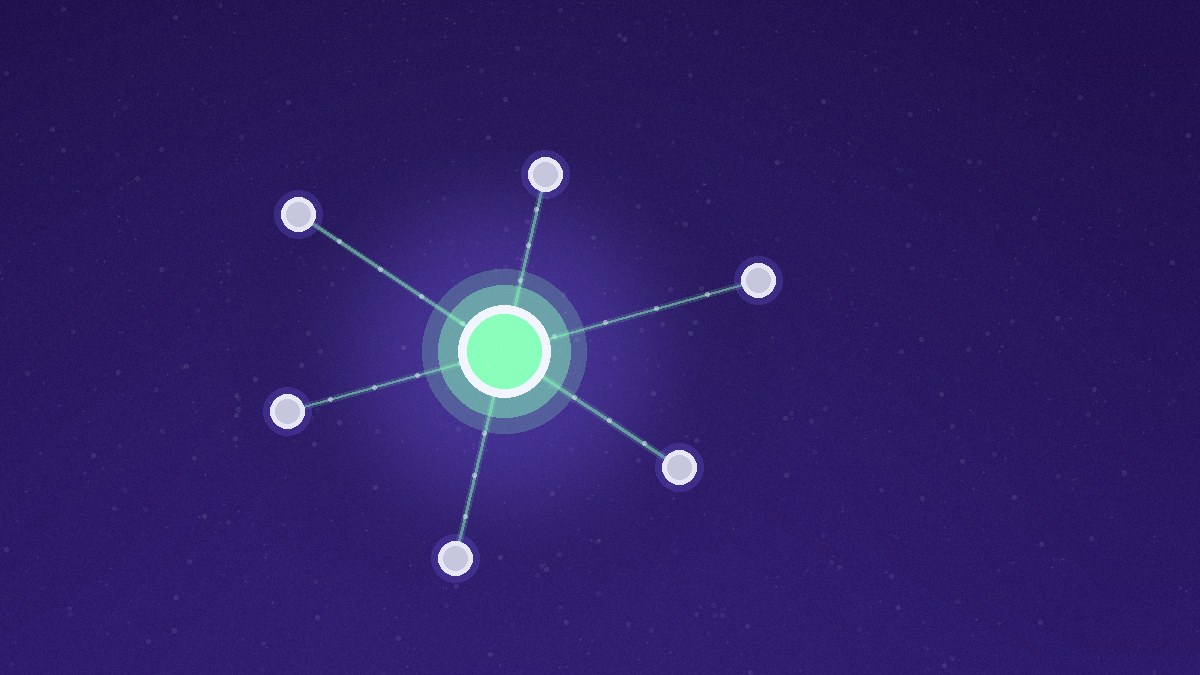
- Cognitive neuroscience settled this decades ago — memory is a graph, not a database. Nodes are concepts and events. Edges are weighted associations. Edge weight is the thickness of association.
- Forgetting is design intent, not a bug. Outdated paths must fade or the map becomes unusable.
- The architectural fix for an agent stack is a knowledge graph that every agent reads from and writes to — a memory layer, not another search index.
Search vs memory: the architectural distinction the LLM hype skips
Pull up the docs for any frontier model. The memory feature is a context window. You can extend it, you can chunk against it, you can layer retrieval over it. What you cannot do is change the underlying shape.
That shape is a sliding window of logs. An archive with a lookup function bolted to one end. When you ask the agent a question, retrieval happens via semantic similarity over uncompressed history. The system fetches what is textually close to your prompt. It does not — cannot — fetch what mattered to the decision you are about to make.
This is search. Search is a very useful primitive. Search is not memory.
A memory system runs a different operation. It scores information at the moment it arrives, decides whether the signal is worth keeping at all, compresses what passes the gate into a structured representation, and lets the rest decay or get dropped entirely. Retrieval against a memory system is a graph traversal over already-compressed, already-valued nodes. Retrieval against a search system is similarity ranking over raw, unweighted history.
If your stack is doing the second and calling it the first, you have a category error baked in at the foundation. Everything you build on top inherits it.
What real memory does that search can't
Three properties separate the two architectures. None of them are nice-to-haves. Each one is load-bearing.
Valuation at encoding, not retrieval
In a search system, every input gets stored. Relevance gets computed at retrieval time — when you query, the system ranks what's already in the index. Valuation runs after the fact.
In a memory system, valuation runs at the door. The system asks: does this input carry decision-relevant signal? If yes, the graph updates — a new node for a novel concept, a new edge for a new association, or a thicker edge on a connection that already existed. If no, the input is dropped. Not down-ranked. Dropped.
This is the part most "AI memory" products skip. They sit on top of an embedding store, encode everything, and rank later. That is search with extra steps.
Compression based on subjective utility
Real memory does not store the world as-is. It compresses the world according to what mattered to the agent doing the storing. The same sales call, heard by your CRO and your support lead, produces two different memory updates, because the two roles value different signals in the same conversation.
A search system has no notion of subjective utility. It indexes the raw text. Whoever queries gets the same ranked window over the same uncompressed corpus. The compression that should have happened at ingestion never happened, so it has to be approximated at retrieval by stuffing tokens at the model until something coherent comes out.
That works for short horizons. It fails at scale.
Forgetting as design intent, not bug
If memory is a navigation engine, then routes you stop walking have to fade. A path-and-distance store that never forgets becomes unusable — the map fills up with roads that no longer go anywhere. Forgetting strips noise to keep signal. Neurons that don't fire together, unwire.
Search systems have no equivalent. The default behavior of an embedding store is to retain. Logs accumulate. The corpus grows. Retrieval has to work harder to find what mattered, because what mattered is now diluted by everything that didn't.
Forgetting is not lossy degradation. It is the mechanism that makes the rest work.
Why agents that "remember everything" fail at scale
Two failure modes are baked into any agent that stores every detail of every interaction. Both are structural. Neither shows up as an error.
The first is overfitting. The agent memorizes specific instances and cannot generalize to new ones. You ask "what did we learn from the Q2 enterprise pipeline?" and the agent returns a verbatim quote from one call instead of the pattern across twenty. It can recite. It cannot abstract. The memorization is too literal to be useful for the next decision.
The second is noise dilution. As stored content grows, the signal that actually mattered becomes a vanishing fraction of total volume. After a year, the ten lines that contained your real ICP insight are buried under sixteen hundred sentences from each of three hundred calls. Retrieval quality collapses with scale — not because the retrieval algorithm got worse, but because the haystack got bigger faster than the needles did.
Both failure modes have the same root. The system never decided what was worth keeping at the door. It stored everything, hoped retrieval would sort it out later, and got punished for that hope.
This is what the "memory is the moat" framing actually means. Storing more is not an axis you win on. The structural limit is the valuation layer, and the teams that build it will pull ahead of the teams that try to brute-force it with bigger embedding stores.
Memory is a graph, not a database
Cognitive neuroscience settled this decades ago. The framing is not novel. It is the working consensus on how biological memory is organized.
Nodes are concepts, events, or locations. Edges are weighted associations between them. Edge weight is the thickness of the association — how strongly two concepts co-activate when one is invoked. The structure is a graph because that is the shape that makes traversal cheap and association natural. Walk one node, the connected nodes light up. Walk a frequent path enough times and the edges thicken. Stop walking a path and the edges fade.
This maps cleanly to an engineering substrate. A knowledge graph for an AI agent looks structurally identical: nodes for entities (a customer, a campaign, a segment, a metric), edges for relationships (this campaign tests this hypothesis against this segment, this customer churned because of this pricing objection), edge weights that strengthen with use and decay without it.
A relational database is the wrong primitive for this. SQL tables enforce a schema designed for atomic facts, not associative weights. You can hand-roll a graph on top of relational storage, but the operation you want, fast multi-hop traversal over weighted edges — is what graph stores were built for.
The shift from "agent memory is a vector store" to "agent memory is a knowledge graph" is the shift that turns search into memory. It is not a feature flag. It is a different shape.
What this looks like in a marketing org's data stack
The abstract version is fine. The concrete version is more useful.
Your marketing organization is probably running somewhere between five and twenty AI agents across paid media, content, lifecycle, attribution, and brand. Each one was deployed at a different time, against a different snapshot of your strategy, with a different local representation of what your ICP is, what your current campaign hypothesis tests, what your North Star metric is this quarter.
None of those agents share memory. Each one has its own context window or its own embedding store, populated with whatever was true the day it shipped. Six weeks later, your strategy team has updated the ICP, deprecated two segments, and changed the funnel model. The agents have not. They are running search over their own private archives.
The fix is not "give each agent more context." That is more search. The fix is one canonical memory layer that every agent reads from at execution time and writes to when it learns something the rest of the stack should know. When the strategy team updates the ICP, the update lands in one node of the graph. Every downstream agent that touches that node on its next run picks up the new definition. No snapshots. No drift.
This is the layer we have been building at Improvado as the core internal substrate for marketing operations. The Miras knowledge graph holds the canonical version of marketing strategy as graph nodes and weighted edges. It sits underneath Improvado's agentic data platform, draws from 1000+ connectors per Improvado's own catalog so the graph stays current with what's actually happening in-channel, and gets deployed in days not weeks. Every campaign agent, attribution agent, and content agent in the stack reads from Miras at execution time — not from a frozen config from the week it was deployed.
The point is the architecture, not the tool. Whatever you build or buy, the shape is the same: one memory layer, many agents, valuation at the door, forgetting by design.
As Daniel Kravtsov has framed it: the agent's real job isn't to do the work. It's to compress the world into the smallest faithful decision somebody can sign their name to. That sentence is the whole thesis. Compression is the job. Storage is not.
A four-question diagnostic: do your AI agents have memory, or just search?
You do not need a consulting engagement to figure out where you sit. You need a five-minute test against four questions.
- At ingestion time, does any layer in your stack score new information for decision-relevance before storing it? If every input goes into the same store and ranking happens later, you have search.
- Do your agents share a single canonical layer for strategic facts — ICP, segments, campaign hypotheses, funnel model — that all of them read from at execution time? If each agent has its own snapshot or its own retrieval index, you have search across multiple silos.
- Does any path in your system fade if it stops being used? If your embedding store only grows, you have an archive, not a memory.
- Can you point to one node in your stack where, if the strategy team edits it, every downstream agent picks up the change on the next run? If updating strategy requires touching multiple agents, configs, or fine-tunes, the canonical layer doesn't exist yet.
Score yourself honestly. Most stacks fail three out of four. A few fail all four and don't realize it because each agent looks fine in isolation.
How to start: don't rebuild your stack, add a memory layer
The reflex when you read all of this is to want a clean rebuild. Don't. Most stacks don't need that.
The staged path that works in practice:
- Pick one orchestrator. Choose the layer that will hold canonical strategic facts as a graph. It can be a knowledge graph product, an agentic data platform with native graph support, or a layer you build. What matters is that there is exactly one.
- Wire one fact first. Start with ICP. Move the canonical ICP definition into the graph. Point one downstream agent — your paid media agent is a good candidate — at the graph instead of its local config. Verify that when the ICP node updates, the paid media agent picks up the new definition on the next run.
- Add the next fact when the first one is stable. Segments next. Then campaign hypotheses. Then voice framework. Then funnel model.
- Deprecate snapshots as you go. As each agent starts reading from the graph, retire its local config. Don't keep both. Two sources of truth is the failure mode you're trying to leave behind.
- Add the valuation gate next. Once the graph is the source of truth, start scoring new inputs at ingestion. Every sales call, every campaign result, every analytics anomaly should pass through a utility filter before it touches the graph. Most of it gets dropped. The fraction that passes thickens the right edges.
Most teams see meaningful behavioral change after the first two facts are wired. The compounding starts when the valuation gate is on and the graph starts forgetting what stopped mattering.
FAQ
What is AI agent memory?
AI agent memory is the layer in an agentic system that decides what information to store, how to compress it, how it relates to other stored information, and what to forget over time. Real agent memory has a valuation step at encoding (deciding what is worth storing at all), structured compression into a graph of entities and weighted associations, and a decay mechanism so unused paths fade. It is structurally different from a context window or an embedding store, both of which are search primitives.
How is AI agent memory different from a context window?
A context window is a sliding window of recent tokens the model has access to during a single call. It does not persist between sessions, does not compress based on importance, and does not maintain relationships between entities. AI agent memory persists across sessions, compresses information based on subjective utility at the moment it arrives, stores entities as nodes with weighted edges between them, and lets unused information fade. The context window is search infrastructure. Memory is a different architecture.
What is a knowledge graph LLM?
A knowledge graph LLM is an architecture that pairs a large language model with a knowledge graph as its persistent memory layer. The graph holds entities (people, customers, campaigns, metrics, concepts) as nodes and relationships between them as weighted edges. The LLM queries the graph at execution time to retrieve structured, relationship-aware context — instead of relying purely on vector similarity over unstructured text. This shape gives the LLM long-term memory with explicit semantics, which is hard to achieve with embedding stores alone.
Why do LLMs need long-term memory?
LLMs without long-term memory restart every conversation. They forget prior decisions, prior corrections, prior context about who you are and what your organization has already settled. For one-off Q&A this is fine. For agentic work — multi-step tasks, multi-session projects, organizational workflows — restarting from zero each time means the agent cannot learn from its own history. Long-term memory turns an agent from a stateless function into a system that accumulates and compounds context over time.
What is AI memory architecture?
AI memory architecture is the design pattern by which an agentic system stores, organizes, valuates, retrieves, and forgets information. A mature memory architecture has at least four components: a valuation layer that scores inputs at encoding time, a structured store (typically a knowledge graph) that holds compressed information with explicit relationships, a retrieval layer that traverses the store at execution time, and a decay mechanism that lets unused content fade. Most current "AI memory" products implement only the retrieval layer and call themselves memory systems — they are search systems with longer histories.
How do you give an AI agent persistent memory?
You give an AI agent persistent memory by adding a layer outside the model that holds structured, valued, relationship-aware information across sessions, and by wiring the agent to read from and write to that layer on every run. The practical pattern is a knowledge graph that holds entities and weighted edges, a valuation step that filters new inputs before they touch the graph, and a decay rule that lets unreinforced edges fade. The model itself stays stateless. The memory lives in the graph, which is what the agent actually queries.
If your AI agents today are sharing one orchestration runtime but no shared memory, the gap is the layer described above. Improvado's agentic data platform pairs the Miras knowledge graph with 1000+ connectors per Improvado's own catalog, so marketing agents read from one canonical memory layer at execution time — connected to the data your platforms are actually producing, deployed in days not weeks. See Improvado's marketing data integrations and Get your demo to see the memory layer in action.
Related reading: Why Pharma Marketing AI Needs an Industry-Specific Knowle...