

For multi-channel consumer brands
Every channel, every fee, one margin you can defend
Amazon, Walmart, Shopify, ad spend, and your ERP in one governed model. True margin by ASIN after every fee — without the twenty-hour sync.
- True margin by ASIN
- Organic vs ad-driven split
- SOC 2 · GDPR · HIPAA
Your data lives everywhere, and none of it reconciles
to extract data from, by hand
Amazon and Walmart portals, DTC, paid social, the ERP — every export pulled by hand, every week.
for one full data sync
The full-account extract runs all day and still crashes — margin lands a day late.
of the numbers in one meeting
Ecommerce, marketing, and finance each bring their own total — the QBR becomes an argument.
Most platforms double-count the same sale. Reconciliation ties every claimed conversion back to your real orders — here's a typical account, reconciled live.
Connect the catalog once — every layer stays governed from there
Wired once, kept live — across the whole marketplace stack
Gross looked healthy. Then the fees landed.
Referral, FBA, storage, and advertising fees quietly take a third of the top line. Every settlement fee is reconciled to each ASIN, so you see real profit per SKU — not a platform-reported number.
- Every Amazon and Walmart fee reconciled from the settlement file, per ASIN.
- Advertising cost folded in, so ROAS and margin read from the same source.
- One true margin the whole team defends, from the SKU up to the board.
Four answers your channel reports can't give you today
True margin by ASIN
Referral, FBA, storage, and ad fees reconciled from the settlement file to each SKU — real profit, not the platform's number.
The ROAS you actually paid for
Ad-attributed revenue separated from organic per ASIN, so budget follows profit instead of the loudest platform report.
Reports that build themselves
Weekly and monthly reporting by line of business generated on schedule, with the same definitions for every team.
Answers on governed data
Anyone can ask a catalog question and get the chart back, grounded in the same governed model finance reads.
What week one looks like with a governed marketplace model
Without Improvado
- Twelve logins, one manual spreadsheet
- 20-hour syncs that crash
- Platform-reported margin, not real
- Every platform grades itself
- Days of analyst time, weekly
With Improvado
- One governed schema for everything
- Selective extraction, your volume
- True margin per ASIN, after 75+ fees
- Organic vs paid split, real ROAS
- Reports build themselves
See it on your own catalog
Bring one messy channel export to the demo. We'll show you what one governed model looks like on your data.
Take the whole story to your team
One page: the marketplace data problem, how the governed model works, and the peer proof — ready to forward to ecommerce, data, and finance.
Get the PDF
One page — problem, model, peer proof.
Something went wrong — please try again.
- The 12-platform / 20-hour / 5-versions problem, quantified
- Selective extraction, ERP join, and true margin after 75+ fees
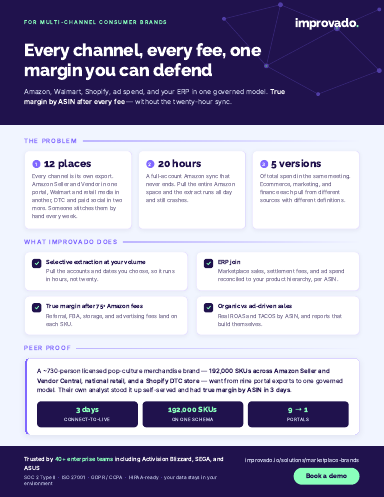
- The 3-day, 192,000-SKU peer story with the numbers
How a licensed-merch brand got there in three days
Connected
Selective extraction starts on the accounts that matter — no services project.
ERP joined
Settlement fees reconciling to the product hierarchy, per ASIN.
Live and signed
Their own analyst ships the dashboards; the team reads one number.
A ~730-person licensed pop-culture merchandise brand — 192,000 SKUs across Amazon Seller and Vendor Central in three countries, national retail, and a Shopify DTC store — went from nine portal exports to one governed model.
- Selective extraction pulled just the accounts and date ranges that mattered, at full catalog volume
- Amazon sales, settlement fees, and ad spend joined to the ERP product hierarchy
- Their own analyst built the dashboards — organic vs ad-driven sales, true ROAS, and margin by ASIN
One margin the whole company can defend
See your Amazon, Walmart, Shopify, ad, and ERP data in one governed model — and what true margin by ASIN looks like on your own catalog.