
Extraction orders
You can find your extraction orders grouped by connections or by data tables.
To see the list of extraction orders related to one of your connections, you need to:
- Select the Connections item in the left menu
- Choose the required connection from the connected sources list.
To see the extraction orders list related to one data table, you need to:
- Select the Data explorer item in the left menu
- Choose the required data table from the list.
- In this case, above the list of extraction orders, you may see a list of load orders related to the same data table.
After this, you will see the overview tab. This tab shows the list of extraction orders for the current connection.
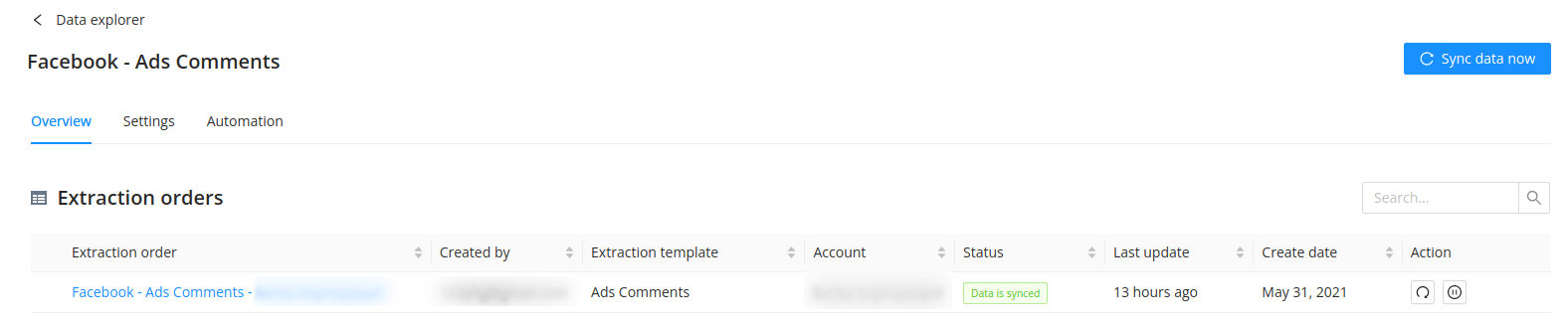
Use the search field to find the necessary extraction order by:
- Extraction order
- Data source (because of extraction order name formation rule)
- Extraction template (because of extraction order name formation rule)
- Account (because of extraction order name formation rule)
Also, you can sort the data ascending or descending in every column except Action.
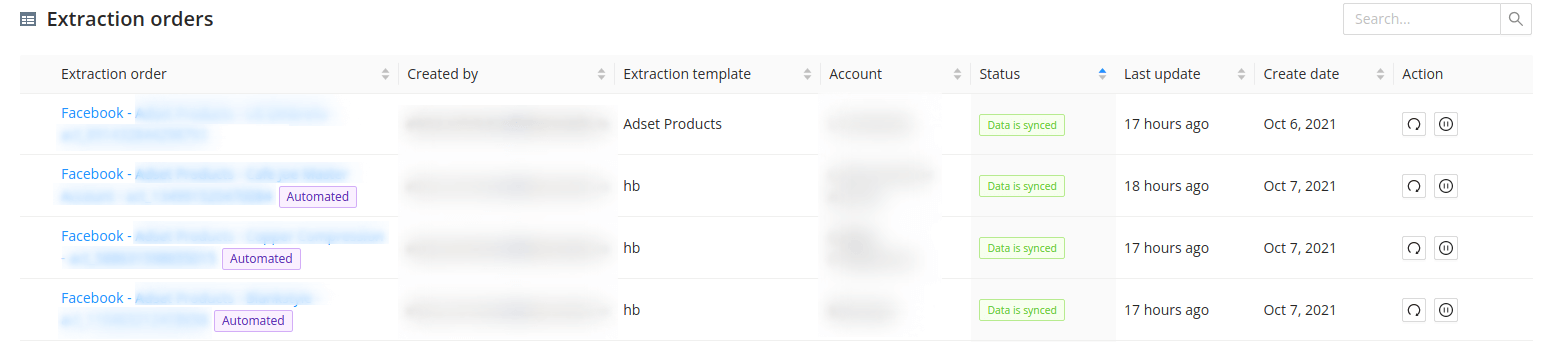
The extraction orders list includes eight columns. Let's look at each of them in more detail.
Extraction order name
The extraction order name is formed according to the Data Source — Extraction Template — Account rule. Extraction orders created via auto-extract have the Automated label next to their names. You can click the extraction order name to dive into its settings.
Created by
Here you see the email of the user who created the extraction order.
Extraction template
This column shows which extraction template you’ve selected when setting up data extraction.
Account
This column shows the account on the data source for which you created this extraction order.
Extraction order status:
- Data is synced - data syncing process is completed successfully
- Syncing - data syncing is in process
- Paused - the extraction order is paused. No data will be extracted according to the schedule
Extraction orders will be automatically paused in the following cases:
- The corresponding connection is deleted from the Improvado platform.
- Any error occurs with the corresponding connection.
- Your account is not available under the corresponding connection.
- Error - something wrong happened, and data was not extracted successfully
To see the description of an issue, you need to click the "plus" icon near the extraction order name.

Last update
Here you can see when the last data sync was completed.
Create date
Here you can see when this extraction order was created.
Action column
There are two icons in this column:
- Run button
- Start/Pause button
You can run extraction order, pause or start data extraction using them.
Please note that you can also use Bulk Actions for multiple selected orders. Learn more.
Note: There is no option to delete the extraction order or your extracted data. You can use Pause instead to pause an extraction. You can always start it again if necessary.
The success message means that the sync process has been successfully initiated, not completed! Until the sync of each extraction order is completed, the error message "Some of Data Table extracts are already running" will appear on repeated click.
Also, you can not run data synchronization while the extraction order is paused. You will see the following error message "Data syncronization was not started, please unpause your extraction order".
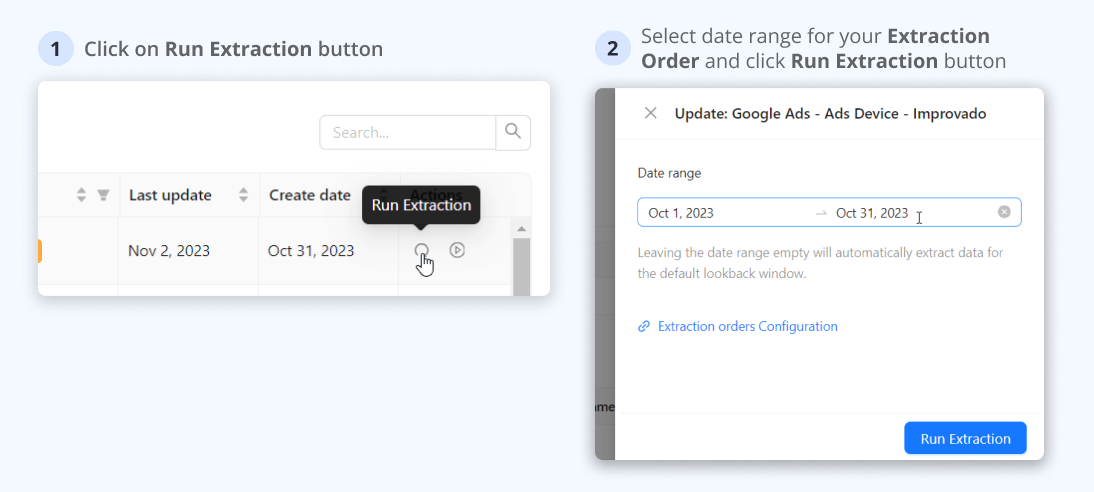
Run Extraction button
Click this button to run the Extraction order for the selected date range.
Related articles
-
How to Backfill Historical Data for Existing Extraction Orders
This instruction includes three simple steps to change historical data depth
-
How to Bulk Edit Extraction Orders Settings
Learn how to update the settings of multiple existing extraction orders simultaneously within one data table
-
How to Configure Extraction Orders
Find out what you need to keep in mind when editing the extraction order settings
-
How to Switch Connection for Existing Extraction Orders
Learn how to Switch Connections for existing Extraction orders
Was this page helpful?
Thanks for the feedback!