

How to Backfill Historical Data for Existing Extraction Orders
Use Sync historical data to reload history for an existing extraction order. For several orders in the same data table, use bulk edit.
Choose the historical range
- Open the extraction order and select its Settings tab.
- Find Sync historical data and choose one of the options below.
- Start from a specific date: select a fixed date in the separate Start date field.
- Default: use the report's current default historical depth.
- Max: use its current maximum allowed depth.
- Custom: enter a depth in the separate Custom historical depth field, within the displayed limits.
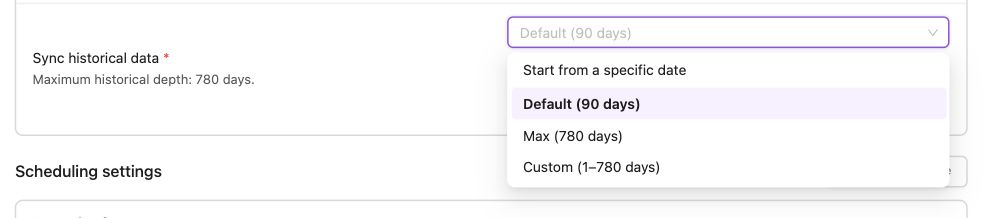
Default, Max, and Custom are rolling ranges: their start moves forward with the current date. Default and Max follow the report's current settings; Custom keeps the depth you chose when the report default changes. Existing fixed dates remain fixed until you explicitly change the mode.
For example, Custom (14 days) loads the last 14 days when history is reloaded. To always start from the same calendar date instead, use Start from a specific date.
Available controls depend on the report. If only a date picker is shown, choose a fixed start date.
Review and apply
- Click Update. If configuration validation is required, wait for it to finish.
- In Review changes, compare the current and new settings. The confirmation tells you when applying the change will reload historical data.
- Click Apply changes, or Back to edit to adjust the draft.
- Open Run history to check the historical run's date range and status.
For an eligible active order, a historical reload changes its status to Syncing. A paused order can be updated, but saving does not unpause or run it automatically.
Limits and scheduled updates
The maximum available history depends on the data source, report, and workspace limits. The form shows the permitted depth. Non-daily reports may cover whole reporting periods. Choosing a shorter range does not delete data that has already been extracted.
Changing the historical range is separate from the lookback window used by regular scheduled runs. A rolling historical range does not request the full range on every scheduled run. See Sync historical data options and Lookback window for details.
Was this article helpful?
Thanks for the feedback!
Questions? The Improvado team is always happy to help. Send us an email, contact your Customer Success Manager, or raise a request in the Improvado Service Desk.