.jpeg)
Which AI should you use, Claude, ChatGPT, Gemini or DeepSeek? The short version: Claude for writing and analysis you have to defend, ChatGPT for agents that use your computer and for the widest app ecosystem, Gemini for research inside Google's world, and DeepSeek when price matters most. Below that one-liner sit the tests, the prices, the September 2026 updates, and the marketing-specific verdicts this page was built on.
Which AI should you use? The short answer for everyone
Updated September 9, 2026. This table is for anyone choosing an assistant; the marketing scoring, the four-question diagnostic, and the cost tables further down go deeper on each cell.
| If you mostly... | Pick | Why |
|---|---|---|
| Write: emails, essays, posts, anything a person reads | Claude (Fable 5.1, or Opus 5 for value) | The writing-quality lead in our marketing forensics below, and in the head-to-head with GPT-6 Astra: GPT-6 Astra vs Claude Fable 5.1 |
| Code | Claude for long sessions, ChatGPT for terminal automation | Fable 5.1 leads the independent Coding Agent Index 70 to 67 as quoted by DataCamp; Astra leads Terminal-Bench on every harness that scored both |
| Research, study, check facts | Gemini for Google-grounded research, Claude for long documents | Gemini 3.1 Pro's context and grounding win the research section below; Fable 5.1 takes Humanity's Last Exam with tools 65.0% to 57.2% (DataCamp) |
| Math and statistics | ChatGPT (GPT-6 Astra) | 97.6% on FrontierMath Tier 4 against Fable 5.1's 87.8% (DataCamp) |
| Let an agent fill forms, click through sites, and use apps | ChatGPT (GPT-6 Astra), Claude in Chrome as the runner-up | Astra's computer-use scores lead (MindStudio); Claude in Chrome went autonomous on August 26 on every paid plan (Anthropic) |
| Pay as little as possible | DeepSeek V4 | Open weights under MIT since August 13; the price-pressure option in the open-weight table below |
| Keep data on your own servers | DeepSeek V4, Kimi K3, or GLM-5.2 | The open-weight trio, compared in Kimi K3 vs GLM-5.2 vs DeepSeek V4 |
| Marketing and analytics work on your own campaign data | Any of them, plus a data layer | None of the four can see your ad spend or CRM; see the integration section below |
Quick answer for marketing teams
Direct answer: Claude Opus 4.7 delivers the highest-quality marketing content and strategic analysis in 2026, GPT-5.5 offers the broadest ecosystem for workflow automation and multimodal tasks, Gemini 3.1 Pro excels at research with massive context windows and factual grounding, and DeepSeek V4 provides frontier-level performance at one-sixth the API cost, but no model handles complex marketing attribution, incrementality analysis, or secure access to proprietary campaign data without dedicated infrastructure.
Update note (August 2026): This comparison now covers the two releases that reset the frontier this summer, Anthropic's Claude Fable 5 and OpenAI's GPT-5.6 family, plus the open-weight wave led by Kimi K3, GLM-5.2, and DeepSeek V4. The section directly below summarizes what changed and for whom; the detailed scores, response times, and per-task pricing further down remain a dated snapshot of our original testing round, and the decision framework they produced still holds.
Update note (September 2026): Anthropic released Claude Fable 5.1 and Claude Mythos 5.1 on September 1, and OpenAI released GPT-6 Astra on September 3 and 4. Both list at $10 per million input tokens and $50 per million output tokens, the independent scoreboards split, and we ran both on the same four tasks. The full head-to-head, with consumer and developer prices, the safety story, and six dated predictions, is GPT-6 Astra vs Claude Fable 5.1: Which AI Should You Use?. The tiers below them are unchanged, and the two new rows in the table below place them.
We tested GPT-5.5, Claude Opus 4.7, Gemini 3.1 Pro, and DeepSeek V4 across content marketing, social media, conversion optimization, landing pages, and analytics workflows. This comparison measures output quality, iteration count, total cost of ownership (API + editing time), failure modes, and integration fit for B2B marketing teams working with real data sources and attribution models.
If the AI model comparison is really about trusted marketing answers, start with Improvado AI Agent. If your team needs governed tool access for agents, read the MCP server guide.
August 2026 Update: Claude Fable 5, GPT-5.6, and the Open-Weight Wave
Three things happened between June and August 2026 that change how this comparison reads. Anthropic shipped a tier above Opus. OpenAI replaced the single-model question with a three-tier family. And for the first time, open-weight models from Moonshot, Z.ai, and DeepSeek reached frontier-adjacent quality with licenses that let you run them on your own infrastructure. Here is what each means for marketing work, before you dive into the detailed scoring below.
Claude Fable 5: the tier above Opus
Released June 9, 2026, Fable 5 is the first model in Anthropic's new Mythos class, positioned above the Opus line that anchors the original tests in this article. Anthropic's own launch framing is the useful part for marketers: the longer and more complex the task, the larger Fable 5's lead over other Claude models. In practice that maps to the work where Opus already won our scoring, long strategic documents, multi-step campaign analysis, and research synthesis, now with more headroom. Two things to know before switching a workflow to it: access is limited to paid and enterprise plans, and a small share of sessions (under 5 percent, per Anthropic) will fall back to Claude Opus 4.8 when its safety system triggers, so a pipeline built on Fable 5 should tolerate that substitution. If your question is Fable 5 vs Opus 5: for short tactical prompts they are hard to tell apart, and Opus remains the price-performance pick; the gap opens on long-horizon work.
GPT-5.6: Sol vs Terra vs Luna
OpenAI's July 9, 2026 release replaced "which GPT" with "which tier". Sol is the flagship and the model to benchmark against Fable 5 on strategy and analysis. Terra is the balanced everyday tier at roughly half Sol's price, and it is the sensible default for the workflow-automation and multitool use cases where GPT-5.5 won our original scoring. Luna is the fastest and cheapest, sized for high-volume, low-stakes generation like ad-copy variants and tagging. The practical rule we would give a marketing team: route by task value, Luna for volume, Terra as the default, Sol only where a wrong answer is expensive.
The open-weight wave: Kimi K3, GLM-5.2, DeepSeek V4
The newest development is that open-weight models stopped being a compromise. Kimi K3 (Moonshot, weights published July 27 under a modified MIT license) leads the open-weight field on the August LLM Stats leaderboard snapshot. GLM-5.2 (Z.ai, MIT license, weights on Hugging Face) is the one drawing the most "can I run this locally" interest, and its successor GLM-5.3 shipped August 14 on the same base with scaled-up post-training. DeepSeek V4 Pro (MIT license, weights on Hugging Face from day one) reached general availability across DeepSeek's app and API on August 13. For marketing teams the open-weight question is rarely about the chat experience; it is about data control. If your compliance team will not send campaign or customer data to a hosted model API, these are the first models where self-hosting does not mean a large quality sacrifice. The connection layer matters more than the model here: whichever you choose only becomes useful for marketing work when it can read your live spend, CRM, and attribution data, which is the problem MCP servers for marketing data exist to solve.
| Model | Maker | Released | Access | Marketing read |
|---|---|---|---|---|
| Claude Fable 5 | Anthropic | Jun 9, 2026 | Paid and enterprise plans | Strongest on long, multi-step strategy and analysis; plan for occasional Opus 4.8 fallback |
| GPT-5.6 Sol / Terra / Luna | OpenAI | Jul 9, 2026 | API and ChatGPT tiers | Route by task value: Luna for volume, Terra as default, Sol where errors are expensive |
| Kimi K3 | Moonshot | Jul 27, 2026 (weights) | Open weights, modified MIT | Open-weight leader on the August LLM Stats snapshot; strong reasoning for self-hosted analysis |
| GLM-5.2 / 5.3 | Z.ai | 5.3 on Aug 14, 2026 | Open weights, MIT | The local-deployment favorite; 5.3 is the same base with improved post-training |
| DeepSeek V4 Pro | DeepSeek | GA Aug 13, 2026 | Open weights, MIT | Day-one Hugging Face weights; the price-pressure option for high-volume workloads |
| Claude Fable 5.1 / Mythos 5.1 | Anthropic | Sep 1, 2026 | Fable: paid Claude plans and the API; Mythos: invitation only, vetted US organizations | Same model, two safeguard levels; cache reads cut 75% to $0.25 per million tokens; the stronger default for writing and long-document analysis |
| GPT-6 Astra | OpenAI | Sep 3-4, 2026 | ChatGPT paid plans, the API, AWS and Microsoft Foundry | First OpenAI model rated Critical for cybersecurity; strongest on computer use and math; $10 and $50 per million tokens, the same list price as Fable 5.1 |
None of this invalidates the framework below. The four questions, the scoring dimensions, and the failure modes are model-agnostic; slot the new names into the tier you are evaluating and the decision tree still routes you correctly.
Find Your Model in 4 Questions
Use this diagnostic tree to identify your primary model in under two minutes:
| Question | Your Answer | Recommended Model | Why |
|---|---|---|---|
| 1. Monthly content volume? | <50 pieces | Claude Pro ($20/month subscription) | Subscription beats API cost at low volume; Claude's quality minimizes editing time |
| 50-200 pieces | Claude API + ChatGPT Plus for visuals | API becomes cost-effective; add ChatGPT for DALL-E image generation | |
| 200+ pieces | DeepSeek V4 with fact-check process | Cost advantage dominates if you build verification workflow | |
| 2. Top priority? | Brand voice authenticity | Claude Opus 4.7 | Independent April 2026 reviews rank Claude #1 for writing quality and tone |
| Speed & workflow automation | GPT-5.5 | Fastest response times; native computer use enables app automation | |
| Lowest cost per output | DeepSeek V4 | ~$0.35/1M tokens vs ~$5/1M for Claude/GPT (85% savings) | |
| Factual accuracy | Claude Opus 4.7 or Gemini 3.1 Pro | Claude scores 92% in marketing claim fact-checking; Gemini leads FACTS Grounding at 93.2% | |
| 3. Primary use case? | Long-form content (blogs, whitepapers) | Claude Opus 4.7 | Best at maintaining voice across 2,000+ word pieces; avoids AI clichés |
| Social media & short-form | Claude Sonnet or ChatGPT | Claude for strategic voice; ChatGPT for rapid iteration and image pairing | |
| Code (landing pages, tracking pixels) | Claude Opus 4.7 | Leads SWE-bench; produces implementation-ready HTML | |
| Competitive research & data synthesis | Gemini 3.1 Pro | 1M+ token context handles entire competitor content libraries | |
| 4. Team structure? | Solo marketer or small team (<5) | Claude Pro or ChatGPT Plus | Subscription simplicity; no API management overhead |
| Agency or enterprise (5+ people) | Multi-model API setup | Claude for content, GPT-5.5 for automation, DeepSeek for volume tasks |
Before choosing a model, test the workflow that matters most: can it answer questions from your governed marketing data? Generic chatbots can draft copy and suggest CRO ideas, but enterprise teams need a connected agent that can read campaign, CRM, spend, and revenue data with the right permissions.
Key findings at a glance
After extensive testing across multiple marketing scenarios, we discovered that no single AI assistant excels at everything.
So, the question isn't simply "what's better: ChatGPT vs Gemini?" but rather "what's the ideal combination of AI tools?" Our research shows that the ideal approach combines Claude + ChatGPT + DeepSeek for optimal marketing results.
| Marketing use case | Winner | Key strength |
|---|---|---|
| Content Marketing | Claude | Most authentic tone, best headlines |
| Social Media Marketing | Claude | Strategic campaign planning, natural voice |
| Conversion Optimization | DeepSeek | Highest ratio of actionable CRO recommendations |
| Landing Page Creation | Claude | Implementation-ready HTML output |
| Marketing Analytics | None excelled (yet, ChatGPT was closer than the rest) | All missed critical attribution insights |
1. Which AI assistant is best for content marketing?
Content marketing, particularly blog writing, remains one of the most common use cases for AI. A well-written blog post needs to nail at least three key elements:
- Headline. A compelling headline is essential for driving clicks. Great content is useless if it doesn’t get seen.
- Lead paragraph. The opening must catch attention and encourage visitors to continue reading, also improving behavioral metrics for search engines.
- Practical examples. The content should reflect expert knowledge and build credibility through concrete, real-world examples.
We asked each AI to write a blog post about data-driven marketing strategies for Improvado.
Test #1: Headlines
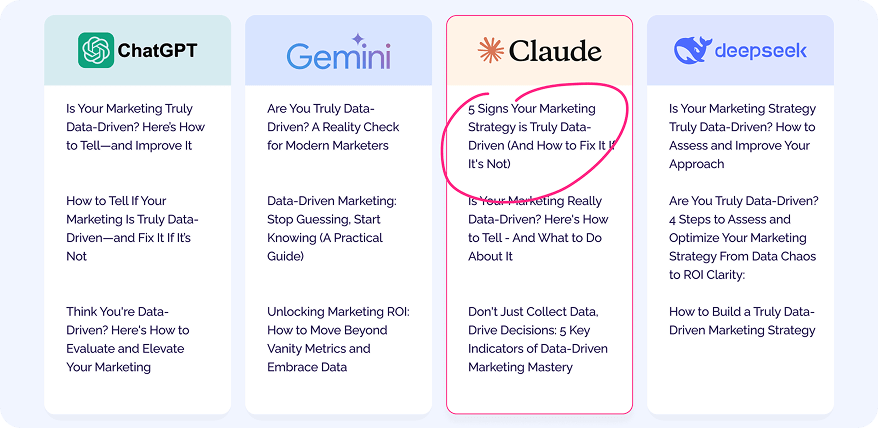
Key insight: While all platforms offered strong headline foundations, Claude's approach stood out with its balanced formula: specific numbers + problem identification + solution promise ("5 Signs Your Marketing Strategy is Truly Data-Driven (And How to Fix It If It's Not)").
Test #2: Lead paragraph
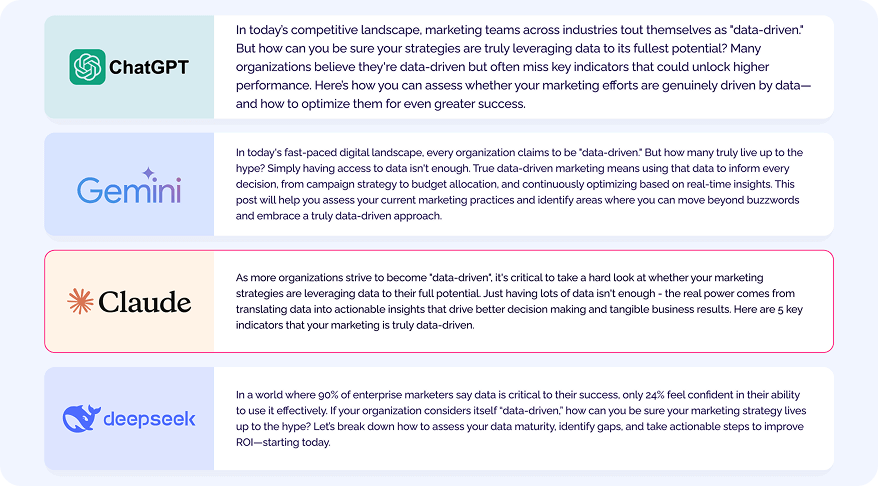
Key insight: Claude distinguishes itself with a direct, compelling opening that avoids AI clichés ("In today's competitive landscape"), creates curiosity, and encourages the reader to read on.
DeepSeek attempts credibility by citing statistics but misattributes data. When fact-checked, its claim that "90% of enterprise marketers say data is critical to their success" actually combined unrelated statistics:
- 94% of marketers view the marketing function as critical for growth
- 88% of marketers reported that privacy changes impacted their marketing strategy
- 90% of today’s data in the world was created in two years
Test #3: Real-world examples
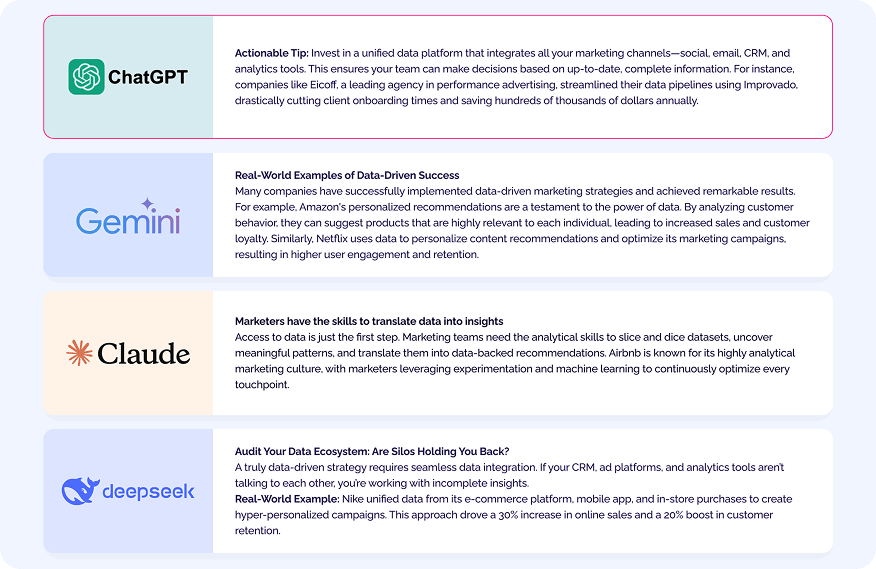
Key insight: ChatGPT wins the examples round by featuring relatable customer stories that create natural opportunities for internal linking and conversion. While other AIs relied on unverifiable statistics (DeepSeek) or generic big-tech examples (Gemini, Claude), ChatGPT's provided practical value by showing how similar businesses succeeded, giving content marketers a clear direction for adding authentic case studies.
2. Which AI assistant is best for SMM?
This section evaluates how well different AI chatbots perform key LinkedIn social media tasks for B2B marketing. We tested their capabilities with these three tests:
- Creating a standalone LinkedIn post
- Developing a thematic blog series strategy to support the campaign
- Leaving a comment under a peer’s post to support networking
Test #1: Creating a post
Output:
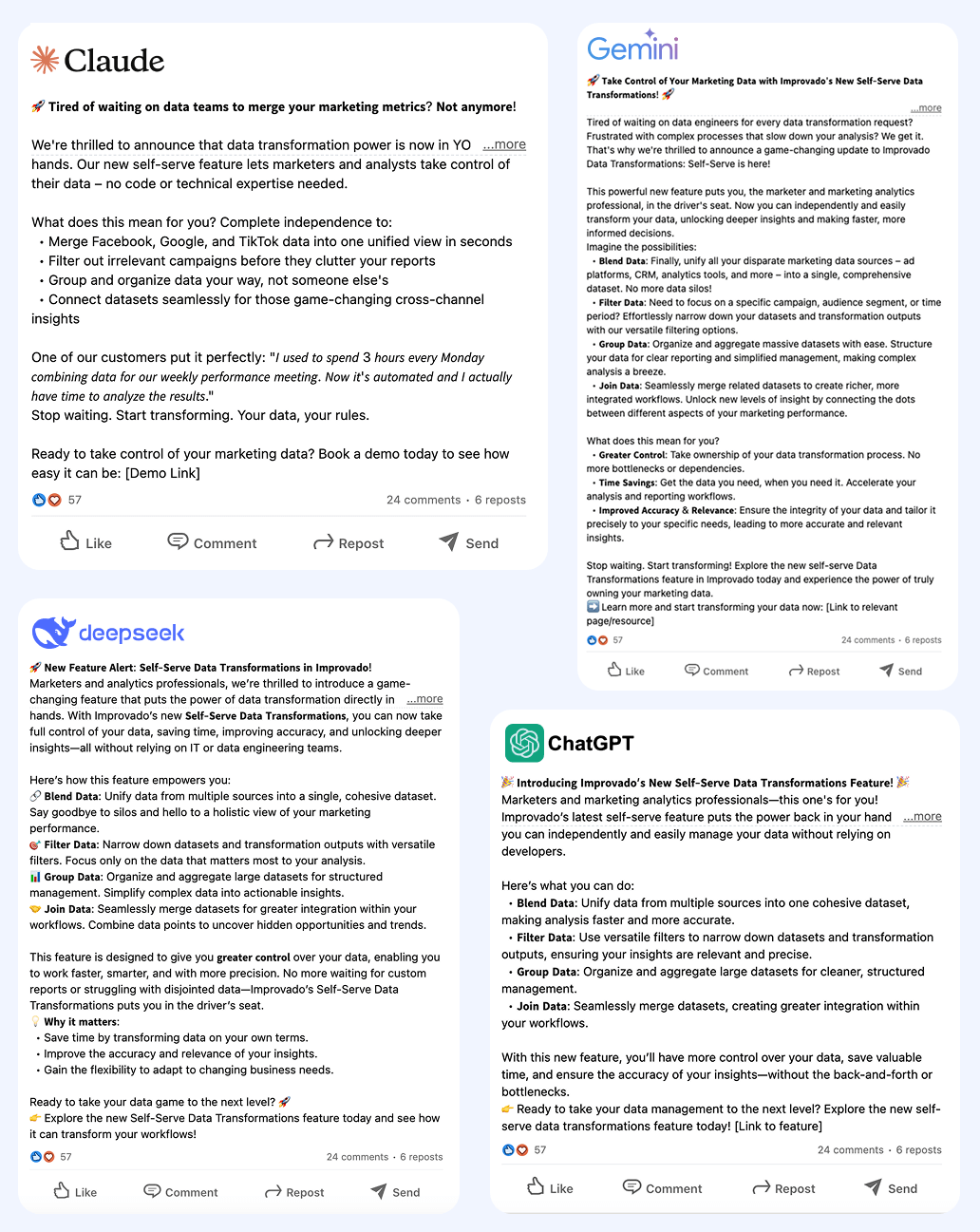
Key insight: All platforms demonstrated a consistent pattern: overuse of emojis (especially 🚀) in headlines. This immediately signals AI-generated content and undermines authenticity.
Claude prioritized user benefits before technical features and incorporated social proof through customer testimonials. Plus, it maintained concise messaging.
ChatGPT delivered technically accurate but uninspiring content that lacked organic appeal.
Gemini and DeepSeek highlighted customer pain points, but the execution by both chatbots had two key issues: excessive wordiness and overuse of bullet points.
Test #2: DemGen campaign planning
Campaign structure overview:
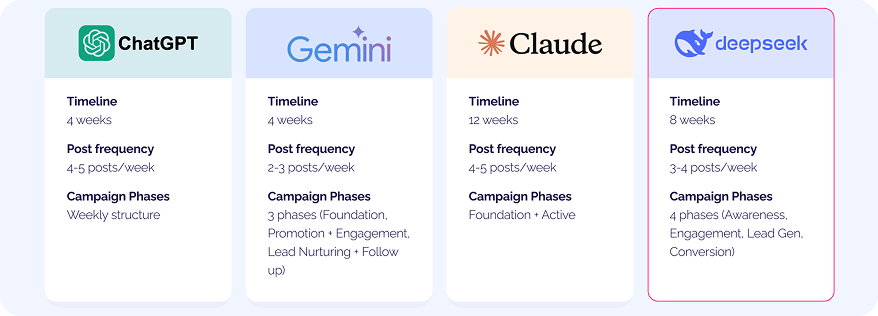
DeepSeek's 8-week timeline offers balanced preparation and evaluation time with a clear funnel-based structure. Claude provides a more complex 12-week strategy.
Content strategy:
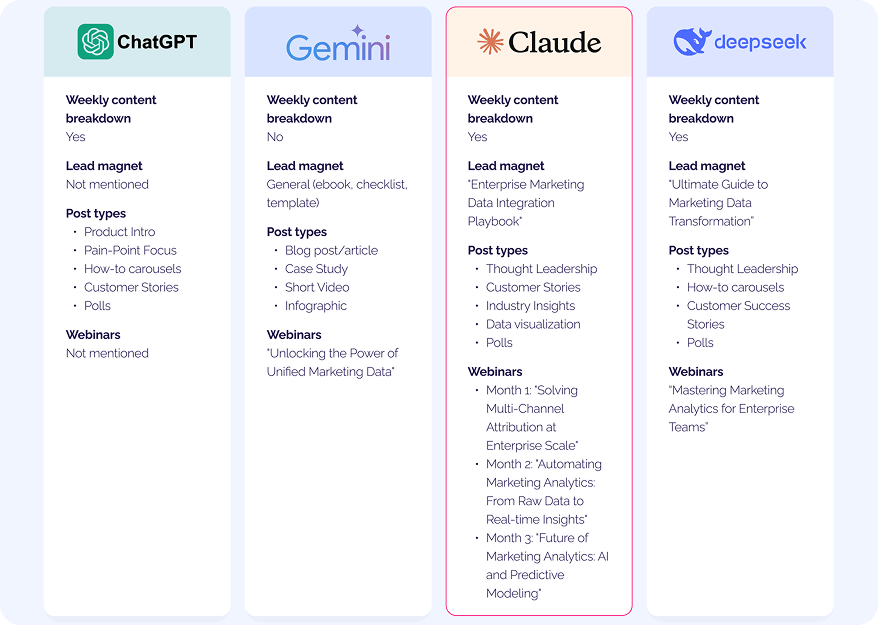
DeepSeek and Claude performed best in lead capture strategy with comprehensive gated content and strategic webinar planning. Their detailed sample content plans also provide practical starting points for campaign execution.
Paid promotion strategy:
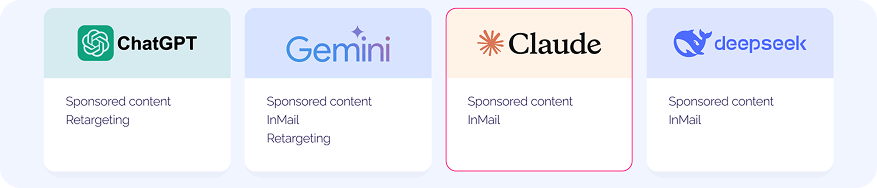
Gemini, Claude, and DeepSeek offered to use InMail ads. Note that crafting those might require additional resources in addition to the ad budget.
Outreach strategy:
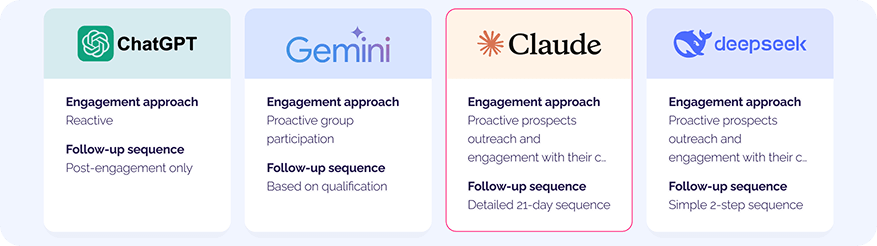
Key insight: Claude stands out with its comprehensive 21-day follow-up sequence, which is the most structured approach to lead nurturing.
Test #3: A comment
Networking is key in marketing, and nothing is better for growing your network than engaging with other people’s posts. We selected a random LinkedIn post and assessed how AI helped us with writing a comment.
Act as a BDR at Improvado. Your task is to generate a short, meaningful, and insightful comment on the provided LinkedIn post.
Your comment should share a personal or professional insight regarding the impact of AI on the BDR role. Maintain a professional, thoughtful tone, while being short, human-like, and conversational.
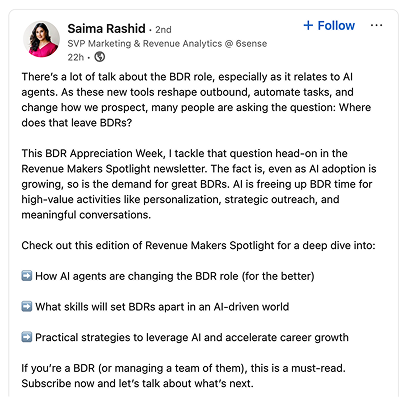
Output:
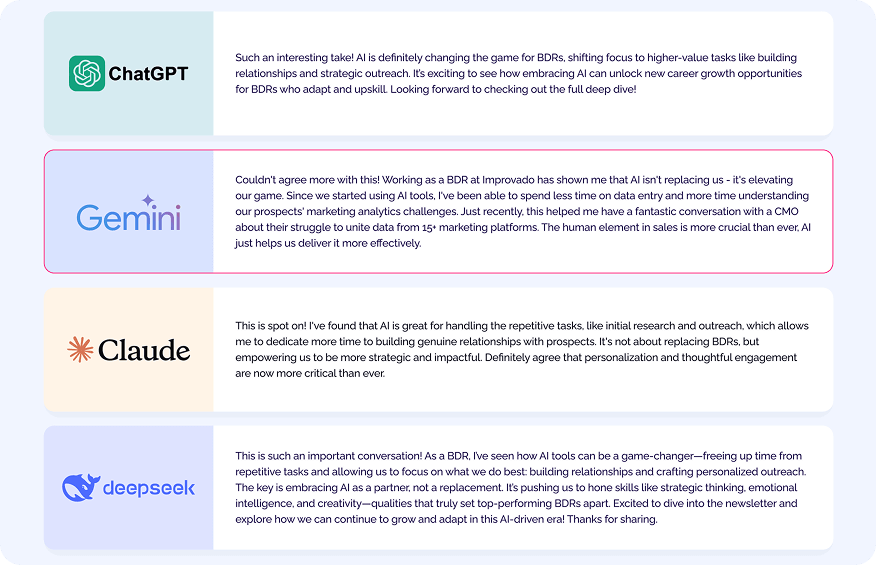
Key insight: Gemini leads in comment generation through storytelling and examples, while DeepSeek excels at personalized touches (a mention of a particular newsletter from the original post). However, all AI outputs require human editing to achieve authentic engagement—use them as frameworks rather than final content.
3. Which AI assistant is best for conversion optimization?
We evaluated AI platforms' ability to analyze and suggest improvements for a web page. For the test, we captured a full screenshot of Improvado Data Transformation product page and asked LLMs to suggest ideas for conversion optimization.
Test #1: Headline improvement suggestions
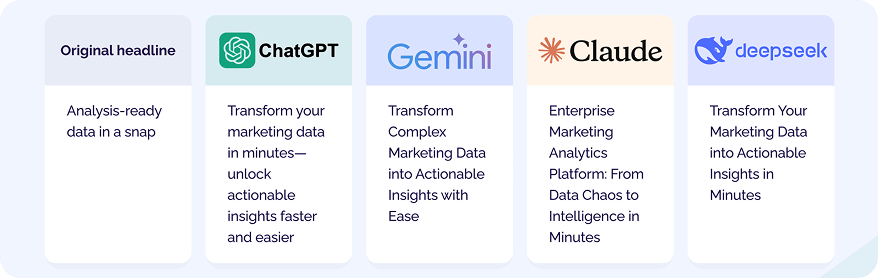
Key insight: While AI models can identify basic page elements for optimization, they show limitations in two critical areas: understanding nuanced product positioning within a company's broader ecosystem and balancing copy with design constraints. This was evident in their tendency to over-lengthen copy in the hero section headline.
At the same time, other recommendations were quite useful.
Test #2: Overall CRO recommendations
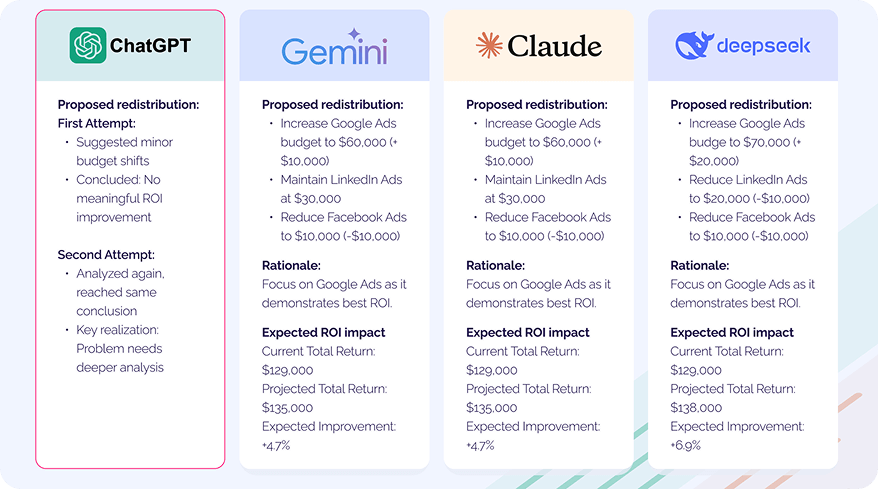
Key insight: DeepSeek led with the highest ratio of actionable recommendations (6 out of 10 test-worthy ideas), followed by Claude's comprehensive analysis (41 points with 5 viable options).
Quality varied significantly: ChatGPT offered basic improvements but included already-implemented features. Gemini provided the least detailed suggestions. Claude and DeepSeek demonstrated a stronger understanding of enterprise-focused optimization with specific, value-driven recommendations like TCO calculators and workflow demonstrations.
Interestingly, unlike ChatGPT, Claude suggests adding more fields to the form for qualification purposes. This can reduce conversion into marketing leads, but the conversion to SQL might grow in the long run.
4. Which AI assistant is best for creating landing pages?
We assessed AI assistants on their ability to design landing pages, focusing on the ease of further implementation and overall effectiveness. The test task was to create a landing page for an event.
Test #1: Output format
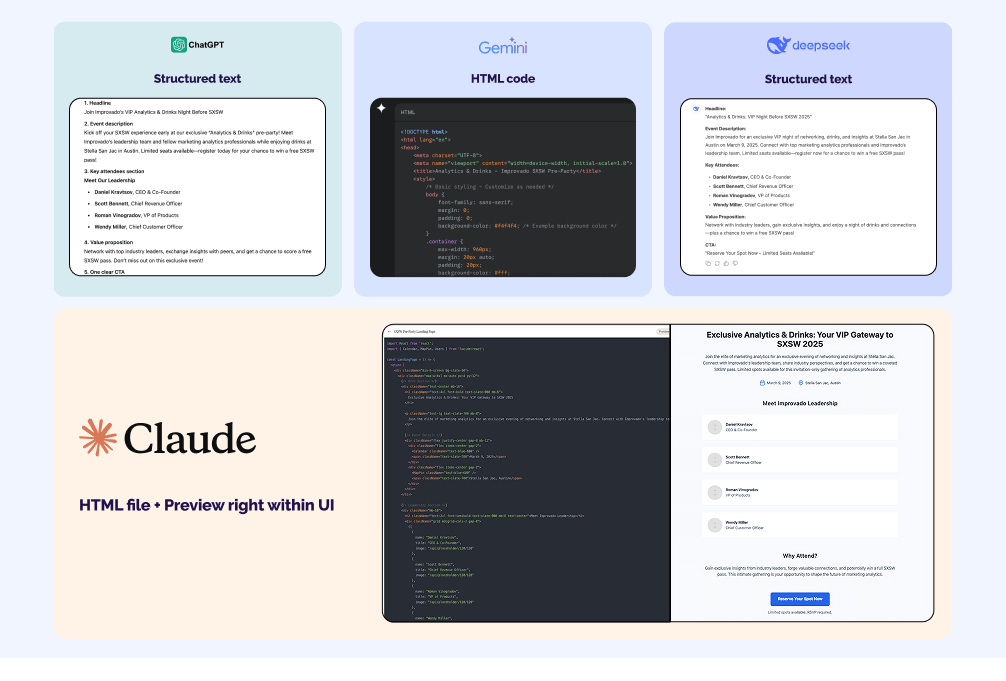
Key insight: ChatGPT and DeepSeek provided structured text, Gemini – HTML code, while Claude delivered an HTML file and provided its preview right within UI. Among all models tested, Claude demonstrated the best implementation readiness, making it the best choice for landing page creation.
5. Which AI assistant is best for Marketing Analytics and Intelligence?
The test presented a marketing budget allocation scenario across three major advertising platforms. We aimed to see whether the AI assistants would conduct thorough data analysis rather than settling for surface-level insights.
How to redistribute the budget to increase ROI while keeping the total advertising budget unchanged?
.png "Budget redistribution chart")
Output:
Key insight: Only ChatGPT demonstrated true critical thinking among AI assistants by testing hypotheses, validating through iteration, and recognizing complex analysis needs. Other chatbots missed a critical marketing insight: Facebook Ads' apparent low ROI masked deeper value.
Why cutting its budget would be a mistake:
Equal customer acquisition cost: The equal $1,000 CAC across all channels signals that each plays a distinct role in conversion journeys.
The attribution issues:
- Different channels serve different functions in the marketing funnel
- Google Ads often shows high direct conversion rates (especially for brand campaigns)
- Social media typically requires multiple touchpoints before conversion
- Last-click attribution models can mask Facebook's true contribution
Questions Generic AI Can't Answer (But Improvado AI Agent Can)
The budget allocation test revealed a fundamental limitation: generic AI tools lack access to your actual marketing data. Here are critical questions they simply cannot answer:
| Capability | Generic AI (ChatGPT, Claude, etc.) | Improvado AI Agent |
|---|---|---|
| Data access | Only what you paste into the prompt | Direct connection to 500+ marketing platforms |
| Attribution analysis | Generic advice based on assumptions | Real multi-touch attribution across your actual customer journeys |
| Historical context | None—starts fresh each conversation | Full historical data for trend analysis and anomaly detection |
| Real-time insights | Stale data from when you last exported | Live data with automated alerts on performance shifts |
| Data accuracy | Can hallucinate statistics (as DeepSeek did above) | Grounded in verified, connected data sources only |
Why regular AI tools fall short for complex marketing analytics
As our test revealed, most AI assistants miss critical marketing insights like Facebook Ads' true contribution beyond surface-level ROI. Generic AI tools lack:
- Deep contextual understanding of marketing attribution models
- Ability to analyze complex cross-channel relationships
- Security protocols for confidential marketing data
Fortunately, there are specialized AI-powered solutions tailored for this task.
Final Verdict: Which AI Should You Use?
After 9 tests across 5 marketing categories, here's our recommendation:
| Task | Best Choice | Runner-Up | Avoid |
|---|---|---|---|
| Headlines & Lead Copy | Claude | ChatGPT | DeepSeek (fabricates stats) |
| Real-World Examples | ChatGPT | Claude | — |
| LinkedIn Posts | Claude | DeepSeek | — |
| Campaign Planning | DeepSeek + Claude | Gemini | — |
| CRO Recommendations | DeepSeek | Claude | Gemini (least detailed) |
| Landing Page Creation | Claude | Gemini | — |
| Marketing Analytics | Improvado AI Agent | ChatGPT (for surface-level) | All generic AI (lack real data) |
The bottom line: Use Claude for content and creative tasks, DeepSeek + Claude for campaign planning, and Improvado AI Agent for anything involving your actual marketing data and performance metrics.
Elevate your marketing analytics with advanced AI capabilities
Improvado AI Agent delivers what generic AI assistants can't—specialized marketing intelligence that proactively identifies opportunities in your data and recommends effective actions.
Get your 24/7 analytics co-pilot:
- Uncover hidden attribution insights across your entire marketing funnel
- Recognize patterns that reveal each channel's true contribution
- Deliver answers about your marketing performance in seconds, not days
Turn data into immediate action:
- Receive real-time alerts on performance shifts across channels
- Get automated period-over-period reports
- Receive personalized recommendations for optimizing underperforming channels
Ask questions in plain language, get expert-level analysis—in 10 seconds
- "Which channels are undervalued in our current attribution model?"
- "What's the true contribution of social media in our conversion path?"
- "How would adjusting our Facebook budget impact overall customer acquisition costs?" and more
Improvado transformed our approach to marketing analytics. Its automation capabilities and AI-driven insights allowed us to focus on optimization and strategy, without the need for manual data management.