

AI Dashboards
Overview
AI Dashboards let you build flexible, interactive analytics views directly inside Improvado — from quick AI-generated layouts to fully custom dashboards built from scratch. Visualize your data, apply global filters, compare performance over time, and share dashboards with anyone, even outside Improvado.
Creating a New Dashboard
There are three ways to create a dashboard:
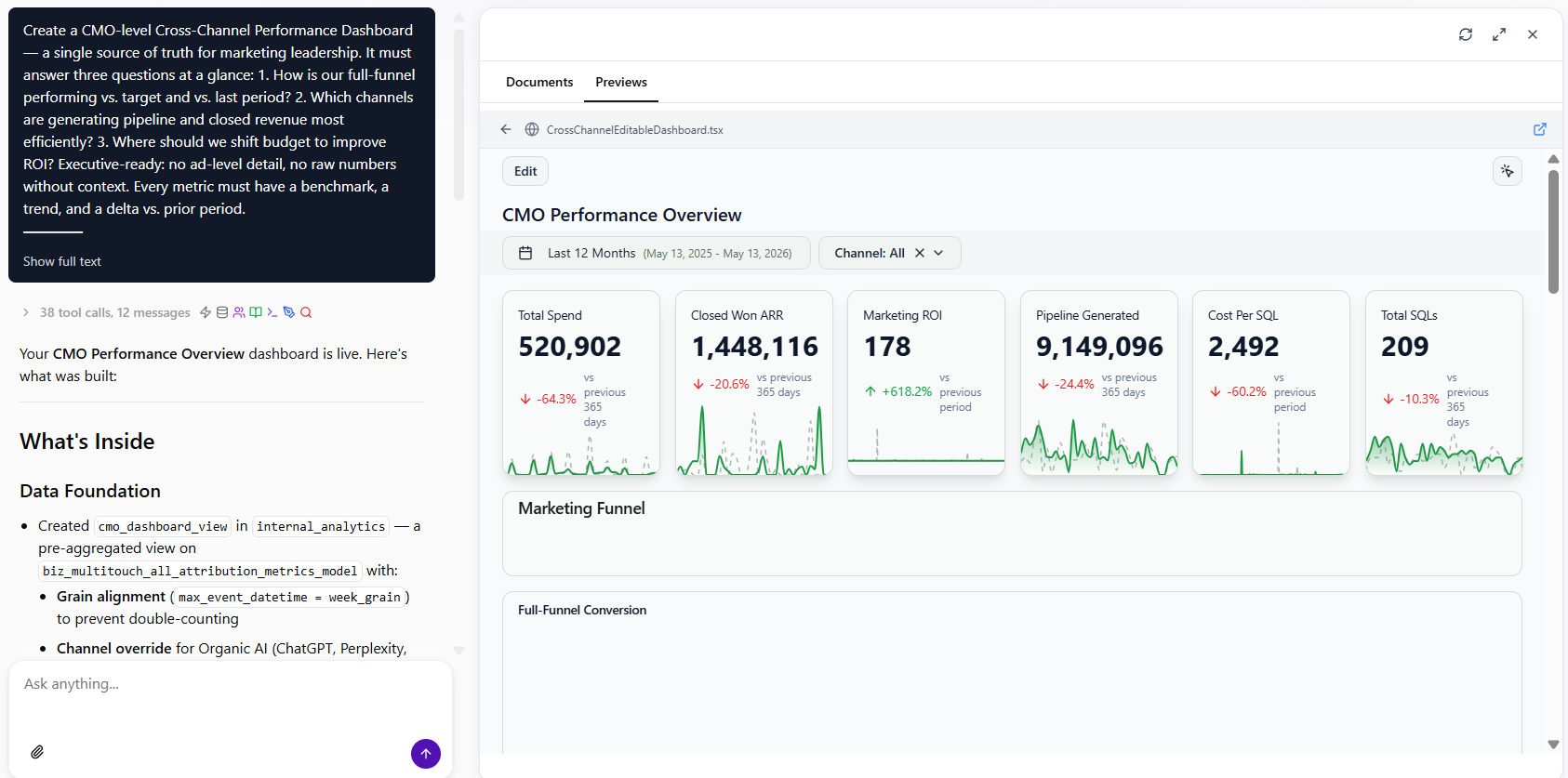
Describe to AI Agent — Open the AI Agent and describe what you need in plain language. The Agent builds the layout, selects widgets, and connects your data automatically.
Use cross-channel template — Start with a pre-built dashboard and customize it to fit your needs.
Start with a blank grid — Full control over widgets, data sources, and layout from scratch.
All three options use the same underlying system and can be customized at any time.
Create a Dashboard with AI Agent
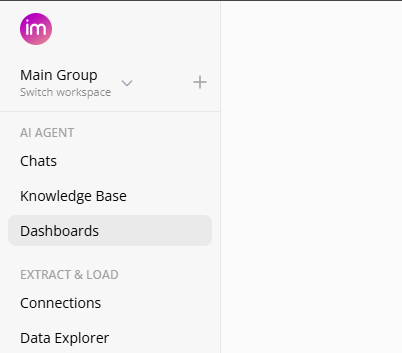
Open the AI Agent from the sidebar.
Describe the dashboard you need in plain language — for example, "Build me a CMO dashboard with spend, ROAS, and CPA by channel for the last 90 days."
The Agent builds the layout, selects the right widgets, and connects your data automatically. Review the result and request adjustments directly in the chat.
You can also use a prepared prompt for common dashboard types. For ready-to-use prompts, see the Create Dashboards with Detailed Prompts guide.
Chat with the AI Agent on a Dashboard
Click Chat in the dashboard header, or press Cmd+J (Ctrl+J on Windows), to open the AI Agent in a panel on the right side of the dashboard. The dashboard stays open next to the chat, and the Agent already knows which dashboard and page you are looking at, its data table and the filters you have applied.
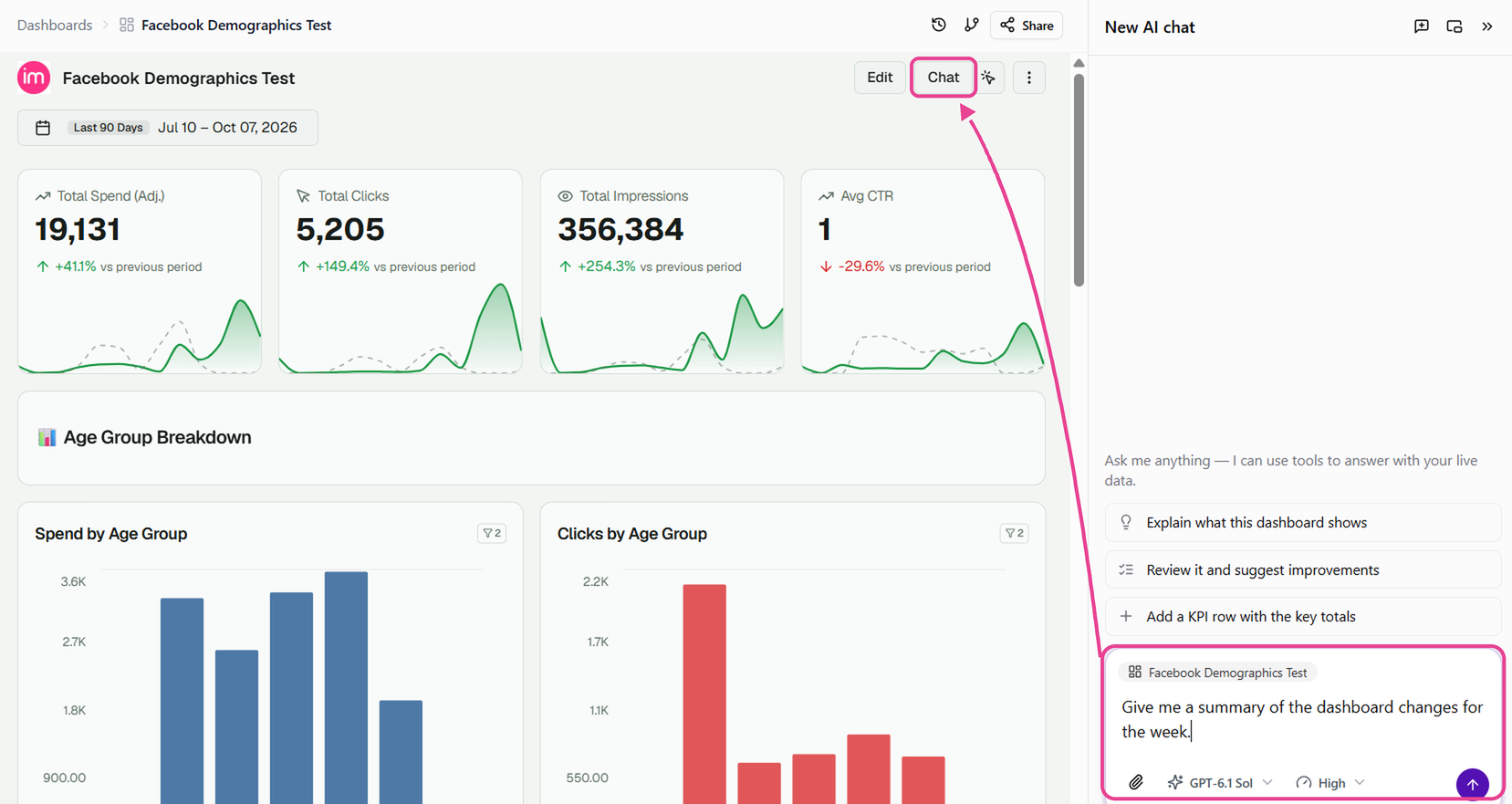
When the Agent changes the dashboard — adds a widget, edits a chart, updates filters — the dashboard refreshes in place, without reloading the page. If you have unsaved changes in Edit Mode, the Agent's update does not overwrite them: a banner lets you decide when to reload.
- Resize or pop out — drag the left edge of the panel to resize it, or switch it to a floating window from the panel header.
- Pick up where you left off — the panel reopens your last chat for this dashboard.
- Open as a full chat — continue the same conversation in the AI Agent.
Ask About a Specific Widget
Use Annotate (the cursor icon next to Chat) to ask about one widget. Click the button, click the widget, and type your question in the box that appears next to it. The question goes to the chat panel together with the widget's context, so the Agent knows exactly which widget you mean. When the dashboard is open inside an AI Agent chat, Annotate adds the widget to that chat's message box instead.
Annotate works on every widget type, including custom components. Press Esc to cancel.
Chat and Annotate are available to users with access to the AI Agent. They are not shown to view-only users or on shared links.
Create a Dashboard Manually
To create a dashboard:
- Click Dashboards
- Click + New Dashboard
- Choose how you want to start:
- Start with a blank grid
- Use cross-channel template
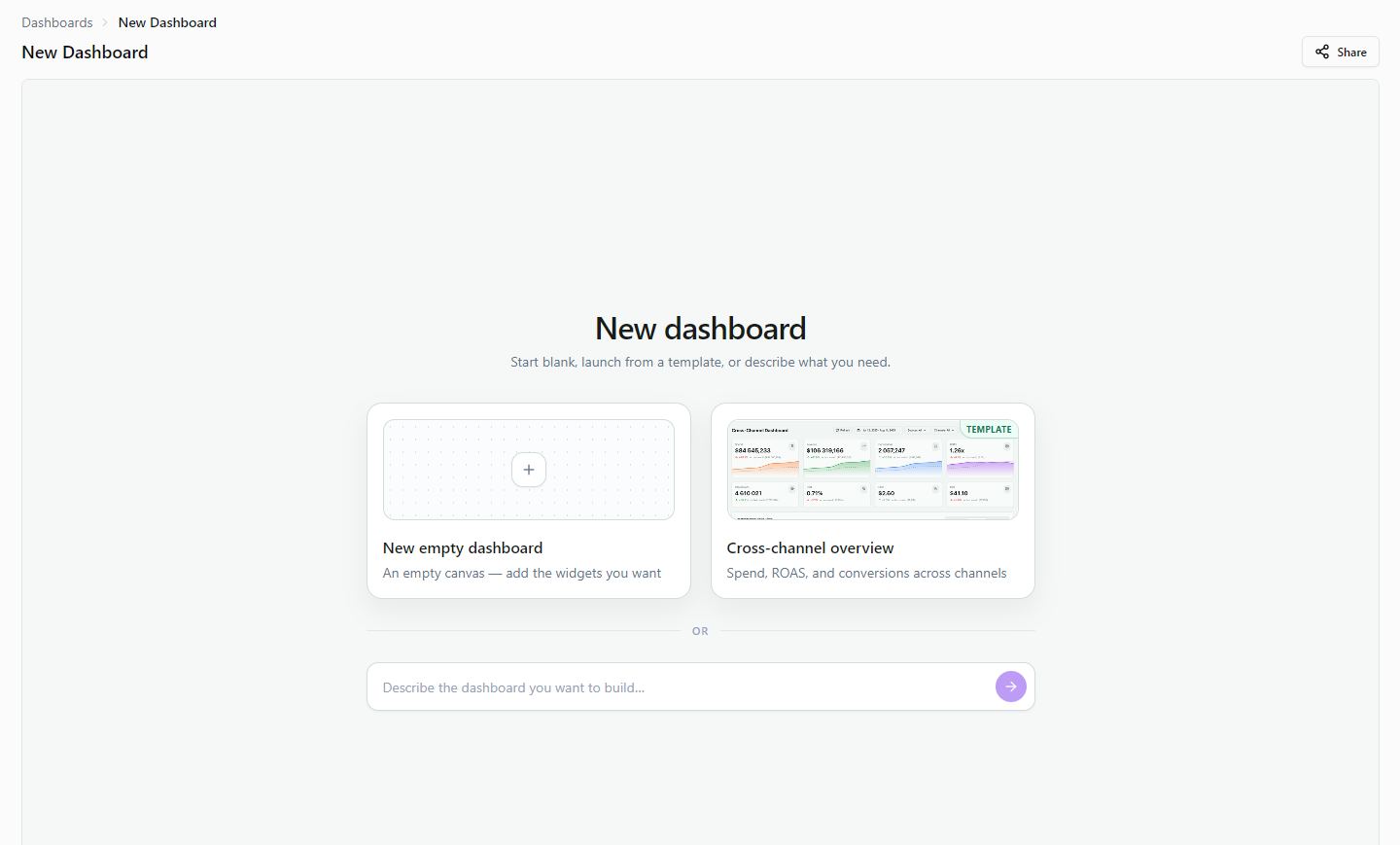
Blank Grid
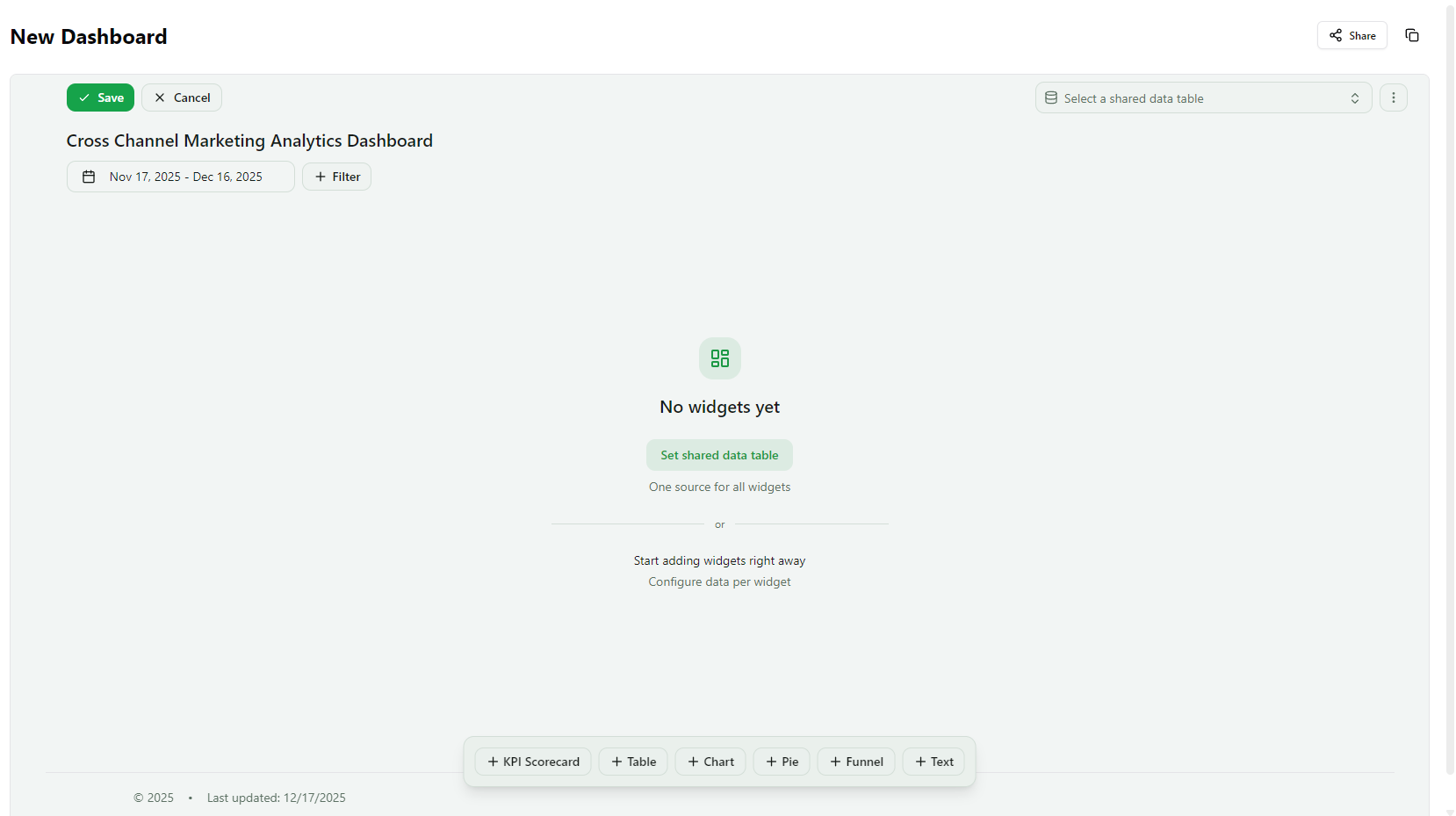
Use a blank grid when you want full control from the start. This option creates an empty dashboard where you can add and configure widgets manually.
Cross-Channel Template
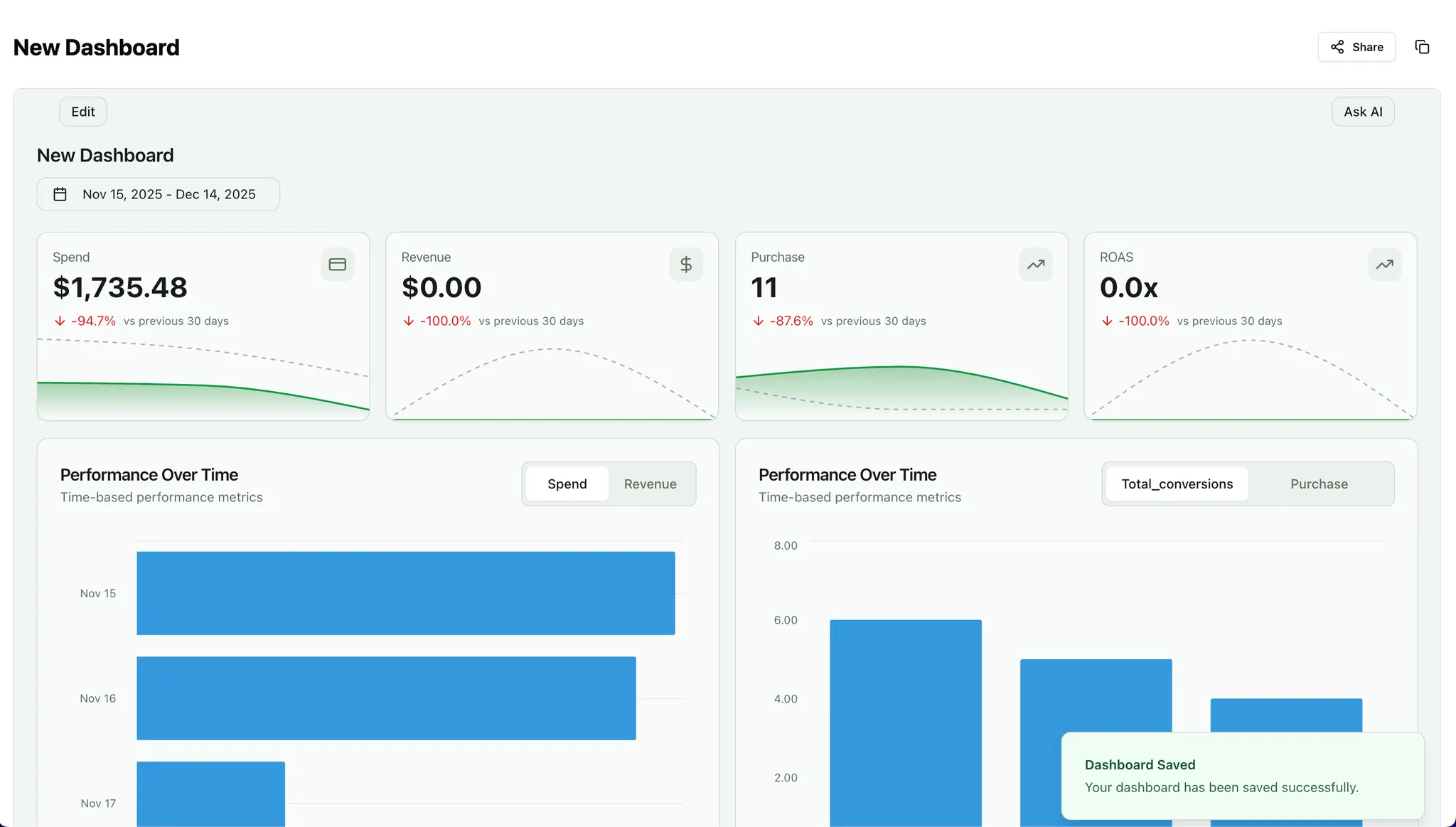
Templates provide a ready-to-use structure with common KPIs and charts already configured. They are ideal for quick analysis and follow Improvado best practices.
Dashboard Components
Once a dashboard is created, you enter Edit Mode, where you can configure data, widgets, and layout.
Key elements of the dashboard:
- Date range selector
- Global filters
- Default data table
- Widget toolbar
- Drag-and-drop canvas
Default (Dashboard-Level) Data Table
Each dashboard can use a default data table, which acts as the default data source for all widgets.
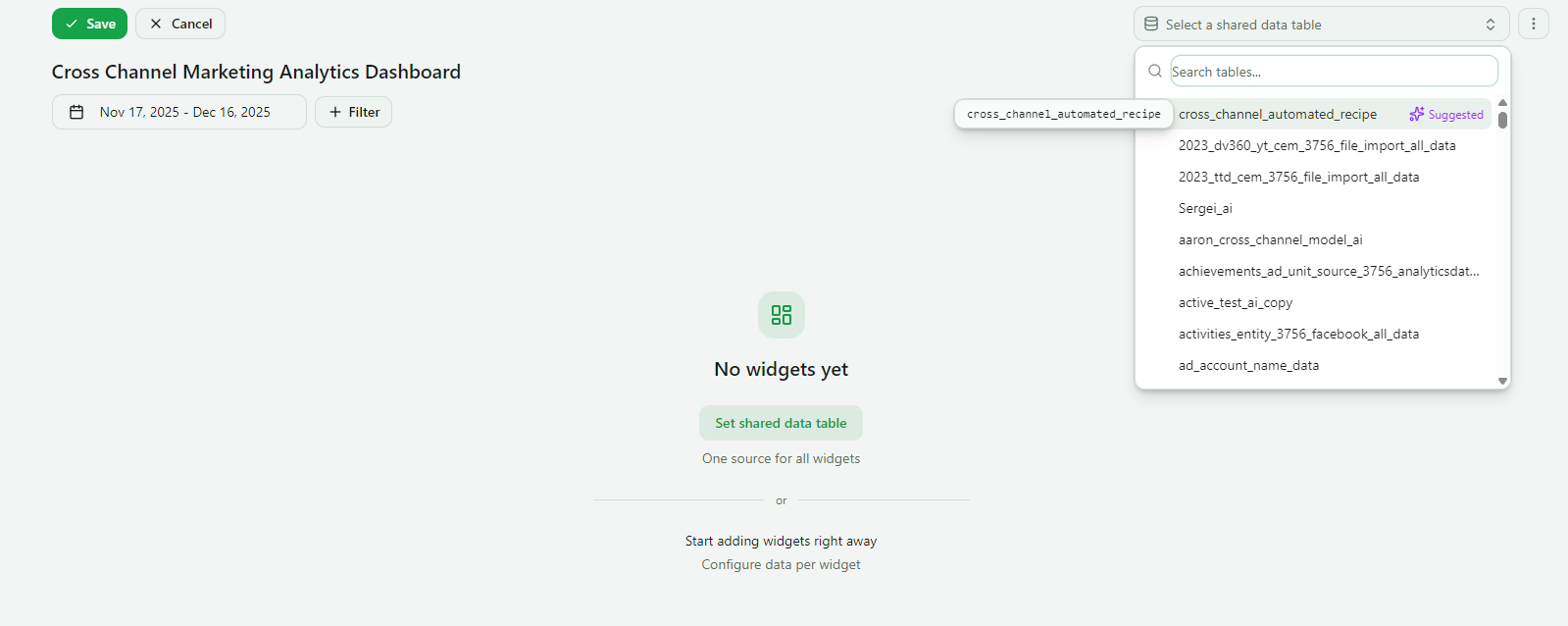
- The default table is selected at the top of the dashboard
- All widgets use it by default
- Individual widgets can override it with their own table if needed
This allows you to:
- Keep dashboards consistent
- Reduce repetitive configuration
- Still support advanced, widget-specific use cases
Adding Widgets
You can add the following widget types:
- KPI Scorecard
- Table
- Chart (Bar, Line, Area, Composed)
- Pie
- Funnel
- Text
- Heatmap
- Sankey
- Geo Map
- Creatives Gallery
- Custom Component
Widgets can be added from the toolbar and placed anywhere on the canvas. For a complete reference on each widget type and its configuration options, see Widget Types Reference.
Widget Configuration
Each widget has a Properties panel that controls its behavior and appearance.
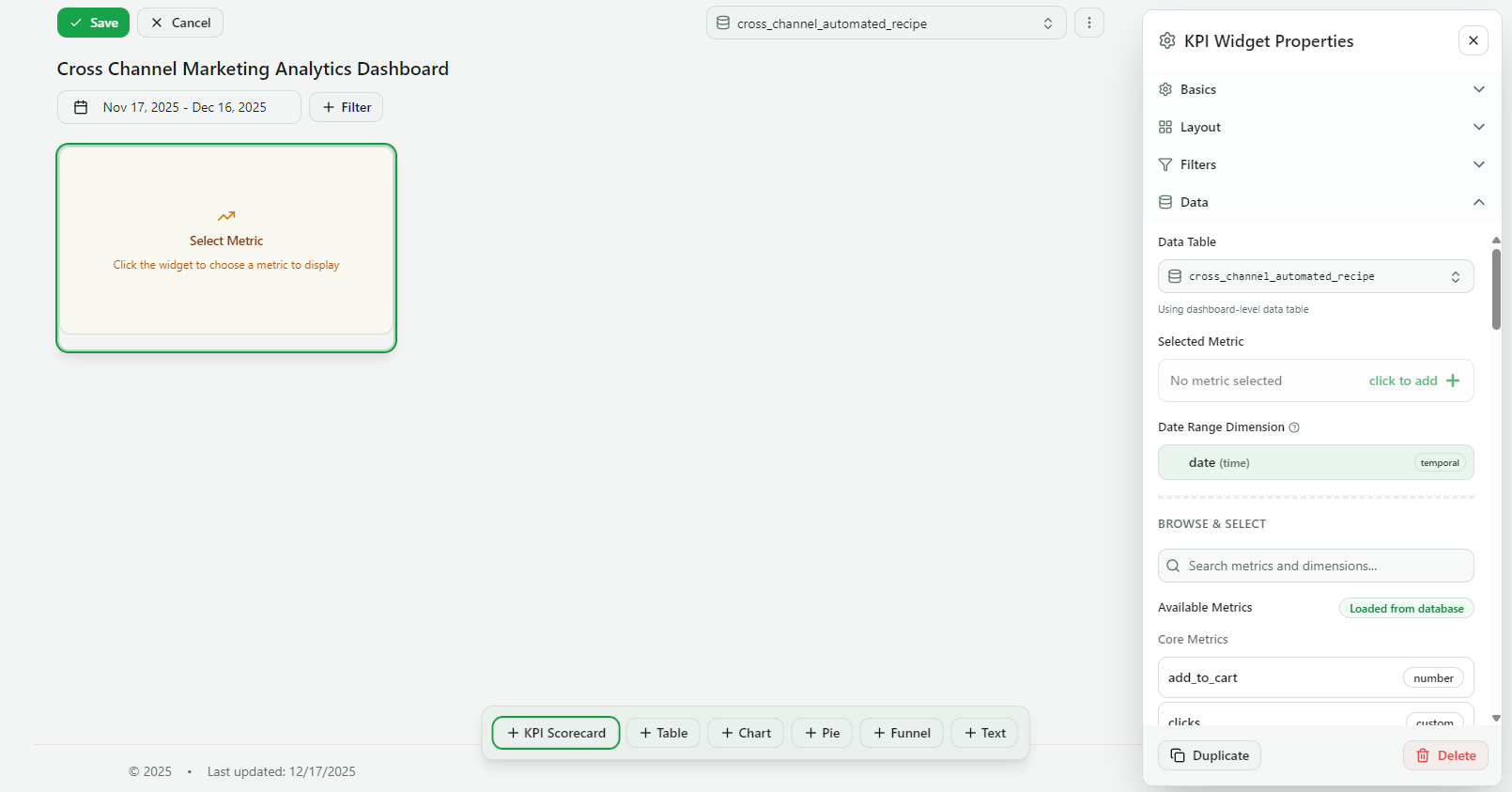
This structure is consistent across all widget types. Use the search field at the top of the panel to find settings by label, option, section name, or related term. Matching sections open automatically and matching text is highlighted; clear the field or press Esc to restore the complete panel.
Basics
- Title
- Description
- Basic display settings
Layout
- Widget size
- Position on the grid
- Visual styling
Filters
- Widget-level filters.
- Filters can be shared across different widgets.
- Note: Widget-level filters have higher priority than dashboard-level ones. You can combine both, but the widget-level filters will take precedence when applied together.
- Filters can be shared across different widgets.
- Comparison with previous periods
- Row/Series Limits
- Sorting
- Independent filtering from the dashboard if needed
Data
- Data table selection (shared or custom)
- Metrics selection
- You can also create custom metrics with custom SQL query.
- Custom metrics can be shared across different widgets.
- Dimensions
- Date range dimension
Query (Custom SQL)
For advanced use cases, any widget supports a Custom SQL Editor that lets you override the auto-generated query with your own ClickHouse SQL. Use dynamic placeholders to make queries respond to active filters and date ranges.
This enables:
- Cross-table joins across multiple data sources
- Window functions for running totals, rankings, and period-over-period calculations
- Complex aggregations not available through standard widget configuration
The built-in Query Viewer lets you inspect the exact SQL being executed at any time — full transparency into what's powering your data.
See Custom SQL Editor for details.
Custom Widgets
For teams with specific visualization needs, dashboards now support fully custom HTML widgets. Drop in any visualization built with D3, Chart.js, or any other library and wire it directly to your connected data and active dashboard filters.
Custom widgets behave like native widgets — they respond to global filters, respect the dashboard date range, and can be placed anywhere on the canvas.
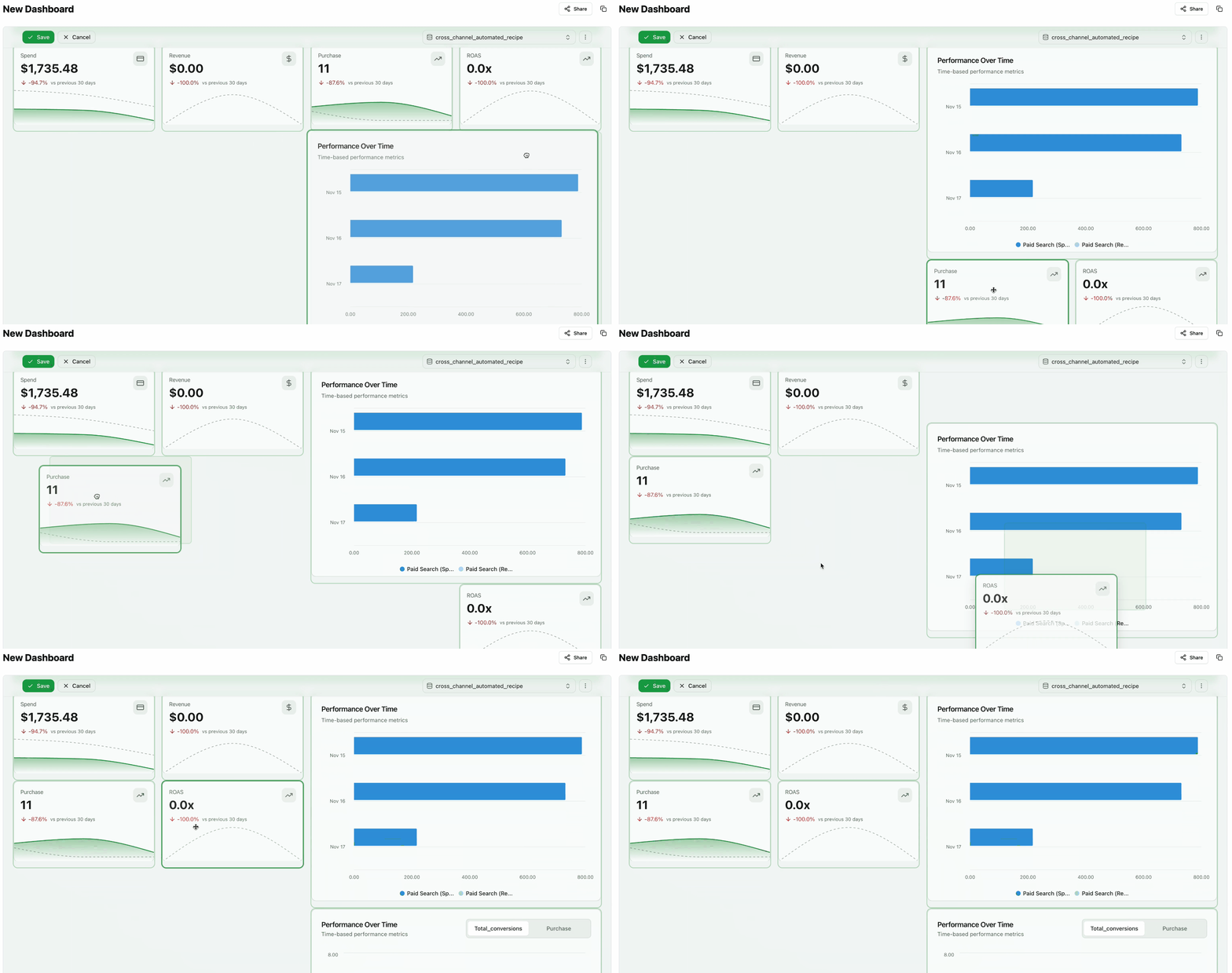
Drag & Drop Layout
Dashboards are fully flexible:
- Drag widgets to reorder them
- Resize widgets freely
- Adjust layout without breaking data configuration
The experience is intentionally lightweight and feels intuitive, similar to traditional BI tools like Looker Studio or Tableau.
Multi-Page Dashboards
Dashboards can now be organized across multiple pages within a single view. Each page has its own widget layout while sharing a common header, filters, and appearance settings.
- Pages — Add, rename, reorder, and delete pages
- Overflow search — When tabs do not fit, open the searchable N more menu to find a page by name
- Display modes — Tabs (horizontal), Sidebar (vertical), or Hidden
- Shared header — Persistent header with logo and branding across all pages
- Inheritance — Child pages inherit parent filters, date range, and appearance
- Sharing — Set on the parent dashboard and applied to every page; a page has no separate access list of its own
Multi-page dashboards are ideal for executive vs. detailed views, multi-channel reports, campaign drill-downs, and regional breakdowns. See Multi-Page Dashboards for the full guide.
Global Dashboard Filters
Dashboards support global filters that apply to all widgets.
You can:
- Add default filters
- Configure custom filters
- Control which filters are active
The Filters panel shows:
- Active Filters — currently applied
- Available Filters — all filterable fields
Filters support autocomplete search, an "Only" button for quick single-value selection, and smart filter skip that automatically ignores filters for widgets whose data table doesn't have the filtered column. See Filters & Date Range for details.
Widget Interactions
Widgets can interact with each other — clicking an element in one widget (e.g., a heatmap cell, chart bar, or table row) automatically filters data in other widgets on the same dashboard. This enables drill-down analysis without manually setting filters. See Widget Interactions & Data Export for details.
Appearance & Branding
Open Customize to set light/dark/system color modes, dashboard fonts and icons, whitelabel logos, global color palettes, and per-widget styling. Search the panel to jump directly to a setting. See Appearance & Branding for the full guide.
Saving the Dashboard
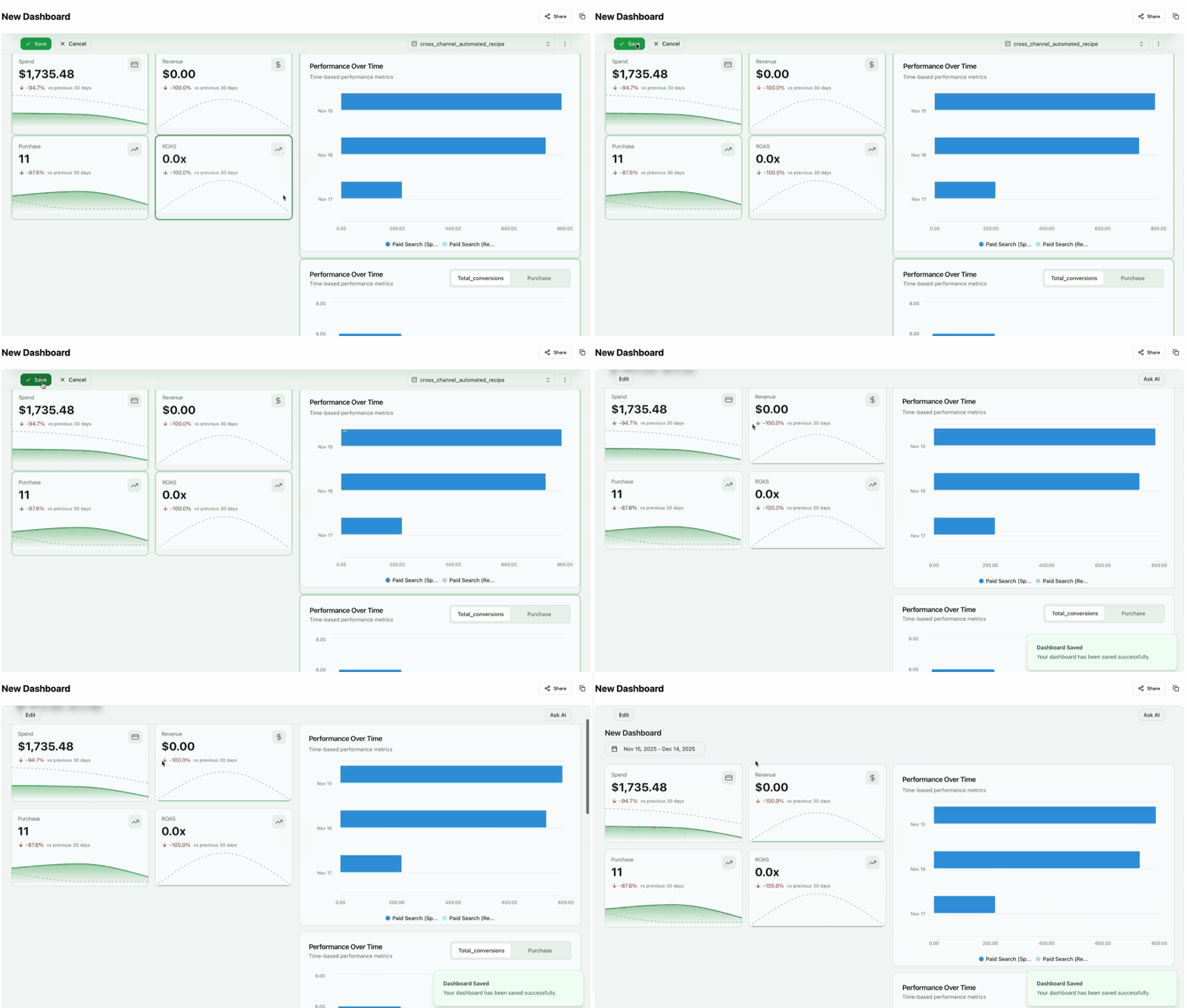
To finalize your dashboard, click Save.
After saving:
- The dashboard exits edit mode
- The final layout is displayed in view mode
- A confirmation message appears
Duplicate a Dashboard
Open the dashboard's More menu and select Duplicate. The Workspace selector defaults to the current workspace; choose another workspace where you are a member to create the copy there. On a multi-page dashboard, Include all pages is selected by default. Clear it to copy only the page you are viewing.
The duplicate keeps the source dashboard's data table configuration. If the target workspace should use a different table, update the default table after the copy opens.
Sharing Dashboards
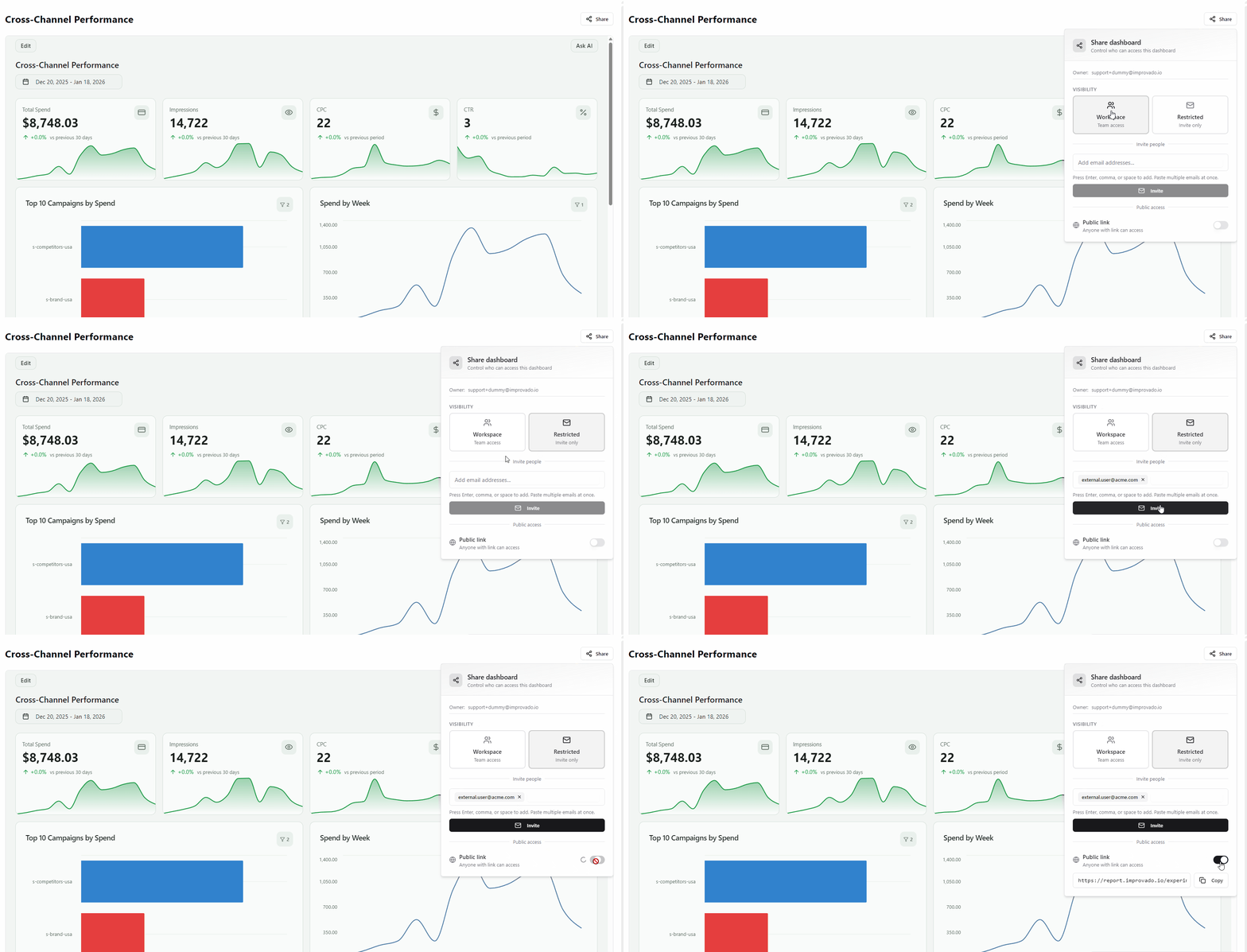
General access
A dashboard has one General access level for the whole workspace, set via the Share button in the top-right corner. Invited people and roles, and a public link, add access on top of it.
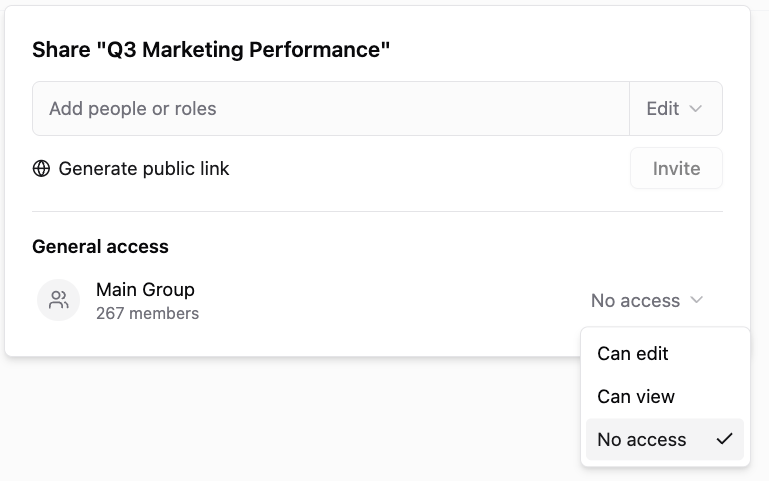
For how these levels interact with role permissions, and for the equivalent settings on Recipes, see Who Can See a Recipe or Dashboard.
Can edit (default)
Everyone in the workspace can open the dashboard, and those whose role can edit dashboards can edit it.
Can view
Everyone in the workspace can open the dashboard read-only — even people whose role could otherwise edit dashboards.
No access
Only the owner and the people and roles you invite can open the dashboard:
- Invite people or workspace roles to the dashboard
- Only they can open it
- Invite external users by email with the Dashboard Guest Reviewer role
- Guest reviewers gain dashboard access without full Workspace permissions
The General access row shows how many members the workspace has.
Only the dashboard owner can change General access. The owner is whoever created the dashboard, unless ownership has been transferred — see Ownership below.
Sharing with roles
Besides individual people, you can share a dashboard with a workspace role — including custom roles. Everyone who holds that role in the workspace gets access, including people who get the role later.
Open Share and start typing in the Add people or roles field. Roles show up in the same list as people, marked Role.
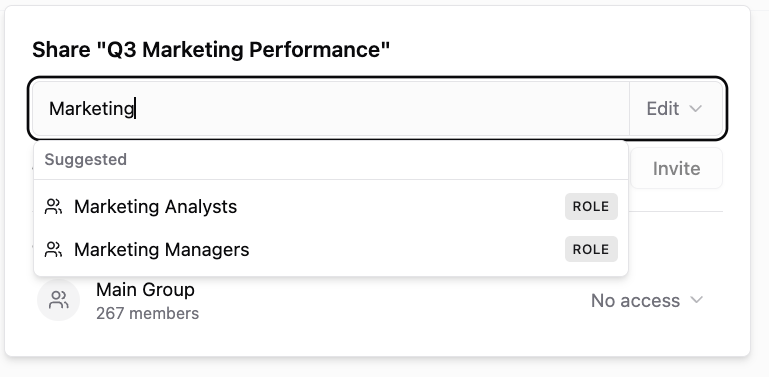
Pick the role, choose View, Edit or Edit & Share, and select Invite.
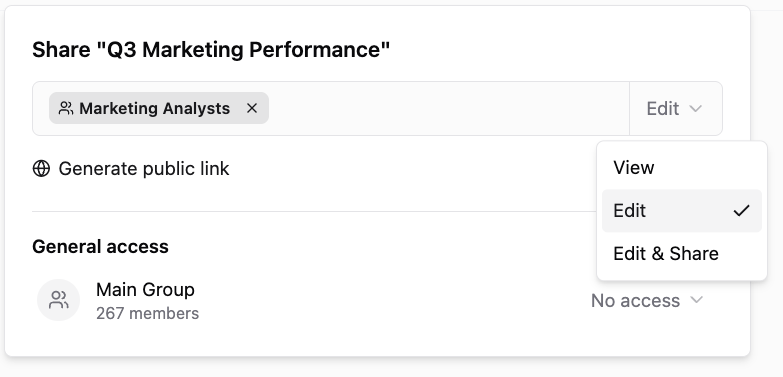
The role then appears in Who has access, where you can change its level or remove it. A role does not notify its members. When someone has access in several ways — General access, a personal invite and a role — the strongest one applies. If a custom role is deleted, its entry shows as Deleted role and no longer grants access.
Public Link
Generate a public link that allows anyone to view the dashboard:
- No Improvado account required
- View-only access
- Ideal for executives, clients, or external stakeholders
Notes:
- Disabling a Public Link: If a public link is enabled, you can disable it at any time. Disabling the link will invalidate it immediately, preventing anyone from accessing the dashboard through that URL. This serves as a security feature, allowing you to revoke access when needed.
- Regenerating a Public Link: If you disable a public link and later enable it again, a new link will be generated. The previous link will not be restored and will remain invalid. This ensures that access is controlled and previous links cannot be reused.
Restricting a Public Link to Approved Domains
A public link can be limited to the email domains you approve. Add a domain under Approved domains in the Share panel, and the link stops being open to everyone: a viewer now has to confirm they own an email on one of those domains before the dashboard opens.
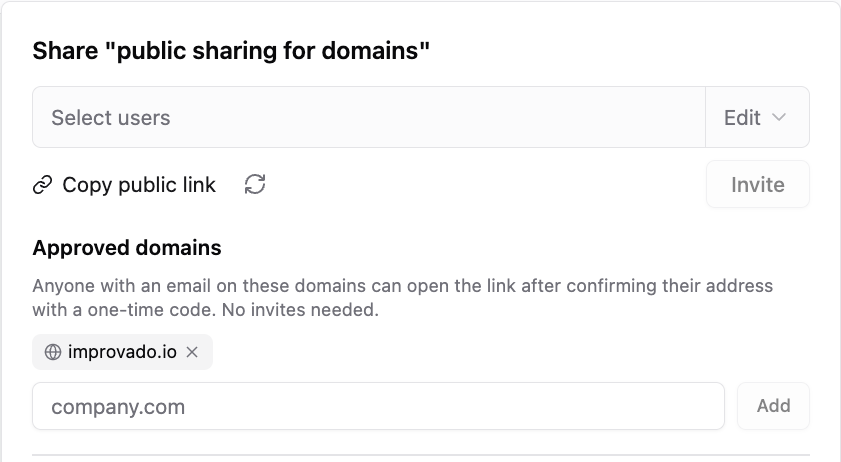
While the list of approved domains is empty, the link stays public — anyone who has it can open the dashboard. Restriction starts with the first domain you add and ends when you remove the last one, so links already in circulation are unaffected until you change them.
Free email providers (gmail.com, outlook.com, and similar) cannot be used as approved domains — a domain anyone can sign up for would not restrict anything.
What the viewer sees
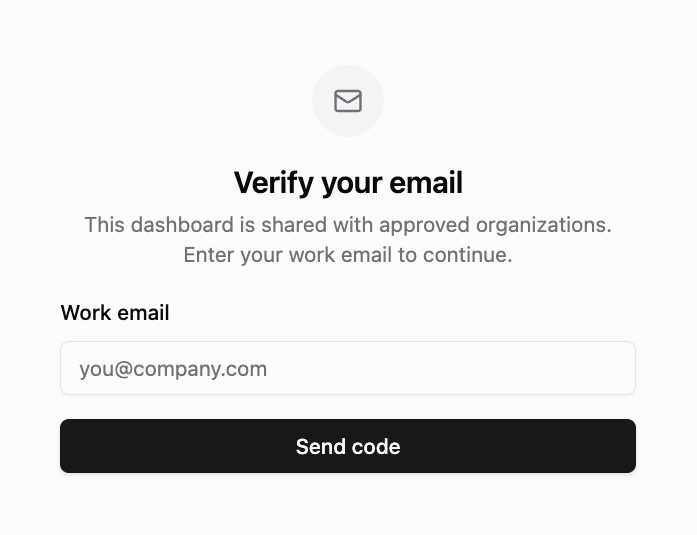
- The viewer enters a work email. An address on a domain that is not approved is refused, and no code is sent.
- A six-digit code arrives by email with your whitelabel branding. It is valid for 10 minutes, allows 5 attempts, and can be re-sent once a minute.
- Entering the code opens the dashboard in view-only mode. No Improvado account and no invite are needed.
- A verified viewer is remembered on that device for 14 days, then confirms a code again.
Seeing who opened the dashboard
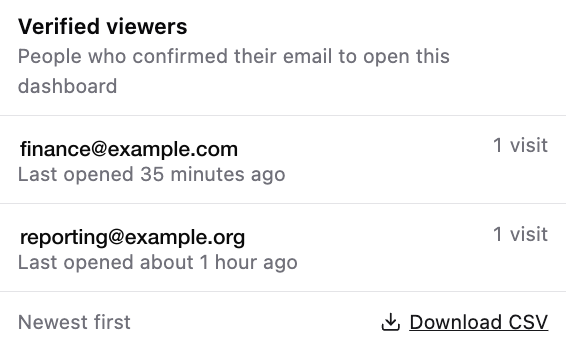
Once a link has approved domains, a Viewers control appears next to the section. It lists who verified, when they last opened the dashboard, and how many visits they made, most recent first. The ten most recent are shown; Download CSV gives the full list, including first seen and revoked viewers.
Taking access away
- One domain — remove it from Approved domains. Everyone who verified with an address on that domain loses access the next time the dashboard loads, and cannot verify again.
- The whole link — disable or regenerate the public link. Every viewer loses access at once, verified or not.
User Roles and Permissions
When inviting people or roles to a dashboard, you can assign one of the following levels:
- View - Users can only view the dashboard
- Edit - Users can view and edit the dashboard
- Edit & Share - Users can view, edit, invite others, and manage sharing settings
| User Type | View | Edit | Invite Others | Change Roles | Enable/Disable Public link | Change General access | Transfer Ownership |
|---|---|---|---|---|---|---|---|
| Owner | ✅ | ✅ | ✅ | ✅ | ✅ | ✅ | ✅ |
| Edit & Share | ✅ | ✅ | ✅ | ✅ | ✅ | ❌ | ❌ |
| Edit | ✅ | ✅ | ❌ | ❌ | ❌ | ❌ | ❌ |
| View | ✅ | ❌ | ❌ | ❌ | ❌ | ❌ | ❌ |
This table describes the level assigned to an invited user. Inviting people and roles, changing their level and managing the public link are limited to the owner and to Edit & Share users — a role permission alone does not grant them. Changing General access, and transferring ownership, are the owner's alone.
Ownership
Every dashboard has exactly one owner, shown as Owner in the Share panel. The owner is the only person who can change General access, and the only one who can hand the dashboard to someone else.
To transfer it, open Share, find the person in Who has access, open the permission dropdown next to their name and choose Make owner. A confirmation spells out what you give up before anything changes.
- The new owner has to be an active member of your agency — invite them to the dashboard first if they are not.
- You keep Edit & Share access afterwards, so you can still edit the dashboard and invite people.
- You cannot take ownership back: only the new owner can transfer it again.
A dashboard the AI Agent created is owned by the Agent, so nobody can change its General access until a person owns it. Ask the Agent in the chat — for example, "make anna@acme.com the owner of this dashboard" — and it hands ownership over.
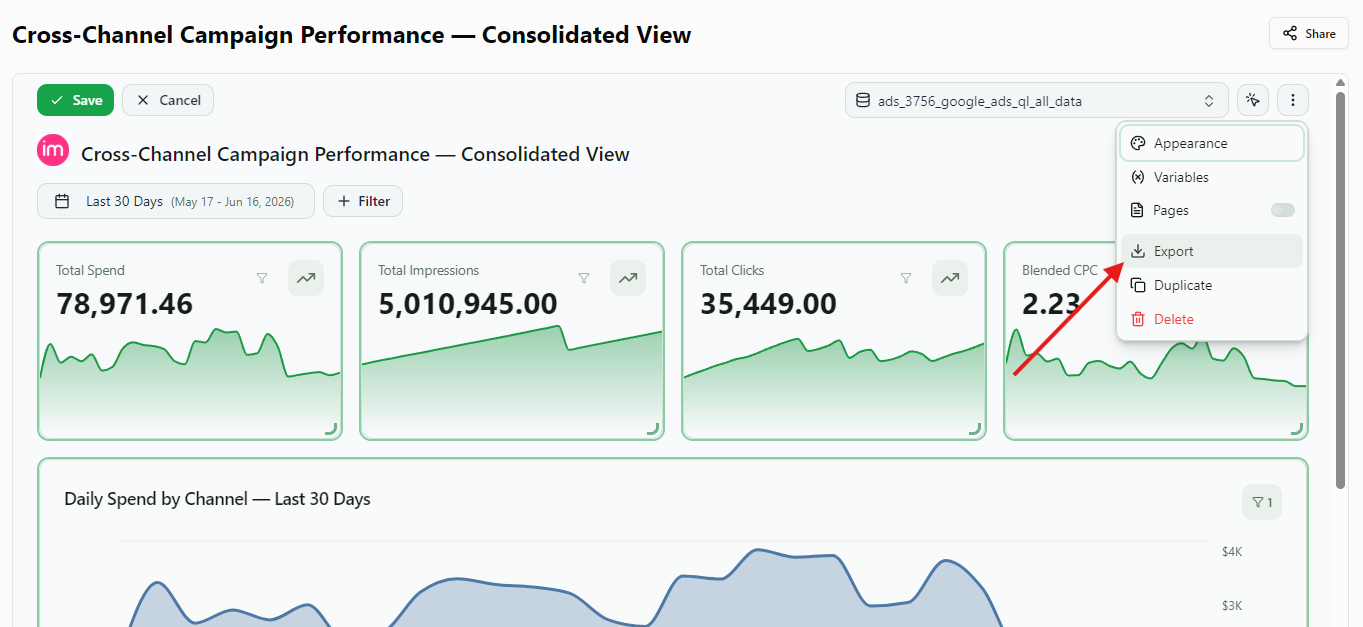
Export to PDF
You can export any dashboard as a branded PDF — ideal for client reports, QBRs, and offline sharing. The PDF captures the dashboard exactly as you see it: the active filters and date range are applied, and your white-label branding is preserved.
To export:
- Open the dashboard in view mode.
- Click Export in the dashboard header (download icon, top-right corner).
- In the export panel, keep File Format: PDF Document, then choose your Paper Size (A4 or Letter) and Orientation (Portrait or Landscape).
- Click Export — Improvado renders the dashboard server-side and downloads a clean, multi-page PDF.
KPI cards, charts, and tables are laid out to fit the page. On a multi-page dashboard, PDF export covers the current page by default. Turn on Include all tabs to render every tab in order and merge them into one PDF. This option can take longer because each page is rendered separately.
Note: The export reflects the dashboard's current state — set the filters and date range you want before exporting.
Export to PowerPoint or Google Slides
The same Export panel also turns a dashboard into a slide deck. Match dashboard layout is on by default: widgets that appear side by side on the dashboard share a slide at comparable widths. Turn it off to let the exporter pack widgets by the space they need. Unlike a PDF, a deck is meant to be worked on after export: charts keep their numbers, tables stay real tables, and text stays text. Nothing is a flat picture unless you choose screenshot slides.
To export a deck:
- Click Export in the dashboard header.
- Set File Format to PowerPoint Presentation.
- Pick a mode under Slides.
- Keep Match dashboard layout on to preserve dashboard rows, or turn it off for automatic packing. This setting is available for modes that produce a .pptx file, but not for Create in Google Slides.
- Choose the tab scope. The current tab is exported by default; turn on Include all tabs to include the complete multi-page dashboard.
- Click Export.
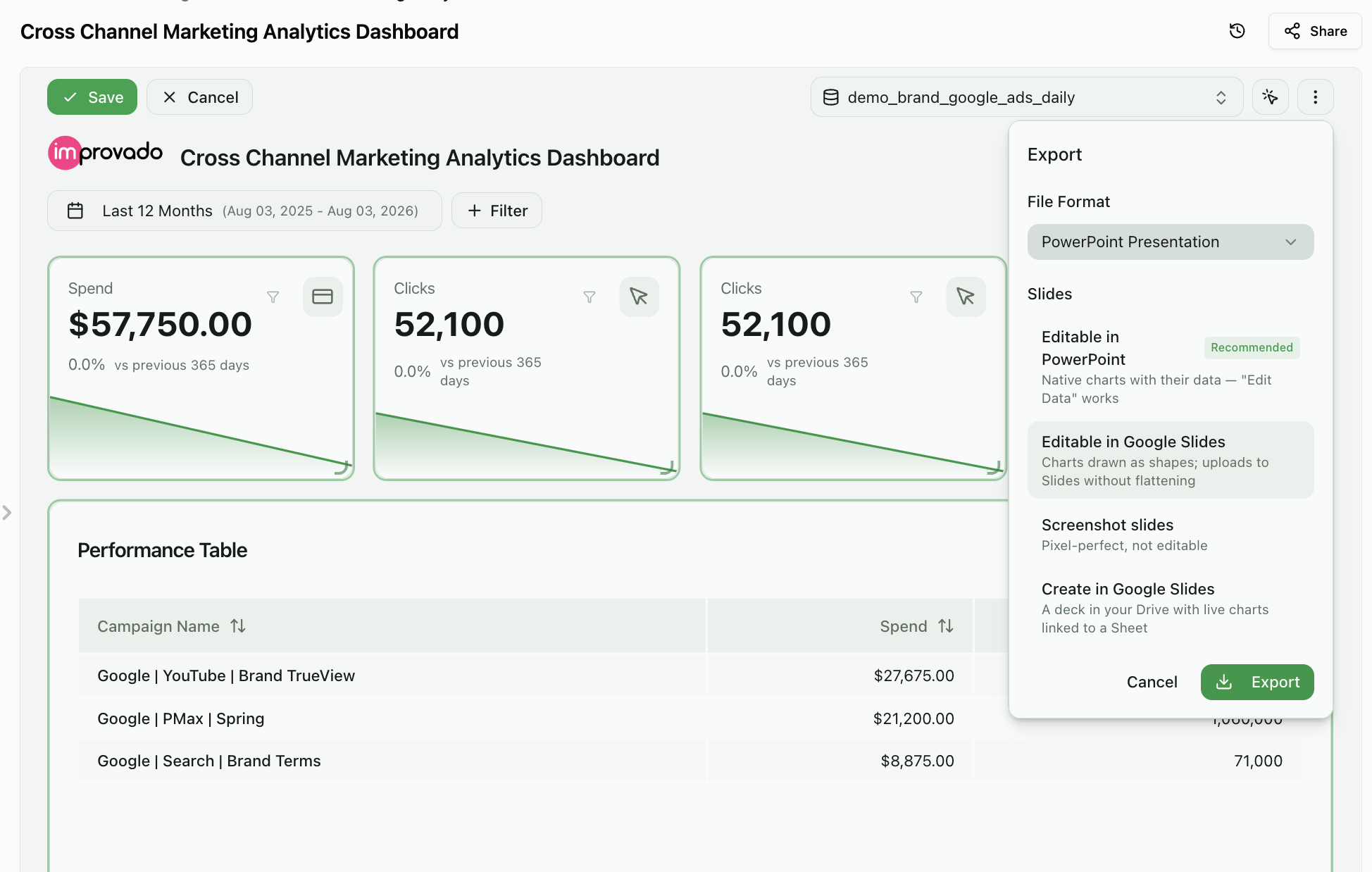
Choosing a mode
The four modes trade editability against fidelity, and the difference only becomes visible after you open the file — so pick deliberately. Nothing is lost by choosing wrong: just export again with a different mode.
| Mode | What you get | Pick it when |
|---|---|---|
| Editable in PowerPoint (recommended) | A .pptx file with native PowerPoint charts that carry their own data — right-click a chart and Edit Data works. | The deck will be finished in PowerPoint or Keynote. |
| Editable in Google Slides | A .pptx file whose charts are drawn as shapes instead of chart objects, so Google Slides imports them without flattening them to images. | You will upload the file to Google Slides and edit it there. |
| Screenshot slides | A .pptx file where each widget is a picture of the real thing — pixel-perfect, not editable. | The deck has to look exactly like the dashboard and won't be edited. |
| Create in Google Slides | A presentation created directly in your Google Drive, with charts linked to a companion Google Sheet — Slides' Update button stays wired to the data. | The deck lives in Drive and the charts should stay connected to their numbers. |
What lands on the slides
The deck is built from what the dashboard renders, so the active filters and date range are applied and your appearance settings (background, text, card and table colors) carry over. When you include all tabs of a multi-page dashboard, each tab starts behind its own section slide.
- KPI cards — grouped onto a slide, each with its value and its comparison line, exactly as the card reads on the dashboard.
- Charts — bar, line, area and composed charts keep their type and their series colors. A bar-plus-line overlay stays an overlay.
- Tables — real tables, with your formatting and table colors, capped at the rows that fit a slide. For every row, export the data to CSV or Excel.
- Pie charts — real pie charts, with the slice colors from the dashboard.
- Funnels — the stages and their values.
- Text widgets — text, with alignment and colors.
Widgets with no slide equivalent — creative galleries, heatmaps and custom components — go in as a picture of the widget on their own titled slide, so nothing silently disappears. A widget whose query is failing also gets a slide, showing what the dashboard shows for it.
Setting up "Create in Google Slides"
This mode writes into Google Drive on your behalf, so it needs a Google connection:
- Connect Google Sheets in Improvado and authorize it read-write (the "Read & Write" scope option). A read-only connection cannot create files.
- In the export panel, choose Create in Google Slides and pick that connection from the Google connection dropdown.
- Click Export. Improvado creates the presentation and a companion spreadsheet in that account's Drive and returns links to both.
The deck and the spreadsheet are created in the Drive of the Google account behind the connection, not in yours — share them from there as you would any other Drive file. Keep the spreadsheet: deleting it breaks the charts' Update link in the deck.
Two limits follow from Google Slides having no chart object of its own: pie slice colors come from the spreadsheet's accent palette, so the first six slices set the colors for every pie in the deck; and widgets that can only be pictured are named on their slide with a pointer to a PowerPoint export, because the Slides API can only insert an image from a publicly reachable URL.
Export data to CSV or Excel
When you need the numbers rather than a report, export the dashboard's data. Every widget exports the data behind it, with the active filters and date range applied, ready to work with in Excel, Google Sheets, or any other tool.
To export:
- Click Export in the dashboard header.
- Set File Format to CSV (widget data) or Excel (widget data).
- On a multi-page dashboard, the current tab is exported by default. Turn on Include all tabs to export every tab.
- Click Export.
| Format | What you get |
|---|---|
| CSV (widget data) | One CSV file per widget; all KPI cards share one KPIs.csv. A dashboard with a single data widget downloads as one .csv, otherwise the files come in a .zip. With Include all tabs, each tab gets its own folder in the .zip. |
| Excel (widget data) | One .xlsx workbook with a sheet per widget and the KPI cards on one sheet. When there is more than one sheet, a Contents sheet comes first and links to every sheet with the full widget title — Excel limits sheet names to 31 characters, so long titles are shortened on the sheet tab. With Include all tabs, each sheet name starts with its tab. |
What is in the file
- Tables — every row, not only the page you see, with the totals row at the bottom. Drill-down tables are expanded to their lowest level, with a column for each level.
- Charts — one row per point on the horizontal axis and one column per series.
- Pie charts and funnels — one row per slice or stage.
- KPI cards — the value, the value as the card shows it, and the change versus the previous period.
- Maps, flow (Sankey) charts, heatmaps and creative galleries — the data behind the widget.
Values are exported as plain numbers, not formatted text, so they sort and add up correctly in a spreadsheet. Each widget exports up to 100,000 rows. Text widgets are not included, and a widget whose query fails or returns no data is skipped — the confirmation message lists any widget that was left out.
Note: Exporting the current tab takes seconds. Include all tabs loads each tab separately and can take a few minutes.
To export a single table, use the ⋮ menu in the table's header — see Widget Interactions & Data Export.
Version History
Every change to a dashboard is saved automatically as a restore point — whether you made it in the editor or the AI Agent made it for you. If an edit doesn't look right, you can roll back to any previous version in a few clicks, without contacting support.
Open Version history from the dashboard header (next to Share) to see every change over time.
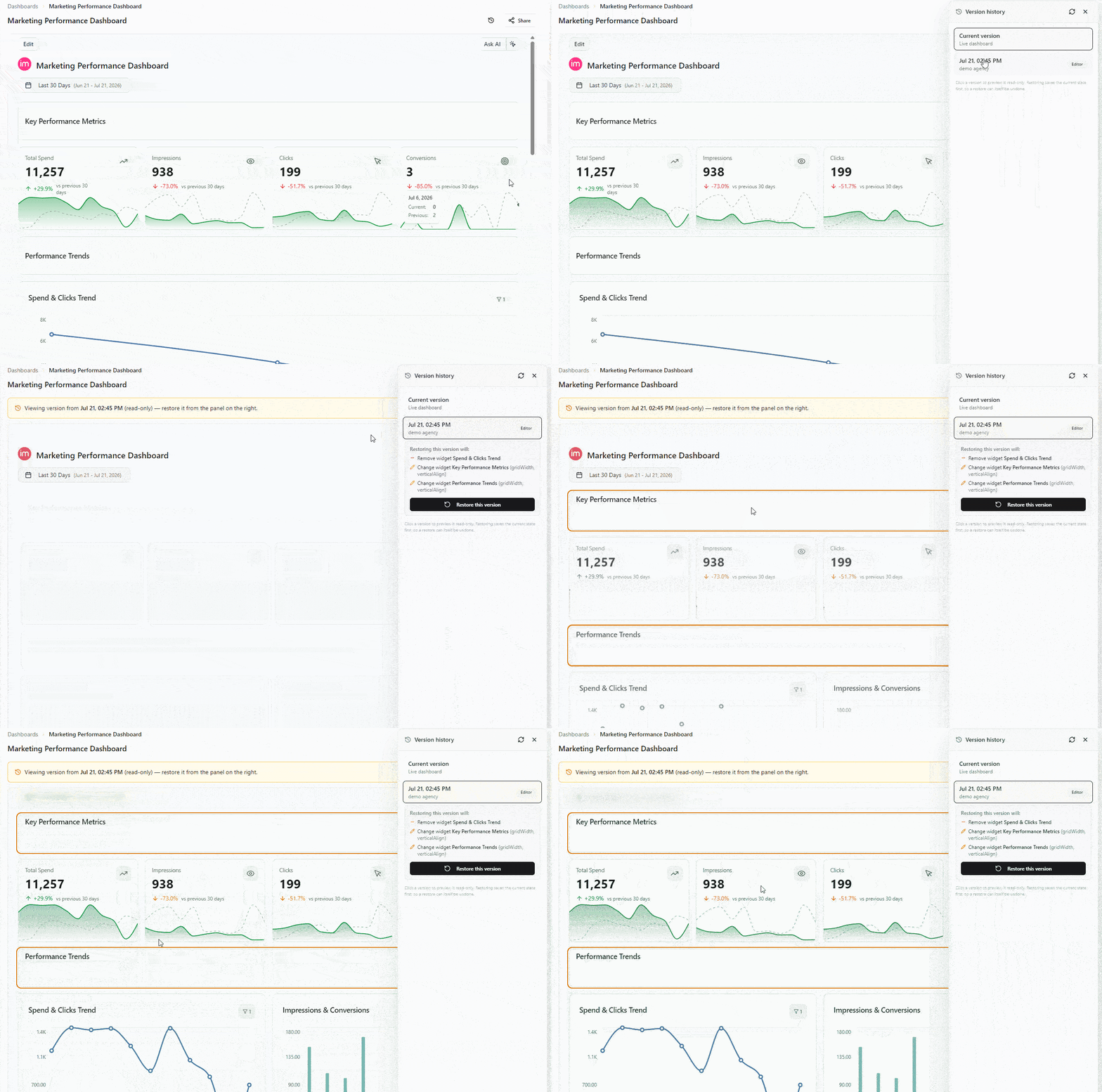
- Browse the timeline — each version shows when it was saved, who saved it, and whether it came from the Editor or the AI Agent. Versions made by the Agent link back to the chat that made the change.
- Preview any version — select an entry to see the dashboard exactly as it looked then, live and read-only, without affecting the current version.
- See what a restore changes — before you roll back, each version shows which widgets and settings would be added, removed, or changed.
- Restore in one click — restoring brings the dashboard back to that version. Your current state is saved first, so a restore can itself be undone.
Version history is available on editable dashboards and is on by default — there's nothing to set up. Restoring a version follows the same permissions as editing the dashboard.
Dashboard Lineage
Every dashboard sits on top of something — a recipe, a SQL view, a data table filled by one of your connections. Lineage draws that chain for you: open it from the dashboard header, next to Share, and you get a read-only map of what the dashboard reads and where the data came from.
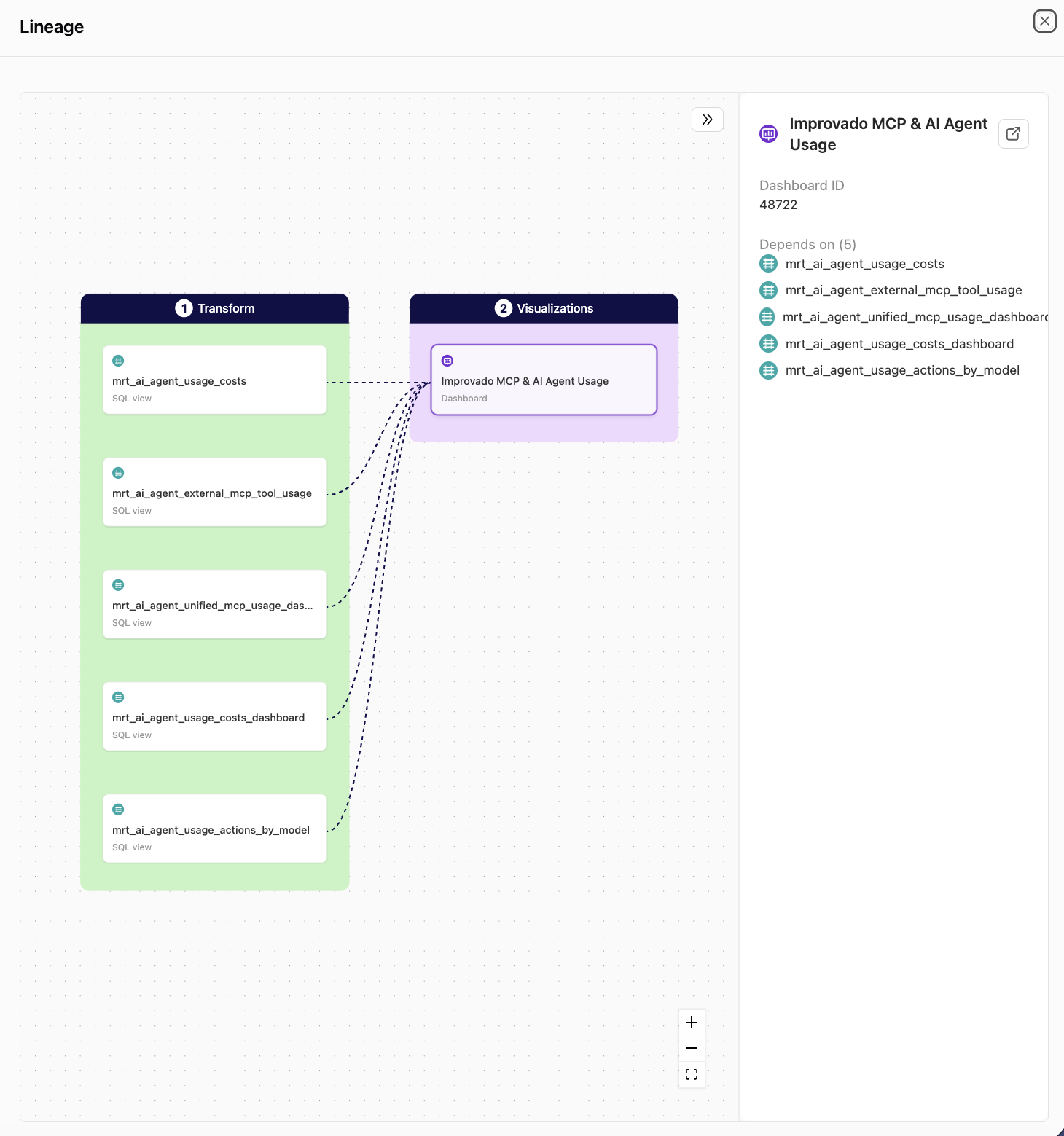
- Follow the data left to right — Extract holds the source connections and the data tables they fill, Transform the recipes and SQL views the widgets read, and Visualizations the dashboard itself.
- See what a dashboard depends on — click any card for its details and the full list of objects feeding it, useful before you change a recipe everyone reads.
- Jump to the source — open the data table, recipe or connection behind a card in a new tab.
The map is read-only and available on any dashboard you can open — nothing you do in the panel changes the dashboard. A few things worth knowing:
- A view Improvado cannot match to a data table or a recipe still appears, as a plain SQL view card without a link. That usually means it was created outside Improvado.
- The map starts at the dashboard and looks upstream. To go the other way — which dashboards and recipes use a given data table — open Lineage UI from Data Explorer.
- It shows your current setup, not history, and is cached for a few minutes: a recipe or connection you changed a moment ago can take a little while to appear. Reopen the panel to pick up the change.
Related articles
-
Appearance & Branding
Customize dashboard look and feel with themes, fonts, icons, color palettes, whitelabel logos, and per-widget styling to match your organization's visual identity.
-
Brand Presets
Save a logo and colour scheme once, apply it to any dashboard, and update every dashboard that follows it by editing the preset.
-
Create Dashboards with Detailed Prompts
Ready-to-use prompt examples that help the AI Agent generate accurate, actionable dashboards for executive reporting, daily campaign management, and creative performance analysis.
-
Custom SQL Editor
Override auto-generated queries with custom ClickHouse SQL for any widget — enabling cross-table joins, window functions, and complex calculations.
-
Filters & Date Range
Apply global filters across all widgets, configure autocomplete, multi-select with 'Only' button, smart filter skip, and use preset or custom date ranges.
-
Multi-Page Dashboards
Organize related visualizations across multiple pages within a single dashboard, with shared headers, inherited settings, and independent layouts.
-
Organizing Dashboards with Folders & Tags
Organize dashboards into a nested folder hierarchy: browse as a tree or list, create and move folders, file dashboards via drag-and-drop or the Move action, and share a link to a specific folder.
-
SQL Sources
Write a SQL query once, give it a name, and use it as the data source for any widget on the dashboard.
-
Widget Interactions & Data Export
Click elements in one widget to filter others. Export table data as CSV or Excel, or copy it to the clipboard.
-
Widget Types Reference
Reference for all dashboard widget types, including KPI, Table, Chart, Pie, Funnel, Sankey, Geo Map, Text, Heatmap, and Custom Component.
Was this page helpful?
Thanks for the feedback!
Questions? The Improvado team is always happy to help. Send us an email, contact your Customer Success Manager, or raise a request in the Improvado Service Desk.